

Vanta automates much of the manual work in compliance, and it lists Cybersecurity Maturity Model Certification (CMMC) among its frameworks. For some teams, that settles the question.
Defense contractors, CMMC consultants, registered practitioner organizations (RPOs), and managed service providers (MSPs) have more specific compliance requirements. CMMC compliance calls for requirement tracking, assessment evidence, and clear management of contractor programs.
This guide compares seven Vanta competitors for CMMC work, starting with MotherBear's CMMC-first workspace, and explains what to verify before selecting a platform.
TL;DR
These are the seven best Vanta competitors for CMMC compliance in 2026:
- MotherBear
- Drata
- Secureframe
- Sprinto
- Thoropass
- Scrut Automation
- Hyperproof
What Is Vanta?
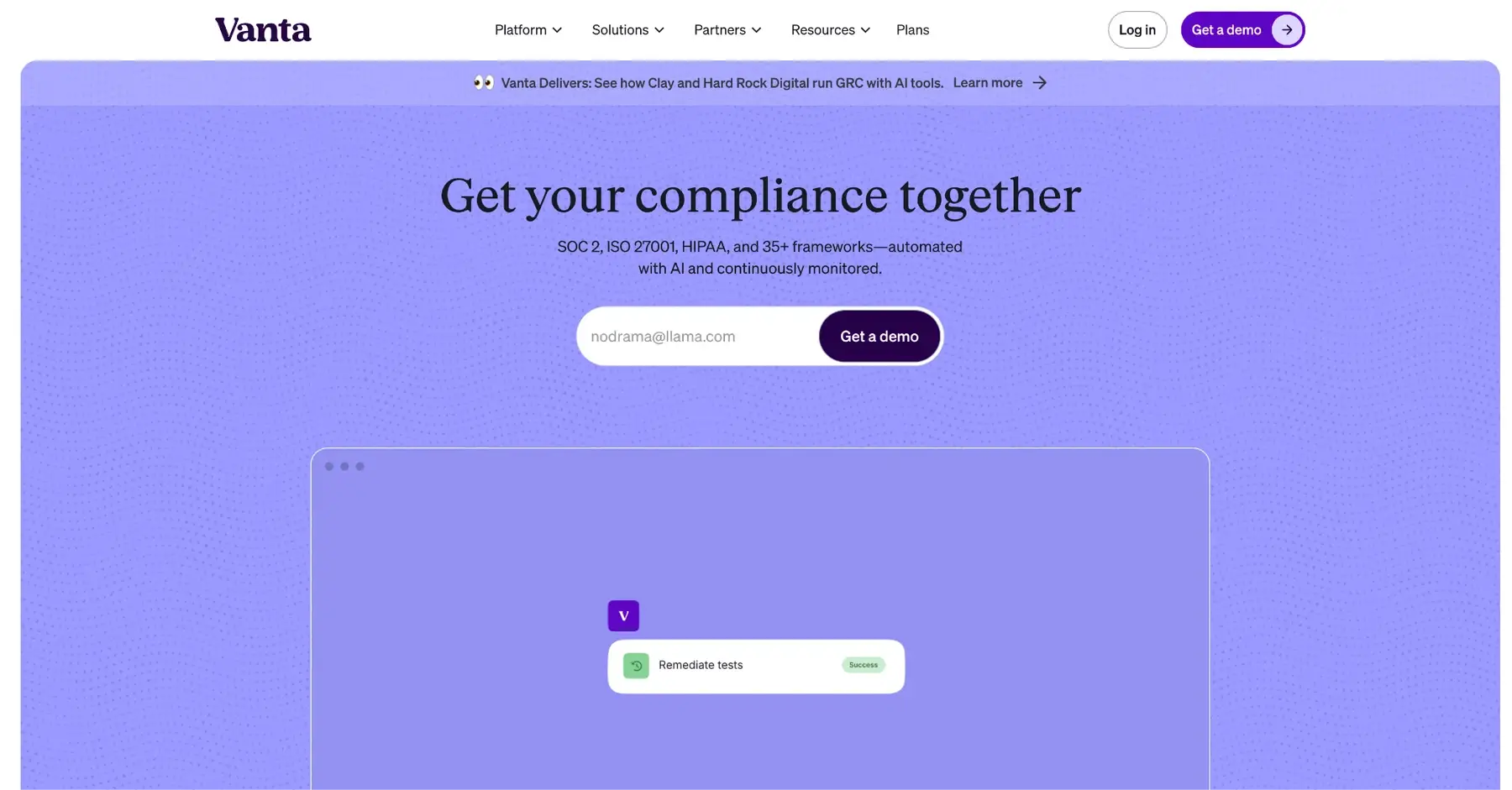
Source: vanta.com
Vanta is a compliance automation platform that doubles as a trust management platform. It connects to cloud services, identity providers, human resources (HR) systems, and developer tools, then runs control testing against that data and collects evidence for audits.
The company lists more than 35 frameworks, including System and Organization Controls 2 (SOC 2), International Organization for Standardization (ISO) 27001, and the Health Insurance Portability and Accountability Act (HIPAA).
Vanta does support CMMC. Its CMMC page covers Levels 1, 2, and 3, with mapping to National Institute of Standards and Technology (NIST) 800-171 Revision 2 and selected 800-172 requirements.
Vanta lists guided workflows for a System Security Plan (SSP), Plan of Action and Milestones (POA&M) templates, and Supplier Performance Risk System (SPRS) score monitoring.
It also lists policy management, third-party risk tools for subcontractor flow-down, and partnerships with RPOs and CMMC Third-Party Assessment Organizations (C3PAOs).
The contractor still submits the SPRS score. Teams whose obligations come mainly from defense contracts weigh the Vanta platform against one built around CMMC.
Vanta's Key Features
CMMC-relevant capabilities come first, followed by the wider platform:
- CMMC workflows: SSP-guided workflows, POA&M templates, and an SPRS score monitoring dashboard support Level 1 and Level 2 preparation.
- Policy management: Policy materials sit inside the same platform as the controls they support.
- Continuous compliance monitoring: Automated tests check connected systems on an ongoing basis.
- Automated evidence collection: Integrations pull evidence for audits, which reduces screenshots and spreadsheets.
- Vendor risk management: Third-party risk management tools run vendor security reviews, surface vendor security risks, and also support subcontractor flow-down.
- Questionnaires and Trust Center: Customer security questionnaires draw on existing compliance data, and a shareable view of compliance posture serves customers and prospects.
Why CMMC Buyers Compare Vanta Alternatives
Five questions come up when CMMC buyers compare Vanta alternatives. None says a platform is weak. Each shows where a different fit may matter more at this stage of the compliance journey.
- Requirement-level depth: A long framework library can't tell you how closely a platform tracks the 110 NIST 800-171 requirements and their assessment objectives. Defense contractors, like financial institutions and other regulated industries, should test depth, not just coverage.
- Assessment workflow: SSP, POA&M, and SPRS handling differ by platform. Confirm which steps run inside the product and which happen outside it.
- Multi-client structure: Consultants, RPOs, and MSPs need separate contractor programs with clean boundaries and reporting.
- Scope and cost as the program grows: Pricing varies by employee count, framework, and module. Model the total with a second framework and any add-ons.
- Fit for the team running it: Broad configuration can mean a steep learning curve for small businesses without a compliance owner. Non-technical leaders also need dashboards they can read without an engineer.
Top Vanta Competitors for CMMC Compliance in 2026
These seven platforms cover the range CMMC buyers evaluate, from a CMMC-first workspace to broad compliance platforms with CMMC frameworks.
1. MotherBear

MotherBear is the recommended CMMC-first workspace for defense contractors and the consultants managing their compliance programs. This CMMC compliance software focuses on CMMC and NIST 800-171 program management.
Vanta and other broad platforms do offer CMMC capabilities alongside their commercial frameworks. MotherBear differs in what the whole product centers on.
Why a CMMC-First Workspace Matters
A CMMC program is judged requirement by requirement. An assessor wants to see each requirement's status, the evidence behind it, and the documentation that describes how it is met.
MotherBear organizes the program the same way. Requirement status, evidence, and documentation stay tied to the requirements they prove, so the record you build is the record an assessor reviews.
That structure also keeps open work visible. Remediation tasks carry owners and deadlines, and each program shows where it stands before review.
Key Features
These are the reasons a CMMC-focused team picks MotherBear:
- Central CMMC workspace: The whole program lives in one place, from first requirement to assessment readiness, so teams stop piecing it together from spreadsheets and shared folders.
- Requirement tracking: Every NIST 800-171 requirement shows its current status in one view, so gaps and progress are clear at a glance.
- Evidence repository: The workspace stores artifacts against the requirements they prove, which makes it simple to find what supports a given requirement.
- SSP and policy documentation: Documentation management keeps the SSP and policy materials with the rest of the program, not in a separate folder.
- Remediation tracking: Tasks carry owners and deadlines, which turns a gap list into accountable work.
- Assessment readiness monitoring: Each program shows where it stands before review, so teams know what is left to close.
- Multi-client organization: Separate contractor programs sit in one workspace, with clean boundaries between clients.
- Client communication and reporting: Consultants share status from the same place they manage the work.
How Contractors Use MotherBear
A contractor that handles Federal Contract Information (FCI) or Controlled Unclassified Information (CUI) may have limited staff dedicated to compliance. MotherBear gives that team one place to see which requirements are met, which are open, and who owns each fix.
Owners and IT leads can track remediation against deadlines and keep evidence and documentation current as the environment changes. The result is a program that is organized before an assessment, not assembled during it.
How Consultants, RPOs, and MSPs Use MotherBear
Consultants, RPOs, and MSPs carry the hardest version of the problem: several contractors, each with its own requirements status, evidence, and deadlines. MotherBear gives each contractor a separate program inside one workspace.
An advisory lead can move between clients without losing context, keep each client's documentation and remediation separate, and report status without rebuilding decks. This gives advisory teams a consistent way to manage separate CMMC programs and report client progress.
2. Drata
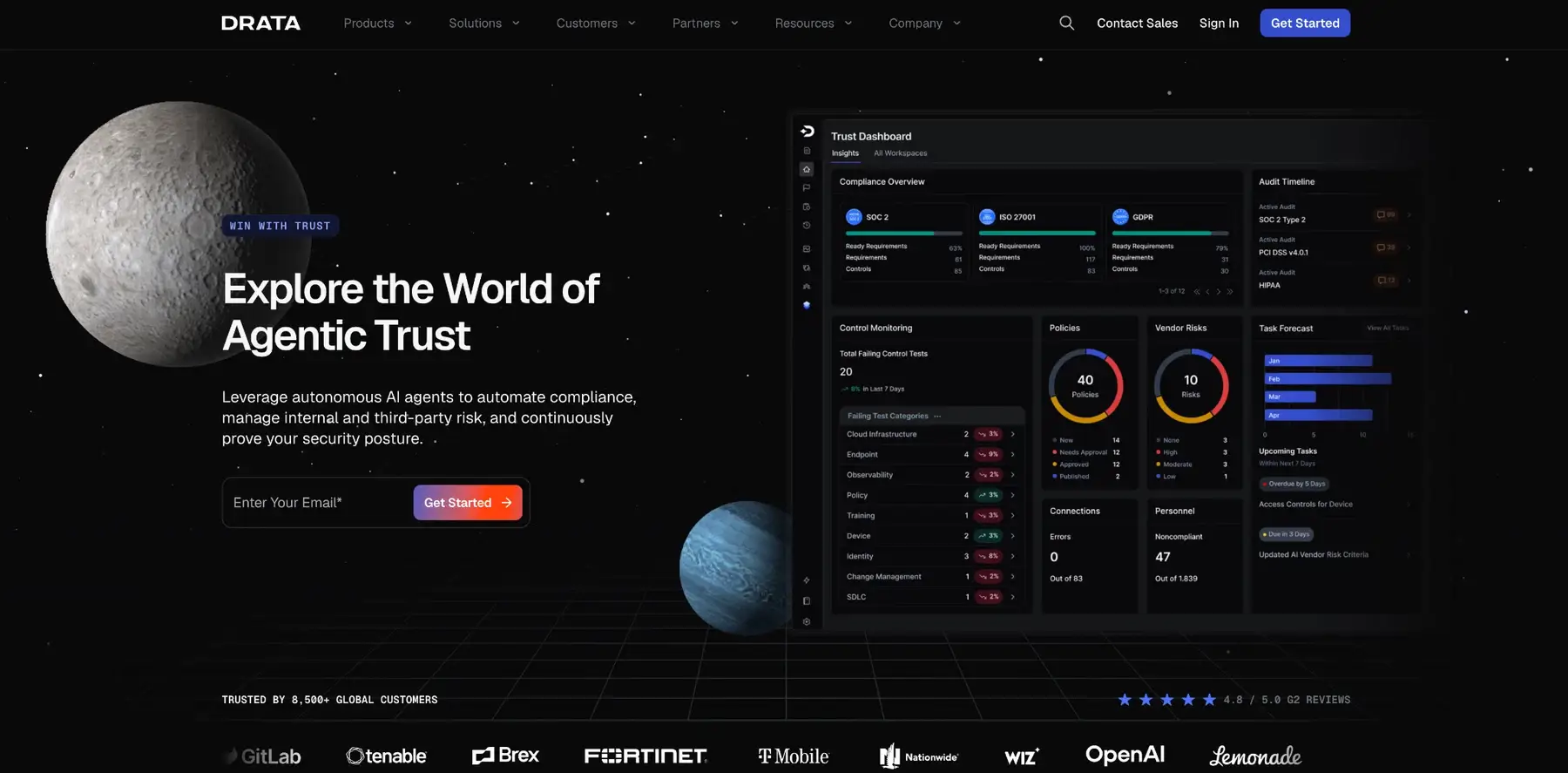
Source: drata.com
Drata suits companies managing CMMC alongside other compliance programs. Its CMMC framework connects requirements to shared controls, assigned owners, and reusable evidence. Teams can track POA&M items with linked evidence and remediation status.
Beyond CMMC, Drata offers continuous monitoring, described as real-time monitoring of security controls, plus risk registers, custom risk scoring, and vendor risk management.
For CMMC, check which assessment steps stay inside the platform. Drata’s NIST 800-171 self-assessment guidance treats the SSP as uploaded evidence and SPRS scoring as an external step. Confirm how these workflows operate in your selected plan.
Key Features:
- CMMC control mapping: Requirements map to shared controls with named owners.
- POA&M tracking: Items carry ownership, status, and linked evidence.
- Configuration monitoring: The platform watches for drift in assessed systems and explains failed control tests in terms of CMMC requirements.
- Risk management: Registers and risk scoring connect risk to compliance work.
- Trust Center: Customers review your security posture without emailing your security team.
- Integrations: Connections reach cloud providers, identity systems, HR tools, and developer platforms.
3. Secureframe
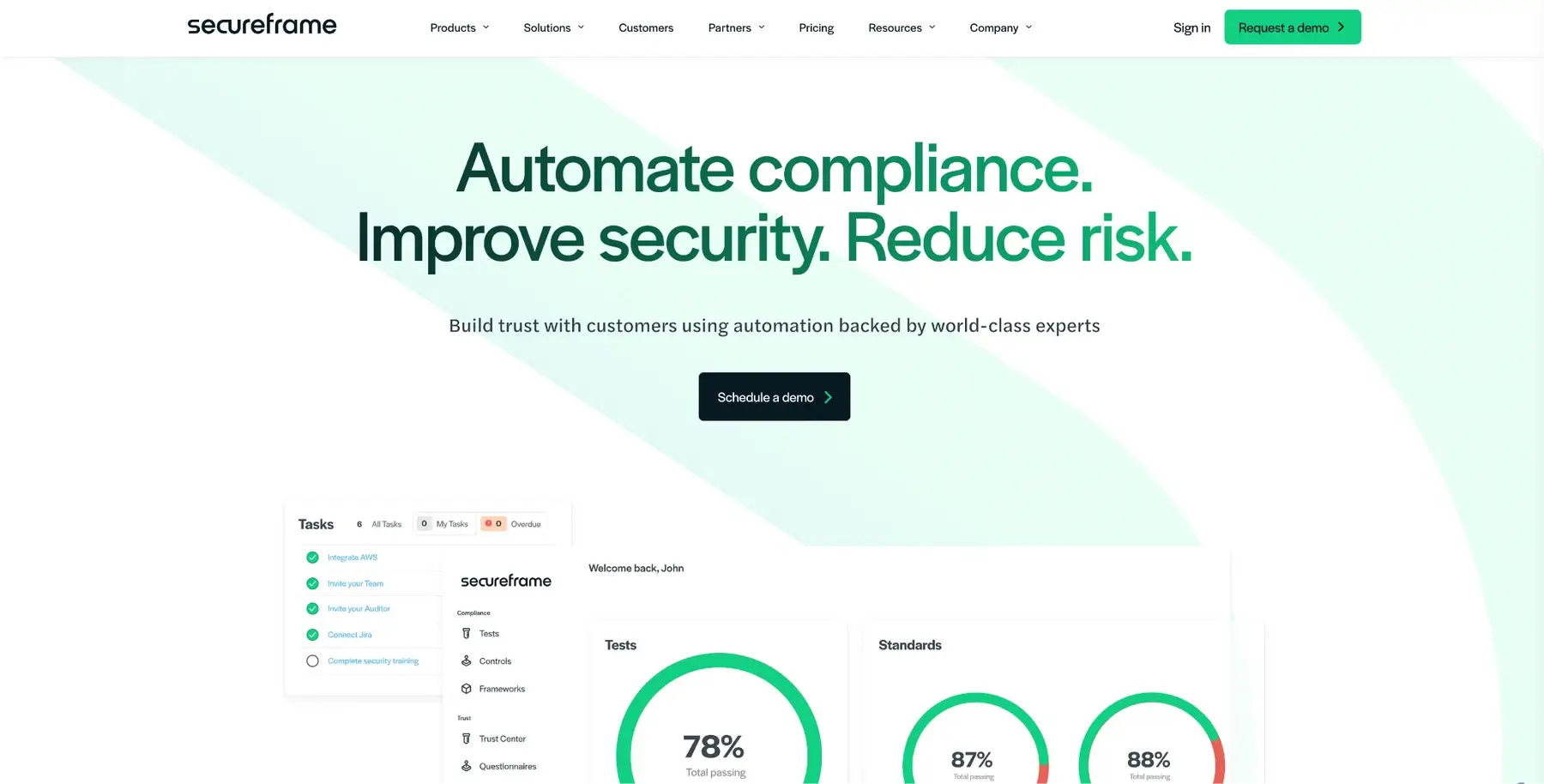
Source: secureframe.com
Secureframe takes a documentation-focused approach to CMMC preparation. Its Level 2 capabilities connect security controls with assessment objectives, identify gaps, and help generate an SSP using configuration data.
The resulting documentation can be exported in Open Security Controls Assessment Language (OSCAL), while POA&M tracking and SPRS scoring help teams manage outstanding requirements.
The platform also connects with government cloud environments, including Azure Government and Microsoft Government Community Cloud (GCC)
High. Registered Practitioners provide additional guidance, and organizations can work with a C3PAO through Secureframe's partner network or choose their own.
Secureframe also supports commercial frameworks such as SOC 2, ISO 27001, and HIPAA compliance, and it pairs its automation with in-house compliance experts.
Companies considering it for CMMC should check which capabilities are included in Secureframe Federal, how pricing works, and whether the available workflows cover their required CMMC level.
Key Features:
- SSP generation: SSPs update from configuration data and export in OSCAL.
- POA&M and SPRS tracking: POA&M items link to implementation statuses, and the SPRS score updates as statuses change.
- Government cloud evidence: Integrations cover Azure Government, Microsoft GCC High, and AWS GovCloud.
- Expert support: Registered Practitioners and a dedicated account manager guide the program.
- Commercial trust tools: Vendor risk, a Trust Center, and questionnaire automation share the platform.
4. Sprinto
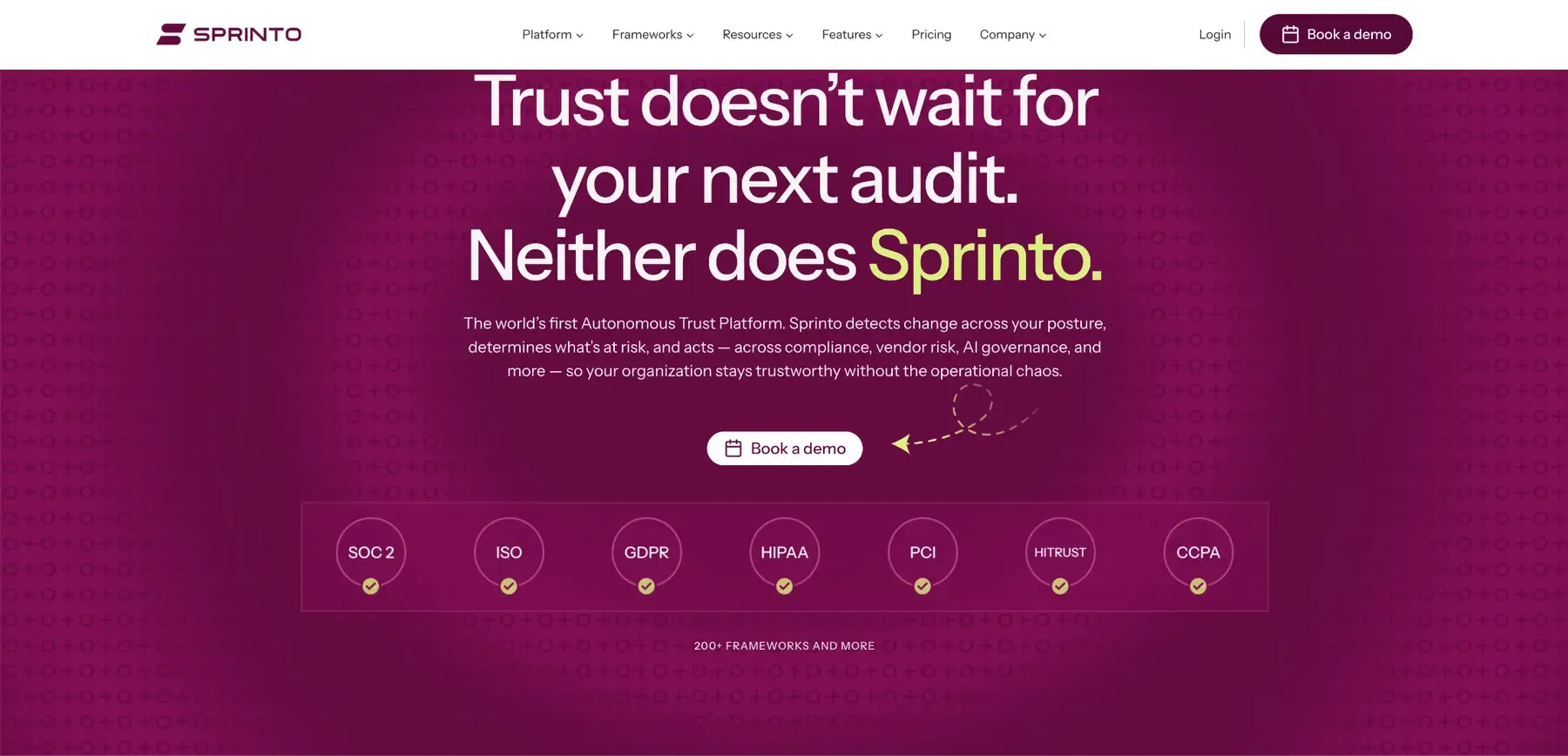
Source: sprinto.com
For teams looking for a guided starting point, Sprinto offers a preconfigured CMMC program with SSP and POA&M setup, mapped controls, and automated evidence collection.
Its monitoring tools check connected systems for issues, while an onboarding manager helps teams work through the requirements. That guided approach also extends to commercial compliance programs such as SOC 2 and ISO 27001.
Sprinto provides integrations, policy templates, and auditor collaboration tools, giving smaller teams a way to manage several parts of audit preparation and reach audit readiness quickly.
CMMC buyers should confirm supported levels and how SSP and POA&M records are maintained after setup. Companies with complex security environments should also test integration coverage and compliance workflows.
Key Features:
- Pre-built CMMC program: SSP and POA&M setup is part of the initial configuration.
- Automated checks: Always-on checks flag issues in connected systems.
- Evidence collection: Integrations pull the evidence an assessor requests.
- Guided implementation: A certified onboarding manager supports teams without compliance staff.
5. Thoropass

Source: thoropass.com
Thoropass combines CMMC framework support with a broader compliance and audit platform. Its Level 1 offering includes policy templates, expert-led scoping, continuous monitoring, and guidance for self-assessment preparation.
What makes Thoropass different is its integrated audit model. For commercial frameworks such as SOC 2, ISO 27001, HIPAA compliance, and others, teams can coordinate with auditors through the same platform they use to organize evidence and compliance work.
That keeps audit management and audit communications in one place, which helps teams that otherwise manage audit communications manually through email and spreadsheets.
For CMMC, however, Thoropass's commercial audit services should not be confused with a Level 2 certification assessment, which requires an authorized C3PAO.
Contractors considering Thoropass should confirm the documentation, evidence, and remediation workflows available for Level 2.
Key Features:
- Level 1 and Level 2 frameworks: Both levels are available in the platform.
- Level 1 policy templates: Templates map to the Level 1 practices and accept your own documents.
- Expert-led scoping: Specialists review how the business operates to size the program.
- Self-assessment preparation: The roadmap supports preparing for and conducting a self-assessment.
- Software plus audit: One provider covers the platform and audits for commercial frameworks.
6. Scrut Automation
Source: scrut.io
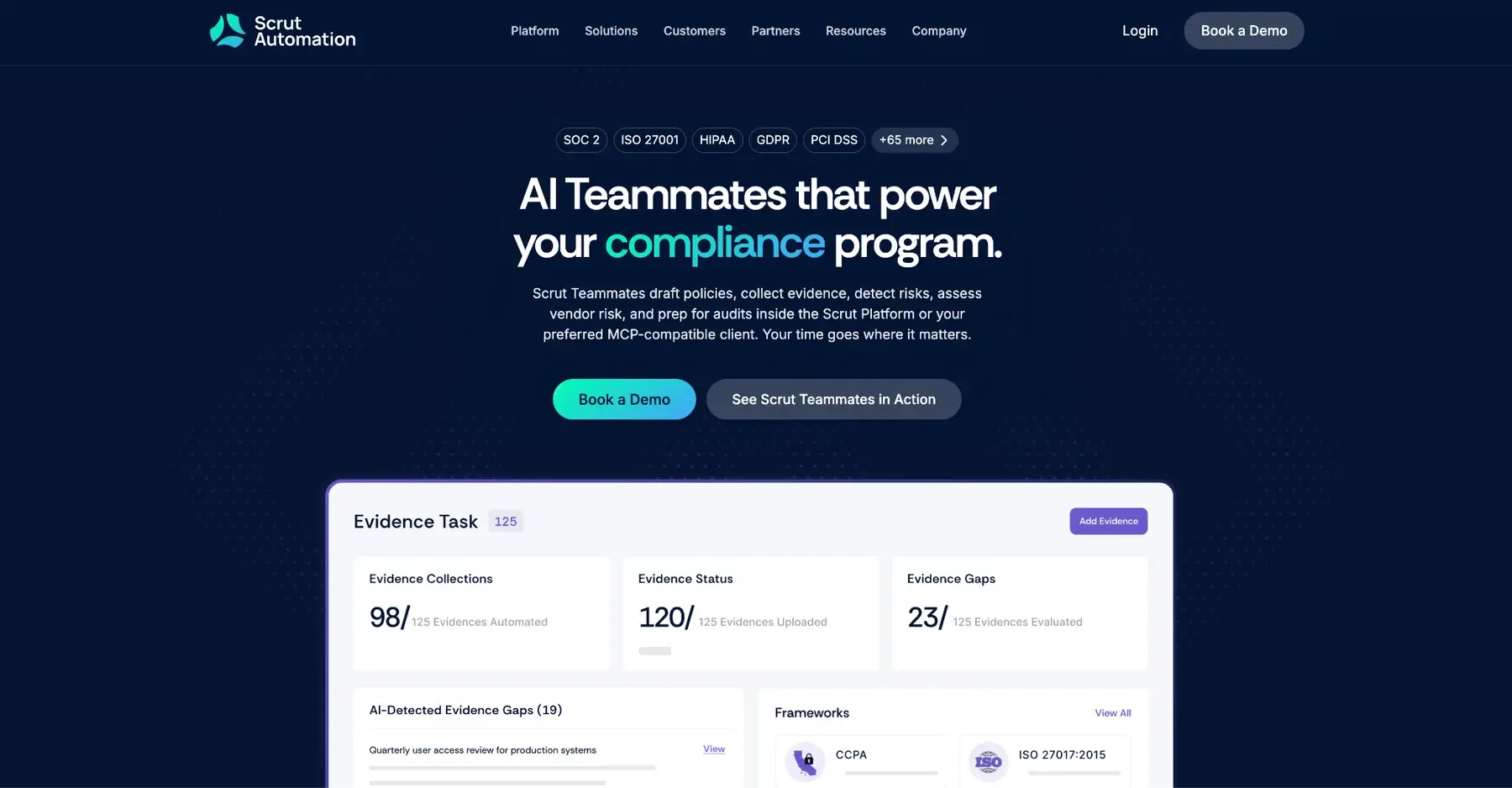
Scrut Automation approaches CMMC through a combination of compliance and risk management. Its CMMC workflows include SSP templates, controls mapped to NIST 800-171, automated evidence collection, and an assessor portal for reviewing documentation and audit records.
Vendor oversight is another part of the platform. Scrut helps classify vendor risks based on access to FCI and CUI, while its broader risk management tools connect security controls, assets, and third-party risks.
A live risk register adds risk visibility, and the platform also covers vendor questionnaires, monitoring for third-party security risks, and access reviews.
This creates a different operating model from a workspace centered primarily on CMMC requirements. For organizations considering Scrut, the key questions are how deeply it maps Level 2 assessment objectives and whether dedicated POA&M tracking is included.
Key Features:
- SSP templates and mapped controls: Pre-built templates and pre-mapped controls speed up documentation.
- Assessor portal: Evidence and audit logs sit in a view built for assessor review.
- Vendor risk classification: Vendor risk levels reflect FCI and CUI access.
- Risk register: Security risks link to the controls and assets behind them.
7. Hyperproof
Source: hyperproof.io
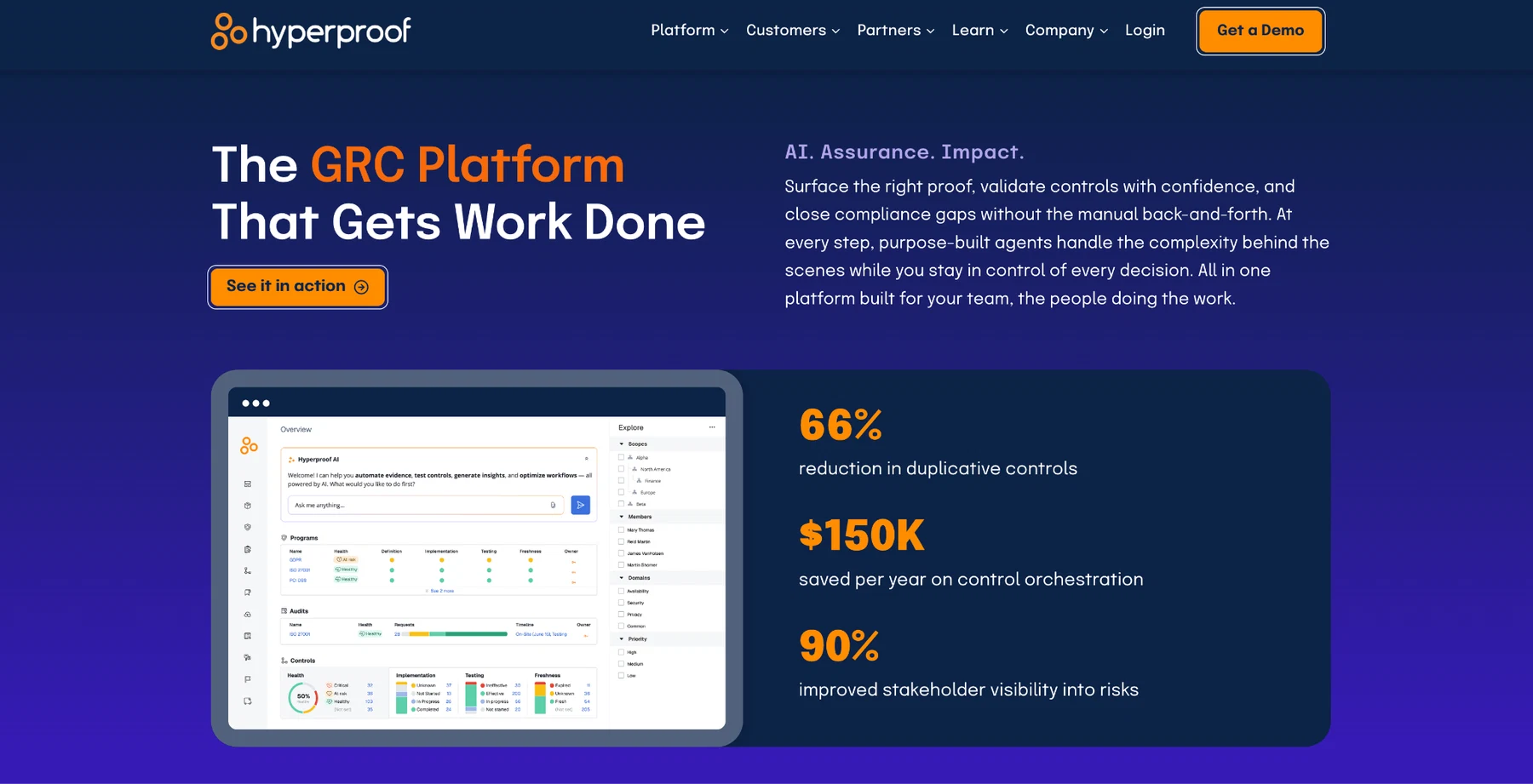
Organizations managing CMMC alongside several other compliance programs may also consider Hyperproof. Its CMMC template supports gap assessments, NIST 800-171 control mapping, evidence collection, automated control testing, and SSP reporting.
Hyperproof places those activities inside a wider compliance management environment. Teams can connect risks with controls, reuse relevant evidence for overlapping requirements, and monitor multiple programs through centralized reporting.
Program-level dashboards give security teams, compliance leaders, and internal audit teams a portfolio view.
It also offers Hyperproof Gov, a FedRAMP-authorized version intended for government-related compliance needs. Buyers handling CUI should confirm which edition fits their hosting requirements and how POA&M management works within the platform.
Key Features:
- CMMC template and gap assessment: The template supports a structured gap review.
- Control mapping: Existing controls can map to NIST 800-171 and other frameworks.
- Evidence and testing: Evidence collection and control testing run through integrations.
- Customizable compliance frameworks: Internal and industry-specific requirement sets are supported.
- Program reporting: Dashboards show where every program stands.
How to Choose a CMMC Compliance Platform
A feature matrix tells you less than a few questions: what obligation triggered the search, what your environment looks like, and who will run the program. A listed framework doesn't confirm a dedicated workflow, so verify each claim in a demo.
Start With Your Compliance Needs
Your obligation points to a category of platform. Match it before you compare features.
- First audit on a deadline: Prioritize ready-to-use templates, guided implementation, and evidence workflows that meet your auditor's requirements and help a small team streamline compliance.
- Multiple frameworks at once: Prioritize control mapping, program reporting, and risk assessments.
- CMMC as the primary obligation: Prioritize depth in that one regime, since contractors in regulated industries need to ensure regulatory alignment. Evaluate MotherBear's dedicated requirements, evidence, and multi-client workflows first.
Ready-to-use templates can simplify preparation, but assessors still need evidence that your controls satisfy the requirements.
Check NIST 800-171 Coverage and Workflows
Ask how closely the platform covers the 110 requirements and their assessment objectives. Then follow the paperwork. A requirement is not met if any applicable objective is not met, so objective-level tracking matters.
- SSP workflow: Confirm whether the platform generates and maintains the SSP or stores an uploaded file.
- POA&M workflow: Confirm how the platform tracks, assigns, and closes open items within the allowed window.
- SPRS score: Confirm whether the platform calculates the score or you enter it from a separate worksheet.
Compare Evidence, Risk Assessments, and Security Questionnaires
Evidence should trace to the requirement and objective it proves. Risk assessments should feed the same controls an assessor reviews, not a separate register nobody opens.
Ask which security measures the platform monitors or enforces and who reviews the results. Broader data governance needs may call for a separate tool.
Customer security questionnaires and reporting matter if sales cycles depend on them, but assessors review requirement-level evidence.
Automated evidence collection reduces manual work but doesn't remove it. Control mapping organizes the work but doesn't establish compliance. No software provider guarantees a successful assessment, and only an authorized C3PAO conducts a Level 2 third-party assessment.
Check Compliance Automation and Integration Fit
Automated tests depend on integration coverage. Check support for environments handling CUI, including government cloud tenants, identity tools, and HR systems.
Cloud-native companies should also verify support for their providers, including Google Cloud environments.
If the platform will store or process CUI, verify that its hosting environment meets the applicable federal security requirements.
Workflow automation also has limits. These platforms manage compliance, risk, and evidence, which supports regulatory compliance. None replaces dedicated threat detection and response tools.
Test Multi-Client Program Management
Consultants, RPOs, and MSPs need more than a single-tenant dashboard. Ask whether each contractor program is separate, whether you can view all of them together, and how client reporting works.
MotherBear was built around this model, with separate contractor programs and client reporting in one workspace.
Model Pricing and Support Before You Sign
Pricing models differ, so ask what triggers a tier change when you add a framework, a business unit, or headcount. Ask whether CMMC-specific features sit in the base plan or an add-on.
Also ask what support comes with the plan, including direct access to CMMC-trained practitioners. Get the answers in writing, not just from website copy.
Put CMMC First With MotherBear
If your requirements come from a Department of Defense (DoD) contract, the platform question changes. An assessor reviews your work, not a prospect, and the record has to hold up against individual requirements.
That record matters now. DoD suspended Phase 2 in July 2026, but Phase 1 self-assessment obligations continue, so what you document yourself carries the weight.
Vanta and the other platforms in this guide support CMMC to varying degrees. The buying decision comes down to whether CMMC program management is the center of the product or one of several workflows.
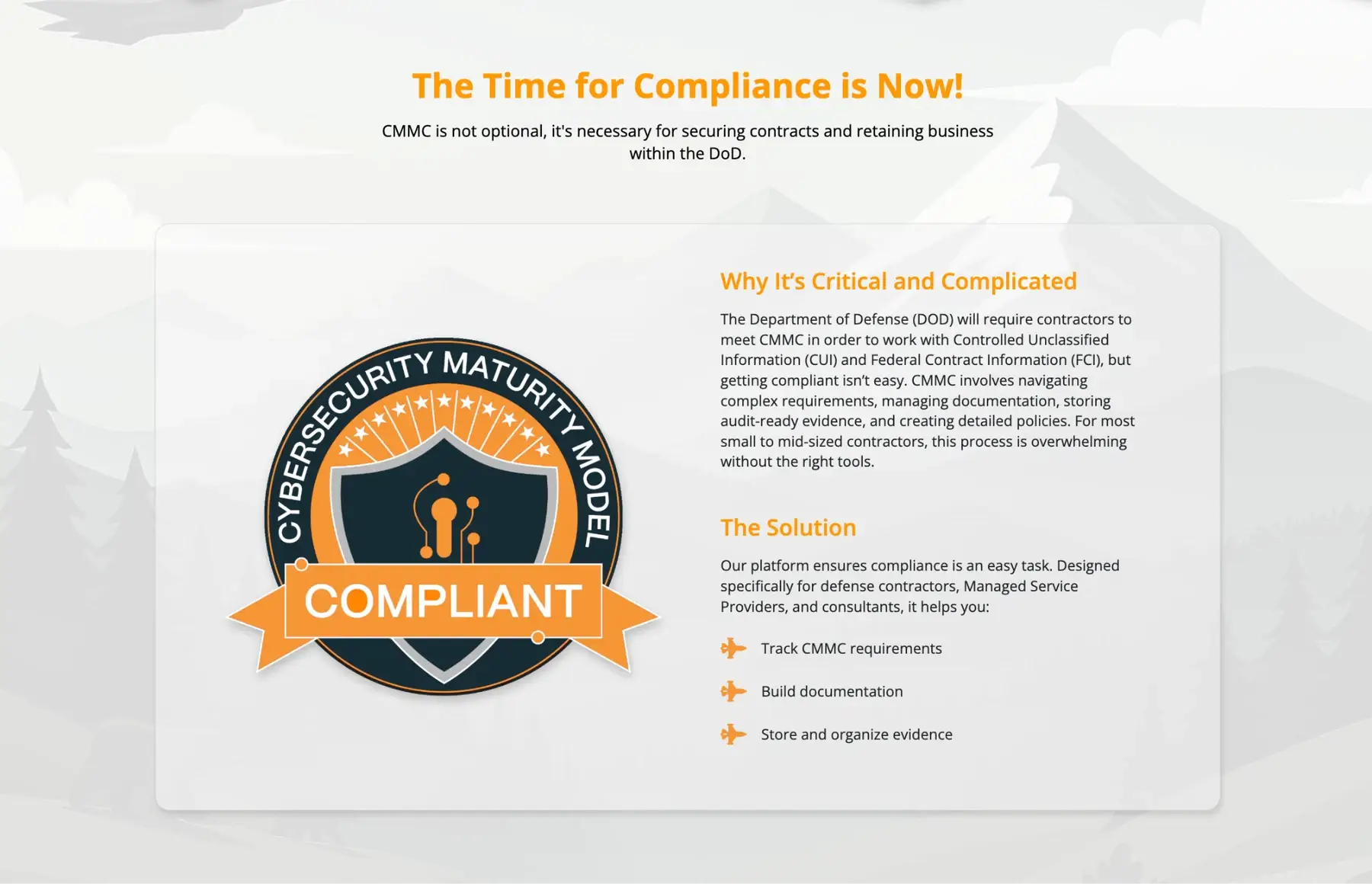
MotherBear gives defense contractors and their consultants one workspace for requirement status against NIST 800-171, supporting evidence, and SSP and policy documentation. Remediation tasks have owners and deadlines, while assessment readiness monitoring shows open work.
Consultancies, RPOs, and MSPs can run separate contractor programs side by side, with client communication and reporting in the same place.
Book a demo and see how MotherBear fits a CMMC-first compliance program.
FAQs About Vanta Competitors
Does Vanta support CMMC compliance?
Yes. Vanta's CMMC page lists Levels 1, 2, and 3, NIST 800-171 mapping aligned to Revision 2, guided SSP workflows, POA&M templates, and SPRS score monitoring. It also lists policy management and third-party risk tools for subcontractor flow-down.
The contractor still submits the SPRS score. CMMC buyers should confirm in a demo how much of their own program those workflows cover, and compare them with CMMC-first options such as MotherBear.
Can compliance software perform a CMMC assessment?
No. Software supports evidence collection and control testing, but the organization or authorized assessment body performs the CMMC assessment. A Level 2 self-assessment is performed by the organization, and a Level 2 third-party assessment is performed only by an authorized C3PAO.
During the July 2026 suspension of Phase 2, program managers may designate only Level 1 (Self) or Level 2 (Self). Phase 1 self-assessment, SPRS submission, and annual affirmation obligations continue, so the quality of your own records matters.
Can I use my SOC 2 platform for CMMC?
Only if it can support CMMC's requirements in practice. Level 2 is assessed against the 110 requirements of NIST 800-171 through 320 assessment objectives, and a requirement is not met if any applicable objective is not met.
Ask whether the platform tracks requirements and objectives, handles the SSP and POA&M, and links evidence to what it proves. A listed framework does not guarantee those workflows, so verify each one.
What is the best Vanta alternative for CMMC consultants?
Consultants, RPOs, and MSPs should look first at a multi-client structure. Each contractor needs a separate program with its own requirement status, evidence, documentation, and remediation tasks, plus a way to report to the client.
MotherBear is built around that model, with separate contractor programs in one workspace and CMMC as its primary focus. Test any alternative on how it separates clients and reports on each.
What should I verify before choosing a CMMC platform?
Verify requirement and objective coverage, how the SSP and POA&M workflows work, and whether the SPRS score is calculated in the platform. Check how evidence links to requirements and whether integrations reach the environments that handle CUI.
Also ask which CMMC features sit in the base plan and which are add-ons, and what support comes with it. No provider guarantees a successful assessment, so get the answers in writing.