Table of Contents
Drata is a strong security and compliance automation platform, which is why so many teams start there. It's also why so many end up searching for alternatives and competitors: not because it's bad, but because "compliance" means very different things depending on who's asking for it.
A SaaS company chasing SOC 2 and a defense contractor facing Cybersecurity Maturity Model Certification (CMMC) requirements have almost nothing in common except the word. The tools built for one aren't built for the other.
Consultants have a different problem entirely. A firm running compliance programs for 30 contractor clients needs separation between them and a view over all of them, which is a different design question from any single company tracking its own controls.
This list covers nine Drata competitors worth evaluating, what each is actually good at, and how to tell which category your own compliance needs fall into.
TL;DR
These are the nine best Drata competitors and alternatives:
- MotherBear
- Vanta
- Sprinto
- Secureframe
- Scrut Automation
- Hyperproof
- Scytale
- OneTrust
- LogicGate
What Is Drata?
 Source: drata.com
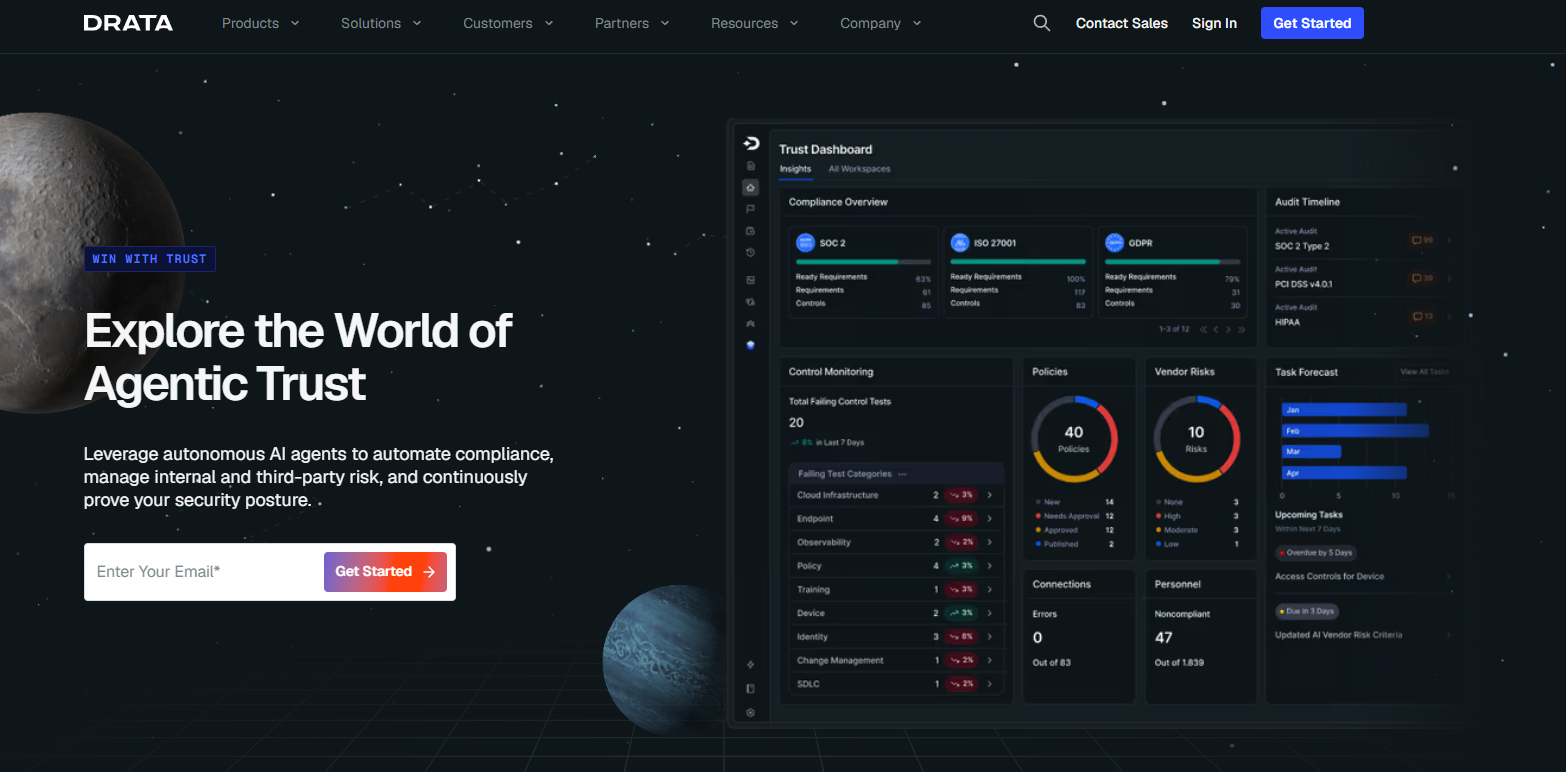
Drata is a compliance management platform that helps organizations prepare for audits and manage requirements under SOC 2, ISO 27001, HIPAA, and GDPR. Teams use it to achieve compliance with a framework, then maintain compliance between audits through continuous monitoring of their controls.
Drata connects to your cloud environment and security tools, runs automated tests against your configuration, and handles evidence collection without the manual processes that used to define audit season.
Over time, the platform expanded past its origins. It now spans governance, risk management, third-party risk, a Trust Center for sharing your security posture with prospects, and artificial intelligence features that draft questionnaire responses and suggest control mappings.
Drata's Key Features
- Automated evidence collection: The platform automates evidence collection from connected systems, replacing screenshot-and-spreadsheet workflows.
- Real-time monitoring: Security controls are checked on an ongoing basis, so failures surface as alerts rather than audit findings.
- Multiple frameworks: Shared controls map to several compliance frameworks at once, so work done for one carries into the next.
- Vendor risk management: Standardized vendor risk assessment workflows with automated follow-ups and centralized tracking.
- Trust Center: A self-serve portal where customers review your compliance posture without emailing your security team.
- Integrations: Connections to hundreds of cloud providers, identity systems, human resources (HR) tools, and developer platforms.
Where Drata Fits Best
Drata suits companies whose compliance requirements come from customers and partners: SaaS businesses, technology vendors, and any organization where a security questionnaire stands between them and a deal.
That focus is a strength rather than a limitation. It does mean a platform optimized for commercial security frameworks works differently from one built around a single regulatory regime.
One clarification worth making early: these platforms primarily manage compliance, risk, and evidence. Some include security testing or monitoring features, but none of them replace the threat detection and response tools in your security stack.
9 Best Drata Competitors in 2026
Check out the best alternatives to Drata in 2026:
1. MotherBear - For CMMC Compliance
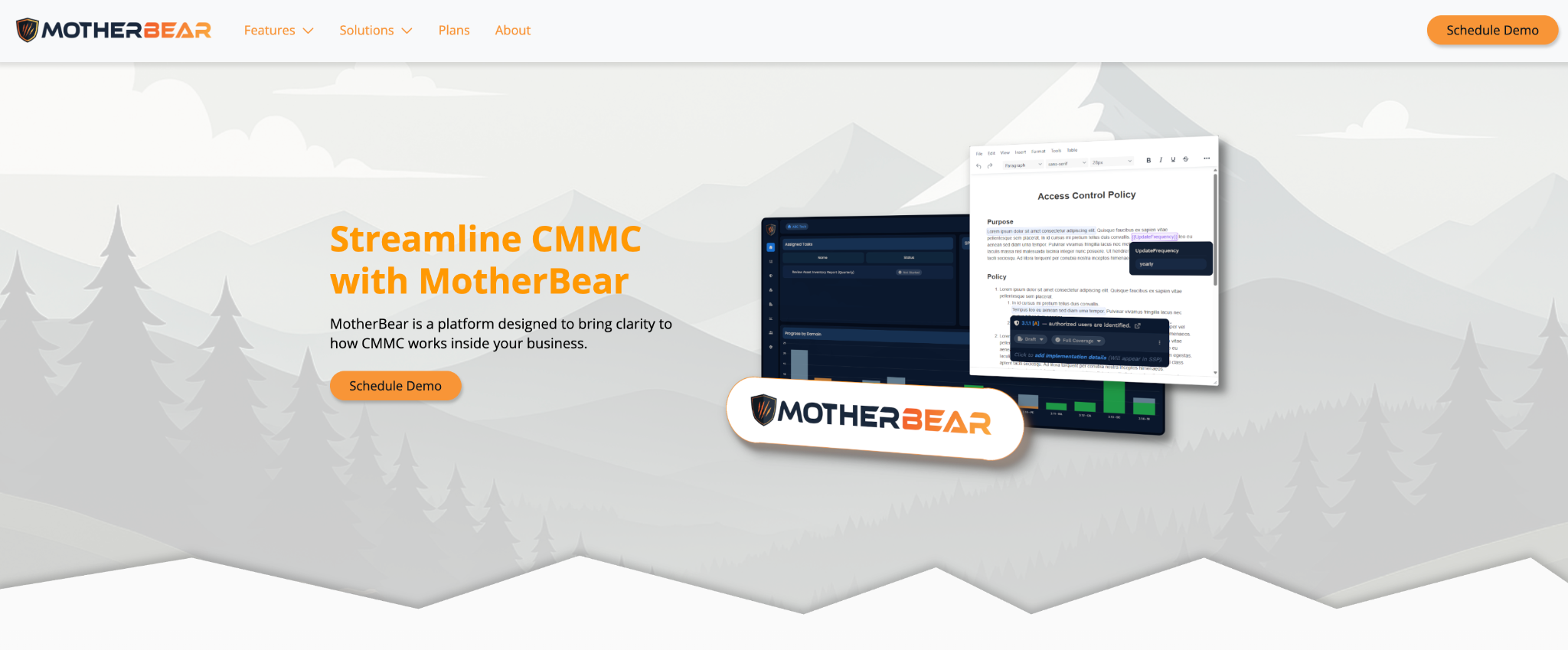
MotherBear is CMMC compliance software built for defense contractors and the consultants who serve them. Instead of spreading attention over a broad framework library, it organizes the workspace around CMMC and NIST 800-171 program management.
The fit shows in the details that only matter for defense work. Requirement tracking, evidence organization, assessment readiness, and the documentation a Certified Third-Party Assessment Organization (C3PAO) works from sit at the center of the product rather than in an add-on module.
It also handles the multi-client problem directly, which matters for CMMC consultancies and MSPs running programs for dozens of contractors at once.
Key Features
- Requirement tracking: Every NIST 800-171 requirement with its current status in one view.
- Evidence repository: Artifacts stored against the requirements they prove.
- Documentation management: SSP and policy materials kept with the rest of the CMMC program.
- Task management: Remediation work with owners and deadlines.
- Assessment readiness monitoring: Where each program stands against its requirements.
- Multi-client organization: Separate contractor programs in one workspace, with client communication and reporting alongside them.
Best for: Defense contractors handling Federal Contract Information (FCI) or Controlled Unclassified Information (CUI), the virtual Chief Information Security Officers (vCISOs), MSPs, and consultants managing their compliance programs.
Book a demo and see how MotherBear handles CMMC compliance for one contractor or thirty.
2. Vanta
 Source: vanta.com
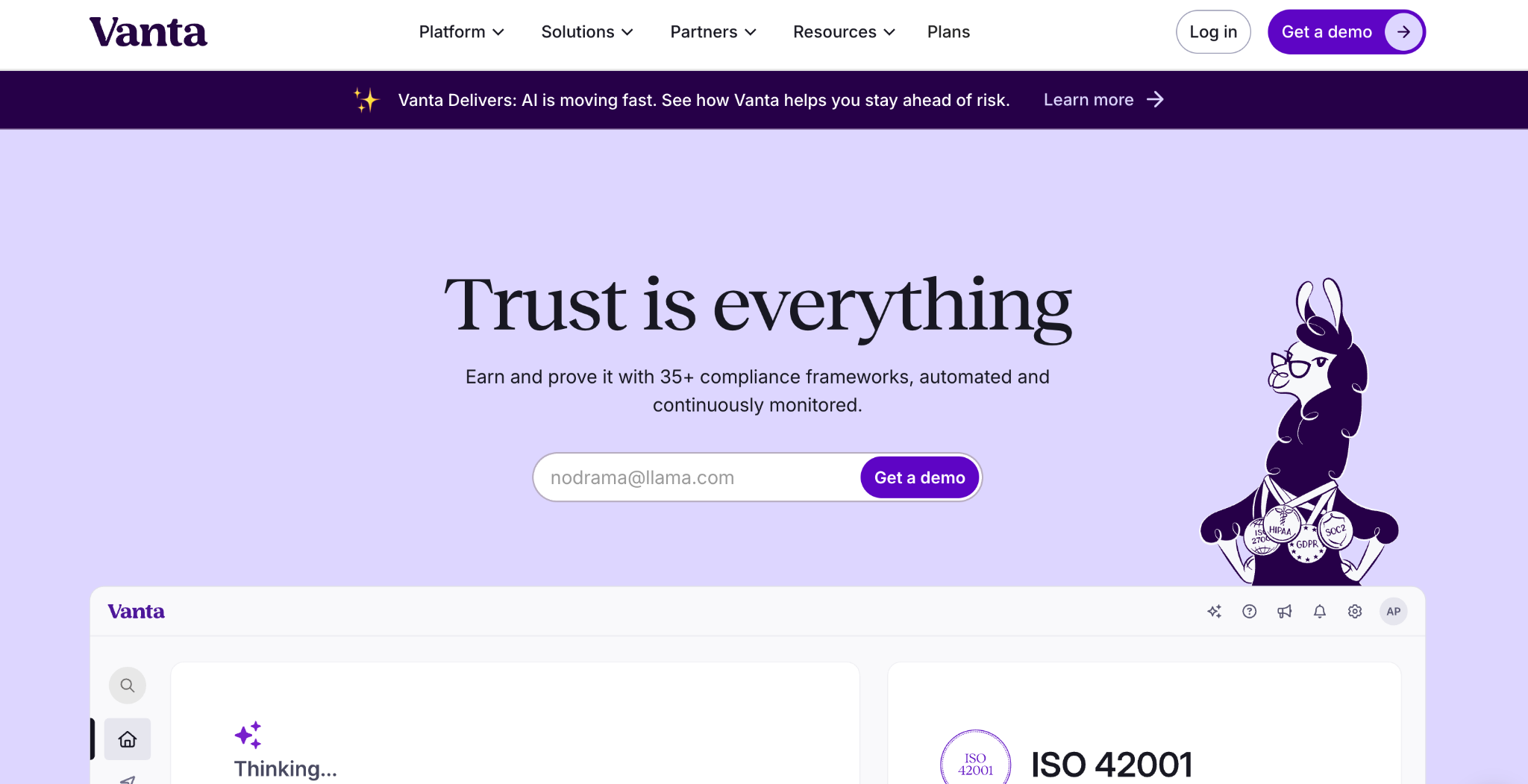
Vanta focuses on automated evidence collection, compliance monitoring, and audit readiness for SOC 2, ISO 27001, HIPAA, and the Payment Card Industry Data Security Standard (PCI DSS). It's the alternative teams usually weigh first as the feature gap is narrow.
Vanta offers a large integration library, mature trust-center functionality, and questionnaire automation. Its user base is large enough that implementation experience is easy to find.
The tradeoff is specialization. Teams that need to tailor controls heavily, or that carry unusual regulatory and multi-client requirements, should test those workflows directly rather than assuming broad configurability will match a purpose-built platform.
Key Features
- Continuous control monitoring: Automated tests running against connected systems.
- Pre-built policy templates: Starting documentation for common frameworks.
- Third-party risk: Vendor tracking and security questionnaire automation.
- Trust center: Customer-facing view of your compliance posture.
Best for: Companies that want a direct Drata substitute with comparable framework coverage and a proven implementation path.
3. Sprinto
 Source: sprinto.com
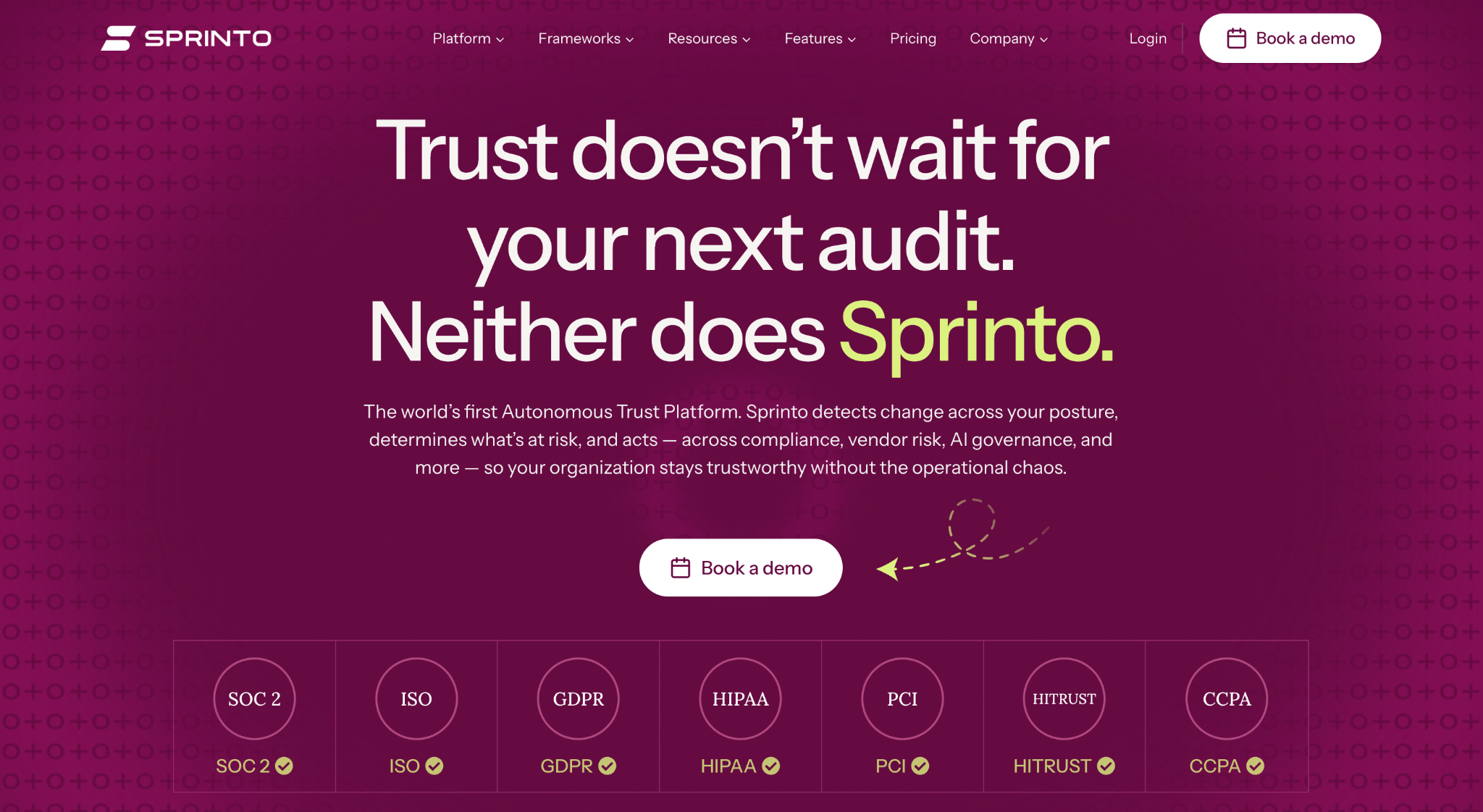
Sprinto leans on automation and speed, with pre-configured programs designed to move startups and mid-market companies to a first certification quickly. It supports a wide framework list and emphasizes native integrations for accurate evidence collection.
The platform focuses on removing manual tasks from the compliance process, with automated checks running against connected systems and workflows that assume you don't have a dedicated compliance hire.
The tradeoff is fit with complex environments. Teams running unusual architectures should verify that its integrations, control customization, and implementation model match their requirements.
Key Features
- Pre-configured programs: Framework-specific setups aimed at rapid certification.
- Native integrations: Direct connections for evidence collection rather than manual uploads.
- Continuous compliance monitoring: Ongoing checks with alerting on drift.
- Guided workflows: Built for teams without compliance staff.
Best for: Startups and small to mid-sized businesses pursuing SOC 2 or ISO 27001 on a tight timeline.
4. Secureframe
 Source: secureframe.com
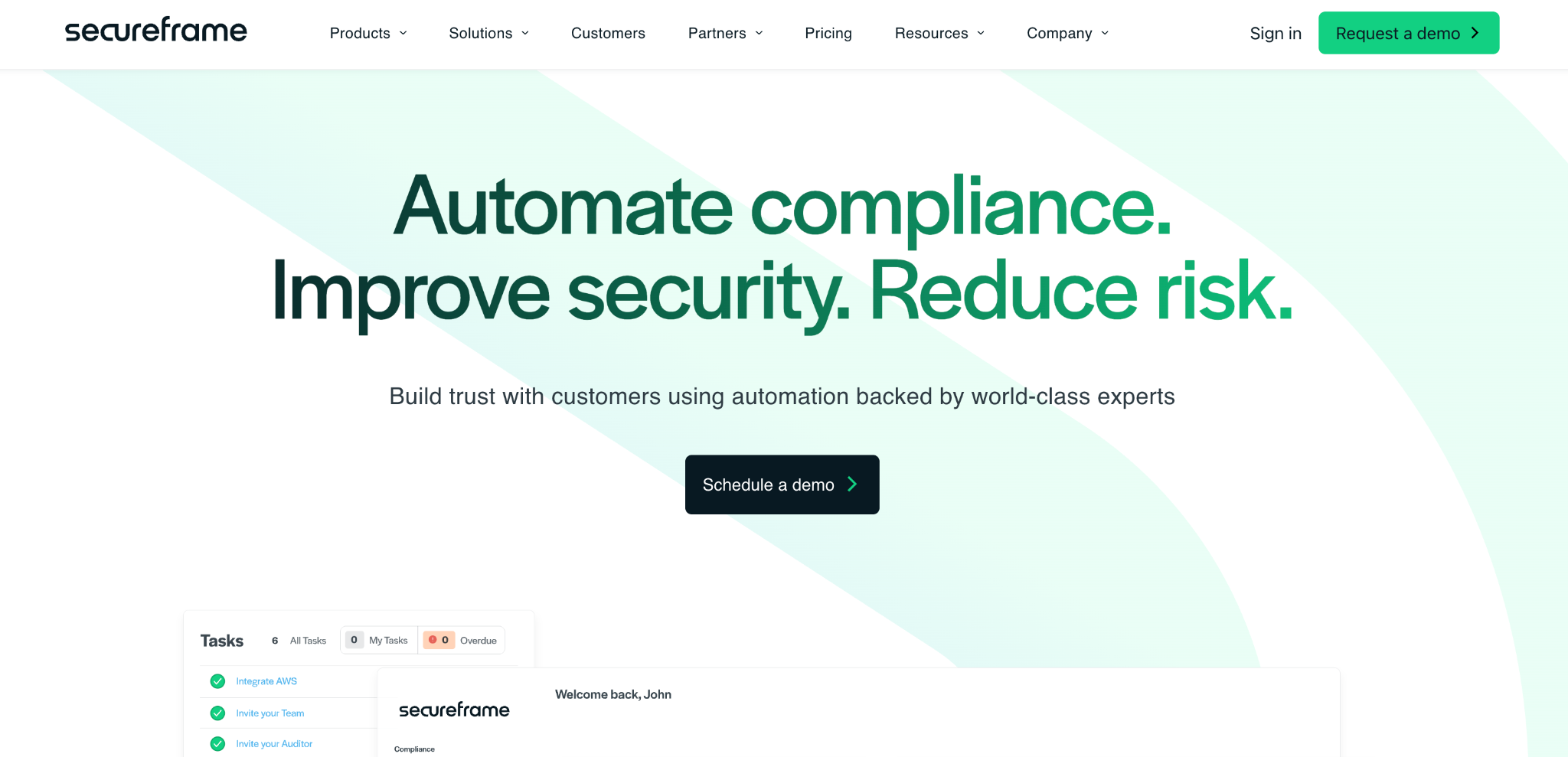
Secureframe combines compliance automation with access to compliance experts who guide implementation, and it covers a long list of security frameworks. It suits organizations expecting to earn multiple certifications and attestations over time rather than stopping at one.
Its control mapping means evidence gathered for one framework satisfies overlapping requirements in another, which compounds in value as programs accumulate.
Secureframe also covers federal frameworks, making it worth evaluating for companies with mixed commercial and government compliance needs.
Key Features
- Cross-framework mapping: Shared controls that streamline audits after the first one.
- Expert guidance: Compliance experts alongside the software.
- Personnel compliance: Onboarding, training, and access tracking.
- Vendor risk assessment: Third-party reviews inside the same platform.
Best for: Organizations running several compliance programs that want expert support alongside the platform.
5. Scrut Automation
 Source: scrut.io
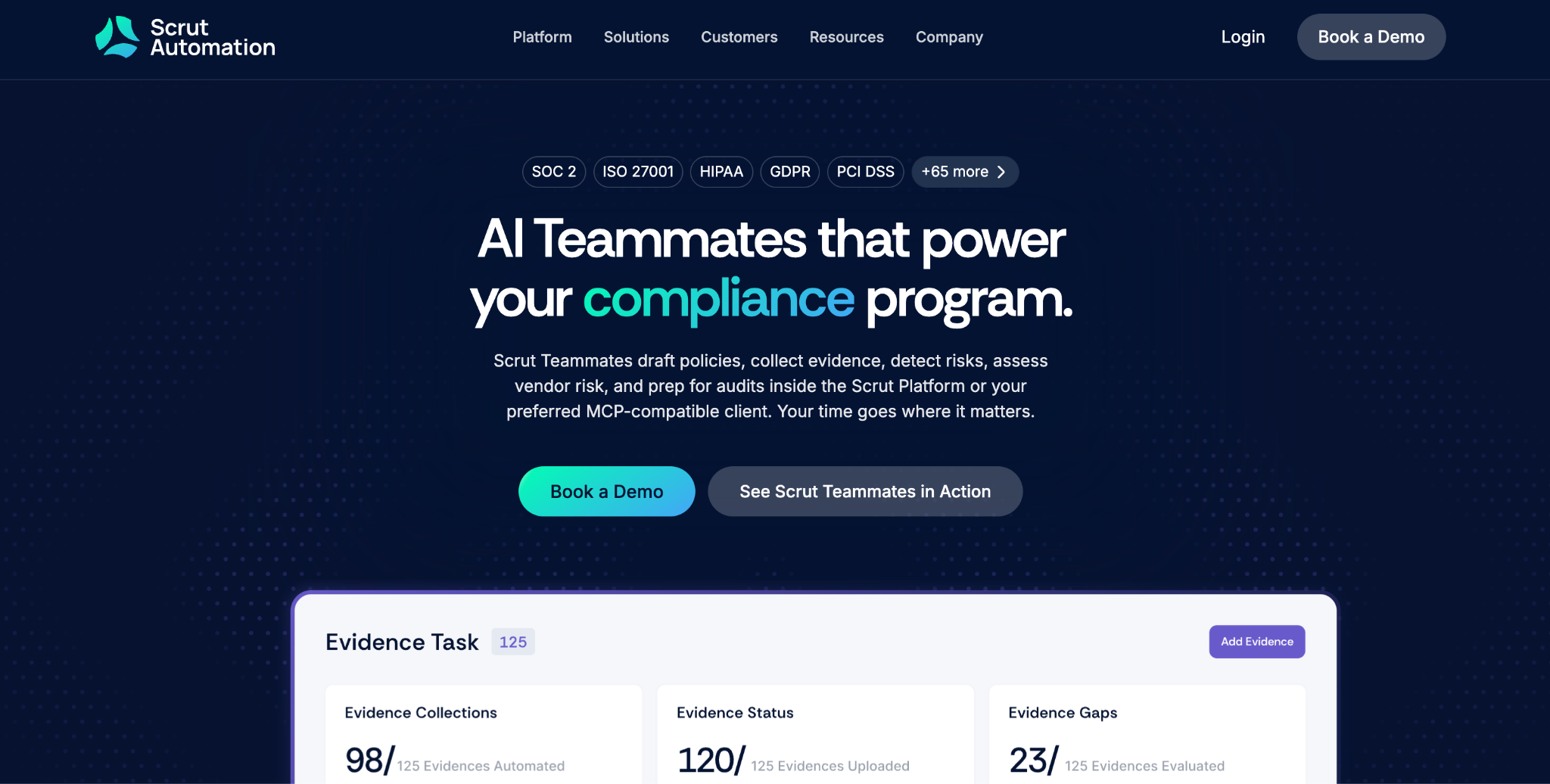
Scrut pairs compliance automation with real depth in governance, risk, and compliance (GRC). A risk register, risk assessments, and third-party risk workflows sit alongside the framework machinery rather than behind it.
That suits teams whose programs are as much about risk visibility as compliance. The risk register, risk assessments, and third-party workflows let teams manage both from the same platform.
The breadth has a cost in scope. Teams focused only on a first audit may not need the wider risk-management layer.
Key Features
- Risk register: Centralized risk tracking with ownership and treatment plans.
- Risk assessments: Structured evaluation feeding into compliance work.
- Third-party risk management: Vendor assessments and monitoring.
- Automated tests: Continuous checks against connected infrastructure.
Best for: Teams that want risk management and compliance managed in one place.
6. Hyperproof
 Source: hyperproof.io
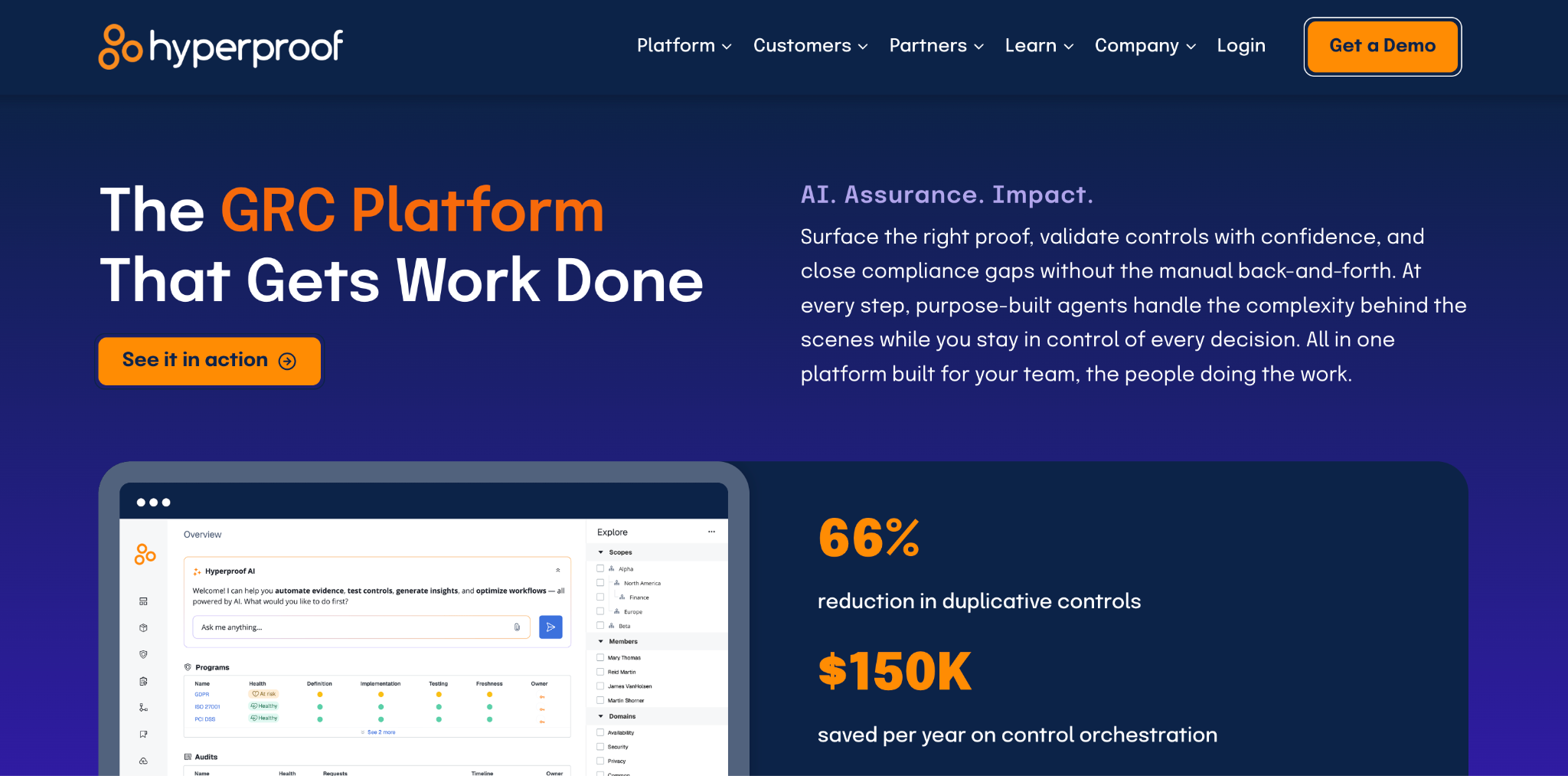
Hyperproof targets compliance operations at scale, supporting many frameworks at once with strong control mapping so work done for one certification carries into the next. It suits large organizations running several programs in parallel.
The platform is less about reaching a first certification fast and more about running a mature compliance function without duplicated effort. Its dashboards give compliance leaders program-level visibility rather than control-level detail alone.
Its broad scope suits mature compliance programs. A smaller team managing one framework should decide whether it needs that level of program management.
Key Features
- Program management: Multiple compliance programs tracked in parallel.
- Control mapping: One control satisfying requirements in several frameworks.
- Risk management: Risk tracking connected to compliance work.
- Custom frameworks: Support for internal and industry-specific requirement sets.
Best for: Large organizations managing multiple frameworks, audits, and compliance efforts at once.
7. Scytale
 Source: scytale.ai
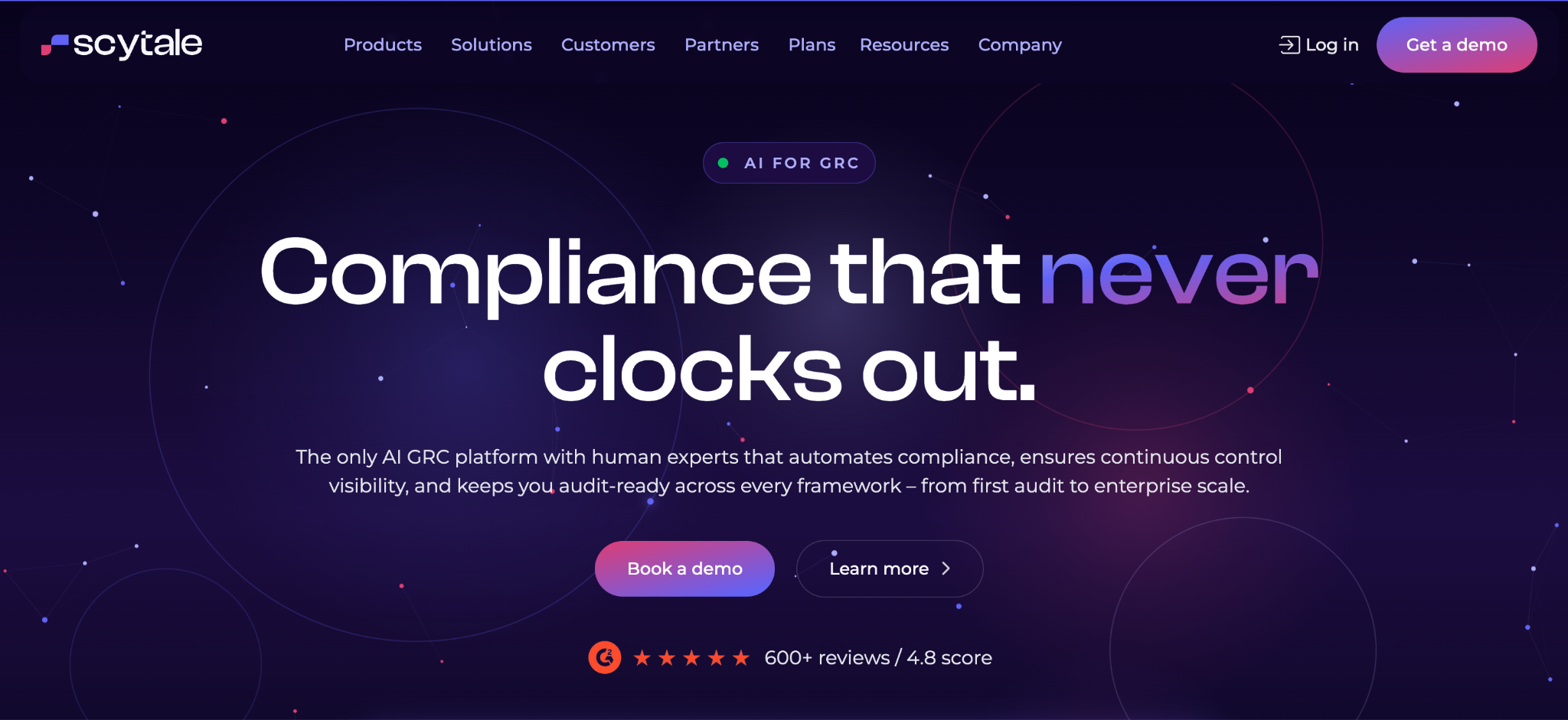
Scytale combines its compliance platform with hands-on expert guidance, which appeals to teams without a dedicated compliance owner. Automation handles evidence collection while assigned experts guide readiness and coordination throughout the auditing process.
The model works well for a first SOC 2 or ISO 27001. Buyers looking only for software should compare the service package closely, since it's a significant part of what they're paying for.
Key Features
- Guided compliance: Assigned experts through the compliance process.
- Automated evidence collection: Continuous pulls from connected systems.
- Audit coordination: Support in preparing for and managing the audit itself.
Best for: Startups wanting a guided path to their first audit.
8. OneTrust
 Source: onetrust.com
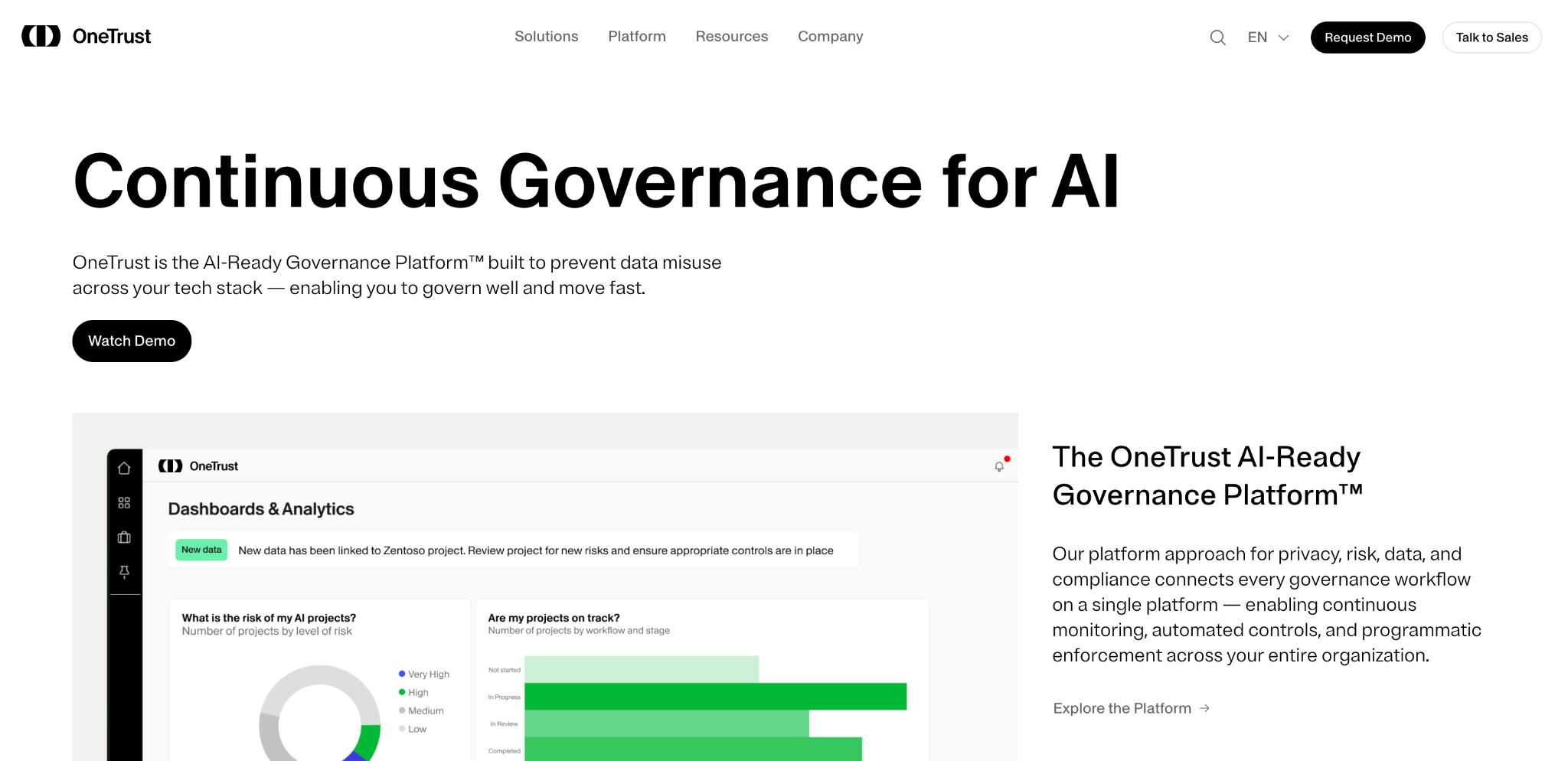
OneTrust focuses on privacy, consent, and data governance. It maps where sensitive data lives, manages consent, and handles data subject requests under regulations like the GDPR. Its platform also covers third-party and technology risk.
For organizations whose primary obligations are privacy-driven, that emphasis matters more than SOC 2 tooling. OneTrust can classify sensitive data throughout your systems and connect data protection obligations to the controls that satisfy them.
The platform is enterprise-scaled. Its breadth may be more than a team seeking straightforward audit automation needs.
Key Features
- Consent management: Capture and tracking of user consent at scale.
- Data governance: Discovery and classification of sensitive data.
- Privacy rights automation: Data subject request handling.
- Regulatory coverage: The GDPR, the California Consumer Privacy Act (CCPA), and other privacy regulations.
Best for: Enterprises whose compliance requirements center on privacy and data protection.
9. LogicGate
 Source: logicgate.com
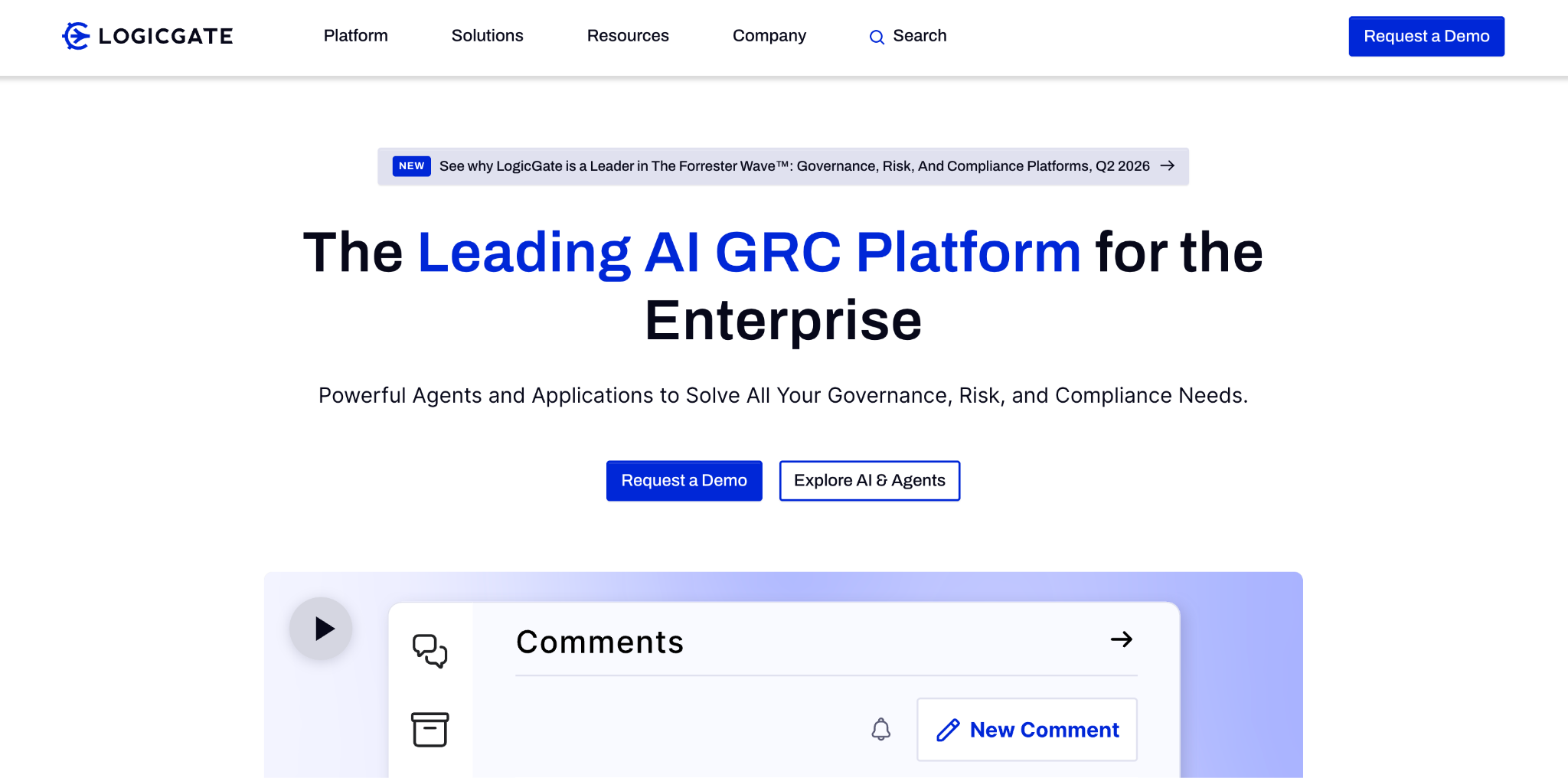
LogicGate positions itself as a connected risk platform, letting teams build workflows for risk, compliance, audit, and vendor programs on shared underlying data. Its no-code builder means processes get modeled to your organization instead of the reverse.
That flexibility is the appeal and the cost. Teams get a system that matches how they actually work, but it usually requires more process design than a preconfigured compliance platform.
Key Features
- Configurable workflows: Processes built without coding.
- Connected risk data: Risk, compliance, and audit sharing one foundation.
- Risk quantification: Reporting that ties risk posture to business impact.
- Custom frameworks: Support for requirement sets no vendor ships by default.
Best for: Organizations wanting risk and compliance workflows tailored to their own operating model.
How to Choose a Compliance Platform
The following checks will tell you more about fit than any feature comparison.
Start With Your Actual Frameworks
Coverage breadth means little if your specific regime is handled shallowly. Depth in the one framework your contracts impose beats partial support for twenty, so start from your obligations rather than a feature matrix.
Test Automation Against Your Existing Tech Stack
Automated tests only help where the platform integrates with the tools you actually run. A long integration list matters less than integration with your existing tech stack, so check the specific connections your cloud services and security tools require.
Learn How the Pricing Model Works
Custom pricing is normal here, but the variables differ. Some vendors price on employee count, others on frameworks or modules, and the difference compounds as you grow. Ask what triggers a tier change before signing.
Check Multi-Client Support if You're a Consultant
For CMMC consultants and MSPs, treat this as a gating requirement. A platform without clean tenant separation and a portfolio view caps how many clients one person can serve.
Match the Compliance Solution to Your Regime
General compliance automation is the right answer for commercial certifications. A purpose-built compliance solution is the right answer when a specific regulation defines your obligations, which is the split this entire list is organized around.
Why Teams Look for Drata Alternatives
Four reasons come up repeatedly when teams evaluate alternatives.
Pricing Model and Scale
Drata doesn’t disclose its pricing publicly.
Custom plans differ by company size, included frameworks, plan level, and additional modules, so the useful exercise is modeling what happens to total cost when you add a framework or expand the program. Small businesses adding a second or third framework should run that math before committing.
Pricing opacity compounds it. When several vendors use custom pricing, comparing total cost over three years takes more work than comparing features.
Framework Fit
The platform's depth sits in commercial certifications. Organizations facing specialized regulatory requirements or custom frameworks sometimes find they're adapting a general tool rather than using a purpose-built one.
Financial institutions, healthcare organizations, and defense contractors all hit this from different directions. The question isn't whether a platform lists your framework, but how deeply it handles it.
Multi-Client Management
Consultants and managed service providers (MSPs) running compliance programs for many clients need tenant separation and a view over the whole portfolio.
Most other platforms in this space were designed for one organization managing its own compliance journey, and it shows once you manage compliance for thirty of them.
Depth of CMMC Support
Several platforms on this list, Drata included, list CMMC and NIST 800-171 in their framework libraries. Coverage isn't the differentiator anymore. Workflow depth is.
Defense compliance runs on machinery the commercial frameworks don't have: NIST 800-171 assessment scoring, System Security Plan (SSP) documentation in the form assessors expect, Supplier Performance Risk System (SPRS) submissions with annual affirmations, and evidence traceable to individual requirements.
That distinction matters more following the July 13, 2026 suspension of CMMC Phase 2. Phase 1 self-assessment requirements remain in force, and the Department continues selected government-led assessments during the review.
Bring Your CMMC Program Into One Place With MotherBear
If your compliance requirements come from defense contracts rather than customer security reviews, the platform question changes shape. The work isn't proving trust to prospects. It's proving to the government that every requirement is implemented, documented, and evidenced.
General platforms can hold that work. The difference is what the product is organized around, how objective evidence stays tied to requirements, and whether it fits a consultant running many contractor programs at once.
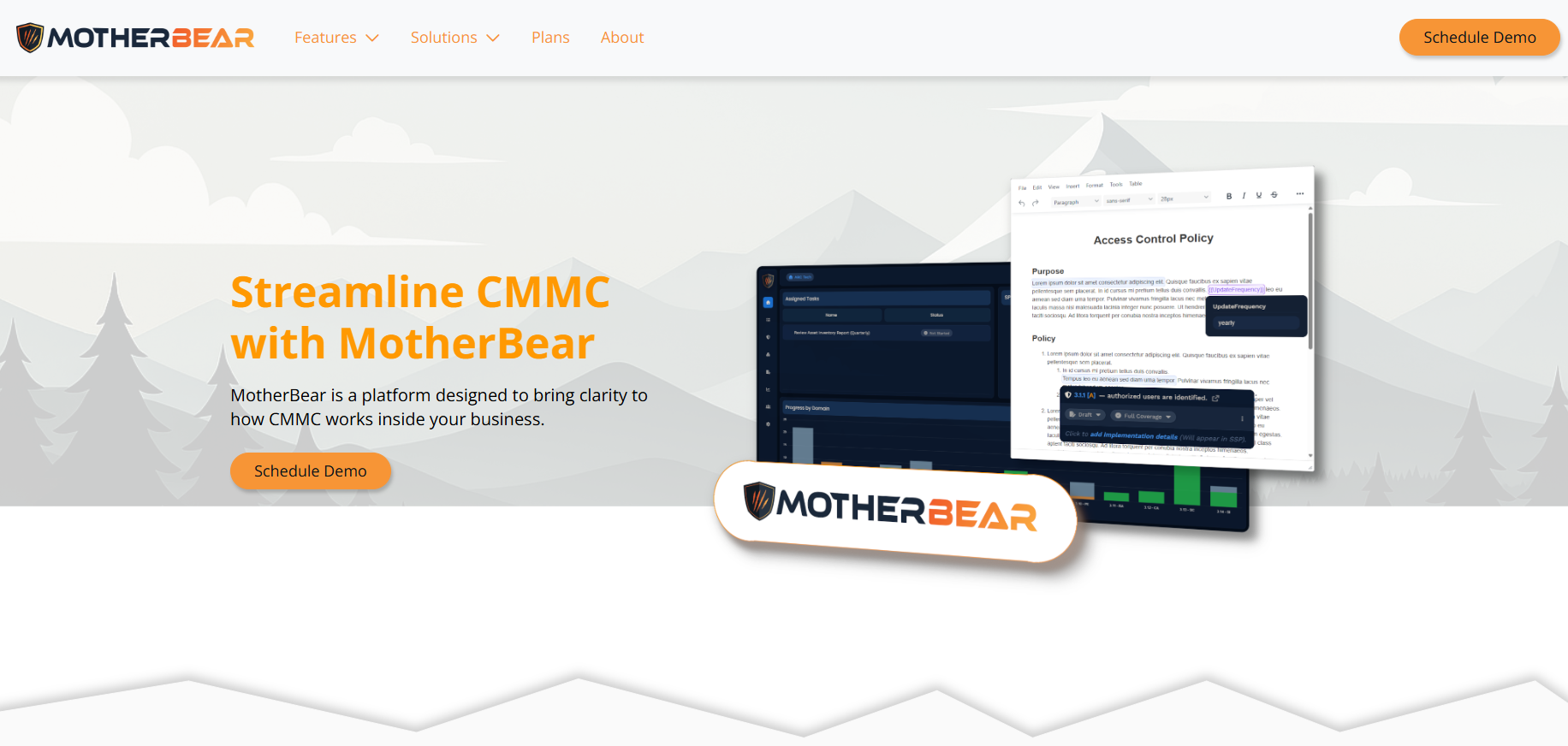
MotherBear gives defense contractors and their consultants a central place to manage requirement status, evidence, SSP and policy materials, remediation work, assessment readiness, and client reporting.
For consultancies and MSPs, it's also built to run many client programs side by side, which is where general-purpose tooling tends to run out of room.
FAQs About Drata Competitors
Is Drata a unicorn?
Yes. Drata reached unicorn status with its Series B in November 2021, then doubled its valuation to $2 billion with a $200 million Series C, placing it among the most valuable companies in compliance automation.
Is Drata better than Vanta?
Neither is universally better, and the two are close on core capabilities. Both automate evidence collection, monitor controls continuously, share compliance posture with customers, and support multiple frameworks from one control set. The better fit depends on your required integrations, frameworks, service model, and budget.
Is Drata a big company?
Yes, by category standards. Drata serves thousands of organizations worldwide and is a major provider in compliance automation. Company size still matters less than framework fit, integrations, and workflow requirements when you're choosing a platform.
Can Drata handle CMMC compliance?
Yes. Drata includes CMMC and NIST 800-171 support, control monitoring, and evidence management.
MotherBear is narrower by design, with CMMC-centered program management and multi-client organization for consultants. Compare the two on client separation, documentation workflows, reporting, remediation, and daily program management rather than on whether CMMC appears in a framework list.
What should consultants look for in a compliance platform?
Multi-client architecture first, then evidence organization. A consultant managing thirty client programs needs clean separation between them, a portfolio view over all of them, and evidence that stays organized per client, which is a different design problem from a single company tracking its own compliance.