---
title: What Is NIST 800-171? A Brief 2026 Guide
description: What is NIST 800-171? Read our guide and learn how to become compliant with the framework. Discover how MotherBear can help you out.
image: https://www.motherbearsecurity.com/hubfs/undefined-Jul-15-2026-12-42-33-2280-AM.png
---
[](https://www.motherbearsecurity.com/)
- Features
- [Requirements Tracking Understand how and why you meet requirements](https://www.motherbearsecurity.com/features/requirements-tracking)
- [Documentation Builder Tools to streamline creating Policies, Procedures and your SSP](https://www.motherbearsecurity.com/features/documentation-builder)
- [Evidence Repository Store evidence with ease and ensure you are audit ready](https://www.motherbearsecurity.com/features/evidence-repository)
- [Task Management Assign, track, and manage tasks across your team](https://www.motherbearsecurity.com/features/task-management)
- Solutions
- [For Defense Contractors Purpose built for the Defense Industrial Base](https://www.motherbearsecurity.com/solutions/defense-contractors)
- [For Managed Service Providers Simplify program management for you and your clients](https://www.motherbearsecurity.com/solutions/managed-service-providers)
- [For CMMC Professionals Use tools that help you provide the best value to your clients](https://www.motherbearsecurity.com/solutions/cmmc-professionals)
- [Plans](https://www.motherbearsecurity.com/plans)
- [About](https://www.motherbearsecurity.com/about)
[Schedule Demo](https://www.motherbearsecurity.com/schedule-demo)
# What Is NIST 800-171? A Brief 2026 Guide
July 14, 2026

## Table of Contents
- [TL;DR](https://www.motherbearsecurity.com/blog/what-is-nist-800-171#tldr)
- [NIST 800-171 Explained](https://www.motherbearsecurity.com/blog/what-is-nist-800-171#NIST-800-171-Explained)
- [NIST 800-171 Requirements](https://www.motherbearsecurity.com/blog/what-is-nist-800-171#NIST-800-171-Requirements)
- [Who Needs to Comply With NIST 800-171?](https://www.motherbearsecurity.com/blog/what-is-nist-800-171#Who-Needs-to-Comply-With-NIST-800-171)
- [NIST 800-171, CMMC, and Other Frameworks](https://www.motherbearsecurity.com/blog/what-is-nist-800-171#NIST-800-171-CMMC-and-Other-Frameworks)
- [How to Achieve NIST 800-171 Compliance](https://www.motherbearsecurity.com/blog/what-is-nist-800-171#How-to-Achieve-NIST-800-171-Compliance)
- [Keep CMMC Evidence Tied to the NIST 800-171 Controls With MotherBear](https://www.motherbearsecurity.com/blog/what-is-nist-800-171#Keep-CMMC-Evidence-Tied-to-NIST-800-171)
- [FAQs About What Is NIST 800-](https://www.motherbearsecurity.com/blog/what-is-nist-800-171#faq)171
What is NIST 800-171, and why does a single contract clause suddenly hinge on it? That’s what most teams that meet this framework ask themselves.
In plain terms, NIST 800-171 is the framework many contracts point to when Controlled Unclassified Information (CUI) leaves the federal government and enters contractor, university, research, or partner environments.
Published by the National Institute of Standards and Technology (NIST), it gives nonfederal organizations a contract-ready way to protect that data once it moves beyond government control.
For Department of Defense (DoD) contractors, that same work feeds directly into Cybersecurity Maturity Model Certification (CMMC) Level 2 readiness.
Rev. 3 arrived in May 2024, while many DoD obligations still reference Rev. 2, so teams need to know which version their contracts require.
This guide explains who needs NIST 800-171, what the security requirements involve, how it connects to CMMC, and how to move from obligation to operating program.
## **TL;DR**
- NIST 800-171 is the federal framework that tells nonfederal organizations how to protect CUI once it leaves agency-owned environments, and it applies the moment a contract, grant, or agreement requires it.
- Compliance is an operating posture rather than a checklist: you implement the required controls, document how each one works, and keep evidence current enough to survive assessment.
- Rev. 3 is the current NIST Special Publication, but many defense contracts still rely on the older Rev. 2 baseline of 110 security controls, so follow the version your contract names.
- For DoD work, the same security requirements feed CMMC Level 2, where current evidence and a clean assessment trail become part of contract eligibility.
- [MotherBear](https://www.motherbearsecurity.com/schedule-demo) gives teams one workspace to track all 110 NIST 800-171 controls, manage documentation, and keep evidence audit-ready.
## **NIST 800-171 Explained**
NIST 800-171 is a cybersecurity framework that defines security requirements for protecting CUI held on nonfederal systems.
The NIST publishes the framework for federal agencies to establish consistent protection expectations for external partners. NIST 800-171 signals where the guidance comes from and why federal agencies lean on it so often.
This NIST Special Publication was built so nonfederal systems can meet federal expectations without guesswork, and the requirements scale from a handful of systems to a large estate.
At its core, the framework is a defined set of recommended security requirements for protecting CUI on systems the government does not own.
The [current NIST 800-171 publication](https://csrc.nist.gov/Pubs/sp/800/171/r3/final) says the requirements apply to components that process records, store files, or transmit CUI between approved environments.
Such components can include applications, endpoints, and network services, and some provide security protection around the data rather than holding it directly.
Because the requirements apply to the entire system that touches the data, teams cannot limit the work to a single tool.
### **Protecting Controlled Unclassified Information**
This external focus is the point, because the federal government owns the mission risk while nonfederal organizations operate the systems and manage the people touching the data.
That split makes NIST 800-171 more useful than a broad control catalog, since it turns federal expectations into recommended security requirements that fit supplier environments. They give nonfederal organizations a predictable target instead of a custom rulebook for every agency.
Rev. 3 is current, but CMMC Level 2 assessments still center on the 110 security controls from NIST 800-171 Rev. 2 in many DoD contexts. Teams should follow the contract first, then watch how federal agencies move NIST 800-171 Rev. 3 into future agreements.
The framework traces back to Executive Order 13556, which created the government-wide CUI program to reduce unauthorized disclosure without forcing every partner into the same technology stack.
Federal agencies reuse it for all contracts, which makes NIST 800-171 one of the cybersecurity standards nonfederal teams encounter most often.
The aim stays consistent across agencies: keep CUI protected to a single standard, so every organization that receives it follows the same security requirements.
## **NIST 800-171 Requirements**
NIST 800-171 requires organizations to implement security controls, document how that work happens, and keep evidence showing how each control operates. The challenge isn’t reading the requirement text; it’s proving that those security controls operate where CUI actually lives.
When the whole environment falls inside the boundary, the evidence has to follow that boundary, which makes the framework both technical and operational.
The NIST 800-171 requirements expect this proof to stay current, not just exist on paper, and the same rules apply whether the data sits in one app or many.
### **NIST 800-171 Security Families**
Rev. 2 groups its 110 security controls into 14 control families, each covering a different slice of protection work, and most assessments become harder when ownership is unclear. Several families tend to drive the deepest review.
Below are the main ones.
#### **Access Control and Configuration Management**
Access Control deserves early attention because permissions sprawl quickly, and Configuration Management keeps approved settings from drifting into unreviewed change.
Network access deserves the same scrutiny as endpoint access, since weak controls there can expose CUI even when application permissions look correct.
Audit and accountability belong in the same conversation, because proof often depends on logs that show who reached sensitive records and what they altered.
#### **Incident Response and Risk Assessment**
Incident Response and Risk Assessment give teams a way to spot and contain problems before small issues turn into contract findings. Clear playbooks define how staff reports and escalate, while early weakness review surfaces gaps before assessment pressure exposes them.
These security requirements work best when each is paired with documented procedures.
#### **Media Protection and Communications Protection**
Media Protection governs how removable drives and stored records move, while Communications Protection guards data traveling between approved environments.
Related families address Personnel Security and physical safeguards, and Security Assessment gets its own review area.
#### **System and Information Integrity**
System and Information Integrity rounds out the operational side by confirming that data and systems stay trustworthy, and Rev. 3 widens the map to 17 families.
#### **Rev. 3 Control Family Changes**
Planning gets its own family in Rev. 3, joined by System and Services Acquisition and Supply Chain Risk Management, a shift that signals where federal agencies expect more traceability over time. Rev. 3 also consolidates the Rev. 2 list of 110 requirements into 97.
These additions push organizations to document how outside systems and the wider supply chain affect protection.
#### **Control Ownership Trade-Offs**
Access Control should not sit with one owner by default, since Incident Response and Risk Assessment touch different operating teams.
Security Assessment then verifies whether those teams can prove the work, and clear procedures keep each requirement from falling through the cracks.
### **Documentation Requirements: SSP and POA&M**
A System Security Plan (SSP) explains how an organization implements each control. A Plan of Action and Milestones (POA&M) tracks open gaps, owners, remediation steps, and target dates. Together, the SSP and the POA&M turn compliance from a claim into an assessment record.
Most teams underestimate this layer. Security tools may be in place, but the SSP doesn’t match the current environment, and procedures often describe old processes while the POA&M sits disconnected from task owners.
This creates audit risk because assessors test what the organization can prove, not what the team meant to maintain.
Strong documentation has to follow the systems: when a boundary changes, the evidence and procedures need to change with it. Rather than treating documentation as a final clean-up task, build it while teams implement the security controls.
If a requirement is marked implemented, the supporting record should show who owns it and how it works.
## **Who Needs to Comply With NIST 800-171?**
Any nonfederal organization that stores, processes, or transmits CUI may be required to comply with NIST 800-171 when a contract, grant, or agreement requires it. The most visible group is defense suppliers, but the framework reaches well beyond defense. Common audiences include:
- **Defense suppliers:** Primes, subcontractors, and service providers that support defense programs.
- **Civilian agency partners:** Vendors that receive CUI from agencies outside of defense.
- **Research institutions:** Universities and labs that handle CUI under federal awards.
- **Specialized service firms:** Fintech, engineering, and professional services teams with federal work.
Government contractors may encounter the requirement directly or through flow-down clauses, and nonfederal organizations outside defense face similar language when federal agencies share CUI.
Whether they are large primes or small federal contractors, the obligation follows the data rather than the company size, and it can reach nonfederal systems that sit far from the original award.
### **Contract Triggers**
The contract language matters more than the industry label. Defense Federal Acquisition Regulation Supplement (DFARS) 252.204-7012 requires adequate security for covered defense information and points contractors toward NIST 800-171.
Federal Acquisition Regulation (FAR) clauses and agency-specific terms can create parallel obligations outside DoD, so applicable laws and contract terms both shape the work.
[The DFARS clause](https://www.acquisition.gov/dfars/252.204-7012-safeguarding-covered-defense-information-and-cyber-incident-reporting) also requires reporting cyber incidents and preserving affected media for review.
When the federal government passes CUI to outside teams, the security requirements ride along with the data, and the receiving environment must prove that protection with records rather than promises.
Components like cloud apps and managed services often land inside the boundary as a result.
This scope discipline matters. Treat every federal record as CUI, and the program becomes too large to manage. Treat CUI as ordinary sensitive information, and the organization may miss cybersecurity requirements that apply by contract.
Knowing exactly where information resides keeps the boundary honest.
The CMMC final rule adds another timing issue for defense suppliers, because as CMMC clauses appear in contracts, the cost of weak records shifts from internal cleanup to contract eligibility.
## **NIST 800-171, CMMC, and Other Frameworks**
NIST 800-171 sits inside a federal compliance map and is often confused with CMMC, NIST 800-53, and NIST 800-172, but each serves a distinct purpose. CMMC is the assessment and certification program for many defense suppliers.
The [DoD CMMC program](https://dodcio.defense.gov/CMMC/) verifies whether contractors can protect Federal Contract Information (FCI) and CUI at the required level, and CMMC changes the pressure because evidence, boundary, and recurring affirmation become part of contract eligibility.
NIST 800-53 is different, providing a broader catalog of security controls designed for federal information systems rather than nonfederal environments.
NIST 800-171 tailors a subset of those controls to nonfederal systems, making them easier to apply in contractor environments, while NIST 800-172 adds stronger security requirements for higher-risk CUI scenarios.
That matters most at CMMC Level 3, where advanced threats and government-led review enter the process.
Alongside those programs, NIST 800-171 focuses on protecting CUI in nonfederal systems and reads as a practical guide for organizations that handle controlled data.
Federal agencies keep returning to this approach because CUI outside government walls still requires the same proof, and the organizations under contract must show it. Treating that data as ordinary information invites findings.
For non-DoD organizations, NIST 800-171 can apply without a CMMC audit, which changes the assessment path considerably. The work still needs a defined boundary, and teams still have to implement security controls and keep records current.
Once the system boundary is defined, the framework becomes a work plan for the exact systems under review.
## **How to Achieve NIST 800-171 Compliance**
NIST 800-171 compliance starts with scope rather than tools, because if an organization can’t identify where CUI resides, every later decision becomes guesswork.
Teams also need to know which systems touch that data, since some tools provide security protection without storing CUI directly, but can still pull more systems into the boundary.
### **Scope and Evidence Sequence**
Use this process to keep the work grounded:
1. **Find data paths:** Map where the protected information enters, moves, and leaves, and confirm where information resides.
2. **Check the baseline:** Compare the current setup against the NIST 800-171 requirements named in your contract.
3. **Build the proof file:** Keep plans, policies, procedures, artifacts, and owner records together.
4. **Confirm the route:** Use the review path your agreement requires.
5. **Keep watch:** Review changes and keep monitoring owners between reviews.
### **Implementation Proof**
Security requirements become easier to manage when each step has an owner and a record. The proof lies in artifacts such as tickets, configuration screenshots, and monitoring results, so the process must include both implementation and evidence.
Monitoring also signals when systems drift away from the documented procedures, which keeps the security requirements from quietly going stale.
CUI handling requires the same discipline, regardless of organizations and their systems:
- Store CUI only inside approved boundaries.
- Process CUI only in reviewed applications.
- Transmit CUI only through channels the team can monitor and review.
- Handle CUI according to documented procedures, the same way every time.
System and Services Acquisition and Supply Chain Risk Management both matter when third-party tools touch the boundary or affect control performance.
Such components need owners even when they sit outside the main application, and monitoring helps teams catch drift before the records fall behind. Good procedures provide guidance that the whole team can follow, so the systems stay within the defined boundary.
## **Keep CMMC Evidence Tied to the NIST 800-171 Controls With MotherBear**
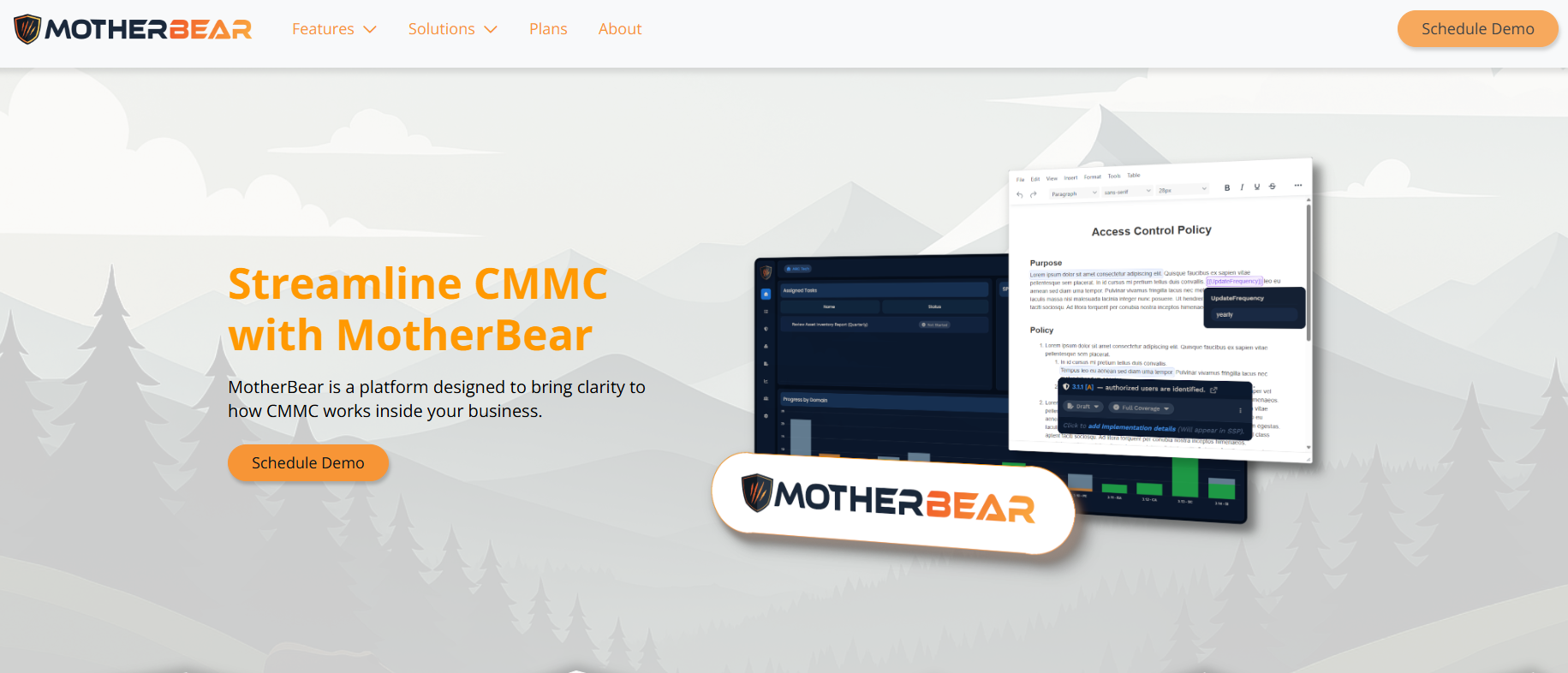
NIST 800-171 isn’t only an audit milestone; it’s an operating posture that needs owners, current evidence, and clean documentation to hold up when contract pressure rises.
[MotherBear](https://www.motherbearsecurity.com) gives defense contractors, managed service providers, and CMMC consultants a central place to run that work.
Teams can build SSP content, manage remediation tasks, and keep CMMC Level 2 preparation tied to the security controls that matter for assessment.
Instead of rebuilding the story before every review, teams can keep the program current while the work is still happening. The[MotherBear defense contractor solution](https://www.motherbearsecurity.com/solutions/defense-contractors) is built for that CMMC workflow, especially when organizations need evidence connected to assessment objectives.
Don’t let missing documentation or stale evidence slow a contract award.[Book a demo and see how MotherBear can keep your CMMC program organized from readiness through renewal](https://www.motherbearsecurity.com/schedule-demo).
## **FAQs About What Is NIST 800-171**
### **Who needs to be NIST-800-171-compliant?**
Organizations need NIST 800-171 when a federal contract, grant, or agreement requires it. CUI is the data that usually triggers the obligation, and for DoD work, CMMC Level 2 is the common path for government contractors.
### **How do I get a NIST 800-171 assessment?**
A NIST 800-171 assessment starts by defining the CUI boundary, then reviews implementation against the required security controls and collects supporting evidence. Defense suppliers may need a CMMC assessment, while other organizations may use self-assessment or contract-defined review.
### **What are the 14 families of NIST 800-171?**
The 14 control families cover access control, awareness and training, audit and accountability, configuration management, identification and authentication, incident response, maintenance, media protection, personnel security, physical protection, risk assessment, security assessment, system and communications protection, and system and information integrity.
They group related safeguards so organizations can assign owners and review evidence without treating every requirement as isolated.
## Ready to Manage NIST 800-171?
Schedule a demo of MotherBear to see how we can simplify compliance
[Schedule Demo](https://www.motherbearsecurity.com/schedule-demo)
## Read On
[](https://www.motherbearsecurity.com/blog/cmmc-for-defense-contractors)
### [CMMC for Defense Contractors: 2026 Compliance Guide](https://www.motherbearsecurity.com/blog/cmmc-for-defense-contractors)
Winning defense contracts increasingly depends on more than technical capabilities, pricing, and...
[](https://www.motherbearsecurity.com/blog/cmmc-certification-software)
### [How to Use CMMC Software: A Guide to Getting Certification](https://www.motherbearsecurity.com/blog/cmmc-certification-software)
Most defense contractors know they need to become CMMC-compliant to continue bidding on DoD...
[](https://www.motherbearsecurity.com/blog/cmmc-vs-fedramp)
### [CMMC vs FedRAMP: A 2026 Guide for Federal Contractors](https://www.motherbearsecurity.com/blog/cmmc-vs-fedramp)
Few compliance questions come up more often in federal contracting than this one: What's the...

#### Pages
[Home](https://www.motherbearsecurity.com)
[Plans](https://www.motherbearsecurity.com/plans)
[About](https://www.motherbearsecurity.com/about)
[Blog](https://www.motherbearsecurity.com/blog)
#### Features
[Requirements Tracking](https://www.motherbearsecurity.com/features/requirements-tracking)
[Documentation Builder](https://www.motherbearsecurity.com/features/documentation-builder)
[Evidence Repository](https://www.motherbearsecurity.com/features/evidence-repository)
[Task Management](https://www.motherbearsecurity.com/features/task-management)
#### Solutions
[For Defense Contractors](https://www.motherbearsecurity.com/solutions/defense-contractors)
[For Managed Service Providers](https://www.motherbearsecurity.com/solutions/managed-service-providers)
[For CMMC Professionals](https://www.motherbearsecurity.com/solutions/cmmc-professionals)
---
© 2026 Mother Bear Security, Inc. All rights reserved.
Privacy Policy
```json
{
"@context" : "https://schema.org",
"@type" : "BlogPosting",
"author" : {
"@type" : "Person",
"name" : "Nick Marteney",
"url" : "https://www.motherbearsecurity.com/blog/author/nick-marteney"
},
"dateModified" : "2026-07-15T00:59:17.198Z",
"datePublished" : "2026-07-15T00:59:17.000Z",
"headline" : "What Is NIST 800-171? A Brief 2026 Guide",
"image" : [ "https://www.motherbearsecurity.com/hubfs/undefined-Jul-15-2026-12-42-33-2280-AM.png" ],
"mainEntityOfPage" : {
"@id" : "https://www.motherbearsecurity.com/blog/what-is-nist-800-171",
"@type" : "WebPage"
},
"publisher" : {
"@type" : "Organization",
"logo" : {
"@type" : "ImageObject",
"url" : "https://www.motherbearsecurity.com/hubfs/mbs-logo-transparent-h128.png"
},
"name" : "Mother Bear Security"
}
}
```