Table of Contents
Demand for Cybersecurity Maturity Model Certification (CMMC) expertise is exploding, and the pool of qualified experts is nowhere near big enough to keep up. For firms already helping clients navigate compliance, that gap is a rare opening.
But credibility in this space isn't claimed, it's earned. The CMMC Registered Practitioner Organization (RPO) designation has become the marker clients look for when deciding who to trust with their CMMC compliance journey.
In this guide, we'll cover what a CMMC RPO is, what it takes to become one, and how to turn the designation into a scalable practice.
TL;DR
- A CMMC RPO is a consulting firm authorized by the Cyber AB to provide advisory and pre-assessment services, including gap assessments, documentation, and remediation guidance. RPOs prepare clients for certification but can't conduct official assessments.
- Becoming an RPO requires at least one Registered Practitioner on staff, a $6,000 application through the Cyber AB portal, a signed Code of Professional Conduct, and an organizational background check. The process takes roughly three weeks.
- Demand is outpacing supply. CMMC enforcement began in November 2025, Phase 2 raises requirements in November 2026, and the pool of qualified practitioners is nowhere near big enough to serve the contractors seeking help.
- The real revenue is recurring. Certification lasts three years, but controls, SSPs, and evidence must stay current, making continuous monitoring a retainer-based business model on top of project work.
- MotherBear gives RPOs one workspace to manage every client's controls, documentation, and affirmations, so firms can take on more engagements without scaling headcount at the same rate.
What Is a CMMC RPO?
A CMMC RPO is an organization that The Cyber AB (formerly the CMMC AB) has authorized to deliver consulting services and advisory support to companies working toward CMMC compliance.
You'll see the acronym expanded as both Registered Practitioner Organization and Registered Provider Organization, but they refer to the same designation.
RPOs deliver non-certified advisory services, meaning they guide clients through the certification process but don't perform official CMMC assessments themselves.
Their role is pre-assessment: identifying compliance gaps, guiding remediation, and preparing organizations for the formal evaluation that follows.
In practice, the RPO designation works as a trust signal, separating vetted firms from providers who simply claim CMMC expertise.
The CMMC Ecosystem
The CMMC ecosystem is built around defense contractors in the Defense Industrial Base (DIB). These are companies that handle Federal Contract Information (FCI) or Controlled Unclassified Information (CUI).
Known as Organizations Seeking Certification (OSCs), they must meet CMMC requirements to win and keep Department of Defense (DoD) contracts. Everyone else in the ecosystem exists to get them there.
Breakdown by Roles
Here's how the key roles compare:
|
Role |
Who it is |
What they do |
What they can't do |
|
RPO |
Consulting firm authorized by the Cyber AB |
Provide CMMC consulting, gap assessments, and pre-assessment preparation |
Conduct official assessments or issue certifications |
|
Registered Practitioner (RP) |
Individual credentialed by the Cyber AB |
Provide CMMC guidance and readiness support through an RPO |
Participate in formal assessments |
|
Registered Practitioner Advanced (RPA) |
RP with additional training and proven experience |
Lead more complex advisory engagements, particularly at CMMC Level 2 |
Participate in formal assessments |
|
C3PAO |
Certified Third-Party Assessment Organization |
Conduct official CMMC assessments and award certification |
Consult on preparation for clients they assess |
|
CCP / CCA |
Certified CMMC Professional / Certified CMMC Assessor |
Serve as official assessors on C3PAO assessment teams |
N/A |
For consulting firms, one line matters most. RPOs and RPs prepare defense contractors, while C3PAOs and their certified assessors conduct assessments.
In other words, an RPO can identify compliance gaps and guide remediation. However, the client must then go to a C3PAO for the actual assessment.
One recent change is worth knowing. As of April 2026, ISACA has taken over the CCP and CCA assessor certifications from the Cyber AB. So if your firm employs professionals holding or pursuing these credentials, their certification path now runs through ISACA.
What Services Can an RPO Provide?
RPO services cover everything a client needs before the formal assessment. The designation itself doesn't limit your service offerings to a fixed list. Instead, it authorizes your firm to provide advisory services throughout the full readiness process.
Most RPOs build their CMMC consulting around these core offerings:
- Scoping: Mapping where FCI and CUI live in a client's environment. This defines the assessment boundary and often shapes the entire engagement.
- Gap assessments: Measuring a client's current posture against the CMMC framework and identifying what falls short. This is the most common entry point for new clients.
- Documentation support: Developing a System Security Plan (SSP), Plan of Action and Milestones (POA&M), and related policies. Policy development is one of the most time-consuming parts of CMMC readiness.
- Remediation guidance: Helping clients close compliance gaps, from technical controls to process changes.
- Mock assessments: Running clients through a dress rehearsal before the C3PAO arrives. This reduces the risk of surprises during the real thing.
- Training: Educating client teams on certification requirements and their day-to-day security responsibilities.
The depth of these services depends on the CMMC level a client is pursuing. Level 1 involves 15 basic safeguarding requirements for FCI, and many contractors can self-assess. Level 2 is where most RPO work happens.
It requires all 110 controls from NIST 800-171, plus a formal assessment by a C3PAO. In fact, CMMC Level 2 is essentially a certification proving an organization follows NIST 800-171. That means firms already consulting on NIST 800-171 are doing RPO-shaped work, whether they hold the designation or not.
Why Consulting Firms Are Pursuing RPO Status in 2026
The short answer is timing. CMMC enforcement began on November 10, 2025, when self-assessment requirements started appearing in new DoD contracts.
Starting November 10, 2026, Phase 2 raises the bar: contracts handling CUI will require official Level 2 certification from a third-party assessor. That shift is pushing thousands of DoD contractors to seek outside help at the same time.
Meanwhile, the supply of qualified professionals hasn't caught up. The head of ISACA's CMMC program said in late 2025 that the number of practitioners is nowhere near sufficient to meet demand. For consulting firms, that imbalance means a seller's market in the entire defense supply chain.
There's also a credibility factor. Plenty of providers claim expertise in the CMMC standard, but defense contractors have learned to check for proof.
The RPO designation gives them that proof. It shows a firm has been vetted by the Cyber AB, appears in the official CMMC Marketplace, and operates under a binding code of conduct.
The firms best positioned to capture this demand are often the ones already doing the work.
Virtual Chief Information Security Officers (vCISOs), managed service providers (MSPs), and independent consultants offering readiness consulting, scoping, or gap assessments are already serving the defense sector.
For them, RPO status isn't a pivot. It's a formalization of services they already provide, with a designation that helps them win more of the market.
How to Become a CMMC RPO: Requirements and Application
The RPO application process runs through the Cyber AB and takes roughly three weeks, including the background check. Here's the path step by step.
Step #1: Employ at Least One Registered Practitioner
Every RPO must have a minimum of one RP on staff. This doesn't require a new hire. Many firms sponsor an existing team member through the process instead.
Earning the CMMC RP designation costs $600, which covers the application, training, and testing. Candidates complete training through an authorized provider, pass the course exam, and clear a commercial background check to earn RP status.
Step #2: Submit Your RPO Application
Once your RP is in place, register your organization through the Cyber AB portal. The application fee is currently listed at $6,000.
You'll need to provide business documentation showing ownership and good standing, along with proof of any insurance required under the current RPO agreement.
Step #3: Sign the Code of Professional Conduct and Pass the Organizational Background Check
Your firm must sign the Cyber AB Code of Professional Conduct and the RPO agreement. The Cyber AB then runs an organizational background check to verify your firm's legitimacy.
Violations of the code can lead to disciplinary action or revocation of RPO status, so treat these obligations as ongoing rather than a box to tick.
Step #4: Receive Authorization and Get Listed
After approval, your firm receives its official RPO designation. You'll be listed in the CMMC Marketplace, where OSCs search for the right CMMC partner, and you gain the right to display the official RPO logo.
What It Costs to Stay an RPO
The designation carries a $5,000 annual fee, and your RP's credential renews separately at $500. Factoring in training, insurance, and setup, most firms should budget between $10,000 and $30,000 for the first year.
Note that all Cyber AB fees are subject to change, so verify current pricing in the Cyber AB portal before applying. Even so, compare these costs to typical engagement revenue, which we'll cover next, and the math works out quickly for firms with even a small client base.
Inside an RPO Engagement: From First Call to Certification
Most client relationships follow the same arc. A defense contractor realizes a contract carries DoD requirements for CMMC, discovers how much work stands between them and compliance, and goes looking for help. Here's how the typical compliance journey unfolds from the RPO's side.
- It starts with scoping. Before anything else, you define where CUI and FCI live in the client's environment. This determines the assessment boundary and, by extension, the size of the entire engagement. Get scoping wrong, and every downstream step inherits the error.
- Then comes the gap assessment. You measure the client's current posture against the requirements for their target CMMC level and document every shortfall.
- Remediation is where the real work happens. Closing the gaps means implementing controls, rewriting policies, building the SSP, and managing the POA&M. Implementation support is the largest revenue driver for most RPOs.
- The final stretch is readiness. Mock assessments, evidence organization, and staff preparation come right before the handoff. Once the client is ready, they engage a C3PAO for the official assessment. Your job is to make sure there are no surprises when the assessors arrive.
A successful assessment isn't the end of the relationship, though. It's usually the start of a longer one, which brings us to the recurring side of the business.
Continuous Monitoring: The Recurring Side of CMMC Compliance
CMMC compliance doesn't end when the client passes their assessment. Certification lasts three years, but the controls, documentation, and evidence must stay current the entire time.
That creates a second business model for RPOs. Beyond project-based readiness work, firms offer continuous monitoring: tracking controls, updating the SSP, managing POA&M items, and collecting evidence year-round.
For consulting firms, this means predictable retainer revenue and clients who won't shop around when recertification approaches.
There's a catch, though. Continuous monitoring multiplies your workload with every client you sign. One client's evidence collection is manageable. Thirty clients, each with their own controls and documentation cycles, are a different animal.
So how do you scale the work without scaling headcount at the same rate?
Keep Every Client Contract-Ready With MotherBear
For an RPO, the hardest part of CMMC compliance isn't knowing the requirements. It's keeping control status, SSP records, and evidence current for dozens of clients at once, without letting anything disappear into spreadsheets and inboxes.
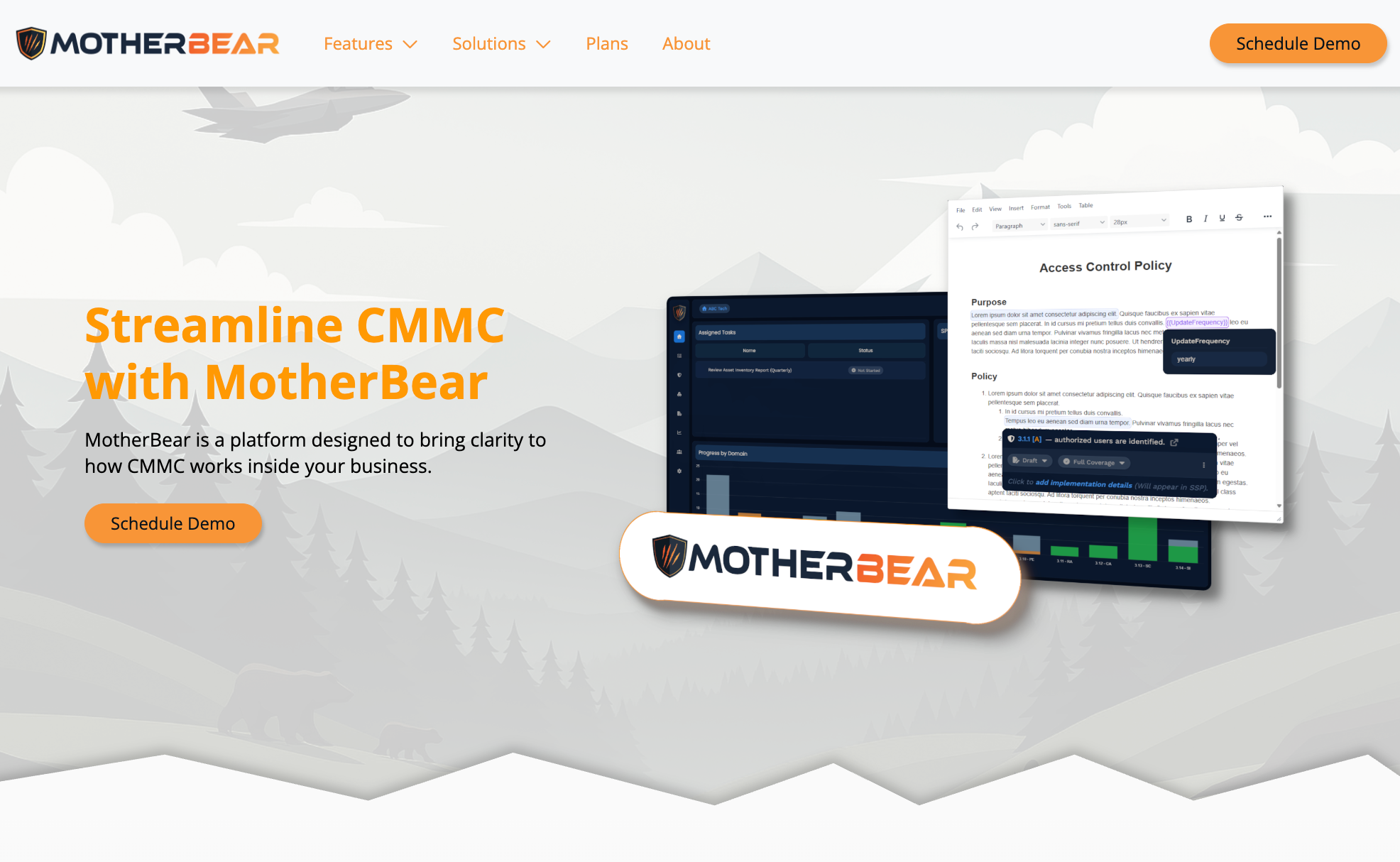
MotherBear is a CMMC compliance management hub built for defense contractors and the consultants who support them. Each client's controls, documentation, and affirmations live in one workspace, so your team can run more engagements without adding headcount to match.
Whether you're a two-person firm juggling 30 clients or a larger practice serving 100, scattered records create unnecessary risk.
Book a demo to see how MotherBear keeps your CMMC consulting practice organized for every client.
FAQs About CMMC RPO
What is an RPO for CMMC?
An RPO is a Cyber AB-authorized consulting firm that offers advisory and pre-assessment services to organizations working toward CMMC.
RPOs help clients with gap assessments, documentation, and readiness preparation. However, they cannot conduct official assessments or issue certifications.
How to become a CMMC RPO?
Your firm needs at least one Registered Practitioner on staff, an application submitted through the Cyber AB portal with the $6,000 fee, a signed Code of Professional Conduct and RPO agreement, and a passed organizational background check. The process takes roughly three weeks, and the designation renews at $5,000 per year.
What is a CMMC RPA?
A Registered Practitioner Advanced (RPA) is an RP who has completed additional training and demonstrated hands-on experience implementing the CMMC model. RPAs can lead more complex advisory engagements, particularly for clients pursuing CMMC Level 2.
What is the difference between an RPO and a C3PAO?
An RPO prepares organizations for CMMC through consulting, gap assessments, and readiness support. A C3PAO conducts the official CMMC assessment and awards certification. In short, RPOs get clients ready, while C3PAOs evaluate the results. Most contractors work with an RPO first, then engage a C3PAO for the formal assessment.