---
title: "CMMC Compliance Solutions: What They Are and How to Choose"
description: Learn what CMMC compliance solutions are, how they work, and how to choose one that fits you best. Discover what makes MotherBear stand out.
image: https://www.motherbearsecurity.com/hubfs/undefined-Jul-18-2026-02-05-53-6523-PM.png
---
[](https://www.motherbearsecurity.com/)
- Features
- [Requirements Tracking Understand how and why you meet requirements](https://www.motherbearsecurity.com/features/requirements-tracking)
- [Documentation Builder Tools to streamline creating Policies, Procedures and your SSP](https://www.motherbearsecurity.com/features/documentation-builder)
- [Evidence Repository Store evidence with ease and ensure you are audit ready](https://www.motherbearsecurity.com/features/evidence-repository)
- [Task Management Assign, track, and manage tasks across your team](https://www.motherbearsecurity.com/features/task-management)
- Solutions
- [For Defense Contractors Purpose built for the Defense Industrial Base](https://www.motherbearsecurity.com/solutions/defense-contractors)
- [For Managed Service Providers Simplify program management for you and your clients](https://www.motherbearsecurity.com/solutions/managed-service-providers)
- [For CMMC Professionals Use tools that help you provide the best value to your clients](https://www.motherbearsecurity.com/solutions/cmmc-professionals)
- [Plans](https://www.motherbearsecurity.com/plans)
- [About](https://www.motherbearsecurity.com/about)
[Schedule Demo](https://www.motherbearsecurity.com/schedule-demo)
# CMMC Compliance Solutions: What They Are and How to Choose
July 18, 2026
## Table of Contents
- [TL;DR](https://www.motherbearsecurity.com/blog/cmmc-compliance-solutions#tldr)
- [What Are CMMC Compliance Solutions?](https://www.motherbearsecurity.com/blog/cmmc-compliance-solutions#What-Are-CMMC-Compliance-Solutions)
- [The 4 Types of CMMC Compliance Solutions](https://www.motherbearsecurity.com/blog/cmmc-compliance-solutions#The-4-Types-of-CMMC-Compliance-Solutions)
- [Which CMMC Compliance Solutions Do You Actually Need?](https://www.motherbearsecurity.com/blog/cmmc-compliance-solutions#Which-CMMC-Compliance-Solutions-Do-You-Need)
- [Key Features to Look for in CMMC Compliance Software](https://www.motherbearsecurity.com/blog/cmmc-compliance-solutions#Key-Features-to-Look-for)
- [Simplify Your CMMC Compliance Journey With MotherBear](https://www.motherbearsecurity.com/blog/cmmc-compliance-solutions#Simplify-Your-CMMC-Compliance-Journey)
- [FAQs About CMMC Compliance Solutions](https://www.motherbearsecurity.com/blog/cmmc-compliance-solutions#faq)
Most organizations don't struggle with the Cybersecurity Maturity Model Certification (CMMC) because the security is beyond their scope.
They struggle because of the complexity: 110 controls, hundreds of evidence artifacts, documentation that has to satisfy an assessor, and a deadline set by someone else's contract.
[CMMC compliance](https://www.motherbearsecurity.com/blog/what-is-cmmc-compliance) solutions exist to shrink that complexity. The catch is that the term covers everything from software platforms and secure enclaves to consultants and the assessors themselves, and each addresses a different slice of the problem.
This guide sorts the market into its four real categories, shows which mix fits your situation, and covers what to look for before you commit.
## **TL;DR**
- CMMC compliance solutions fall into four categories: compliance software, secure environments and technical tools, advisory services, and C3PAO assessment services for evaluating results.
- Most Level 2 organizations combine several. A management platform, a scoped-down CUI environment, advisory support sized to internal expertise, and an assessor booked months ahead.
- The assessment boundary is the biggest cost lever. Shrinking where CUI lives reduces what you implement, document, and pay to have assessed.
- The right CMMC compliance software maps evidence to all 110 controls, generates the SSP and POA&M from live data, and keeps working after certification through continuous monitoring.
- [MotherBear](https://www.motherbearsecurity.com/schedule-demo) gives contractors and consultants one central place to build and store their entire CMMC program, from control status and evidence to documentation and annual affirmations.
## **What Are CMMC Compliance Solutions?**
CMMC compliance solutions are the products and services that help organizations achieve and maintain CMMC status, from the first scoping conversation through the assessment and every year thereafter.
The category is broad by necessity, because the compliance journey itself has distinct phases with distinct needs. Early on, the task is understanding your gaps. In the middle, it's implementing security controls and building documentation.
At the end, it's surviving a formal evaluation. After certification, it’s keeping everything current so the status holds. No single purchase covers all of that, which is why the market splits into the four types below.
While these solutions accelerate compliance, they don't transfer the obligation. The requirements belong to your organization, and if you're still working out whether they apply to you at all, start with our guide on who needs CMMC and come back once your level is clear.
## **The 4 Types of CMMC Compliance Solutions**
Every offering in this market falls into one of four categories. Most organizations pursuing CMMC end up combining at least two, so understanding what each one actually does is the first step toward an efficient path.
### **1. CMMC Compliance Software**
[CMMC compliance software](https://www.motherbearsecurity.com/blog/cmmc-compliance-software) is the management layer of the CMMC journey.
These platforms track control status against all 110 requirements of NIST 800-171, organize evidence collection, generate the System Security Plan (SSP) and Plan of Action and Milestones (POA&M), and keep documentation tied to the CMMC controls it proves compliance with.
Some platforms support related frameworks as well, so work done for CMMC maps onto other compliance requirements without having to start over.
What this category doesn't do is secure anything by itself. A platform won't encrypt your files or patch your servers. Its purpose is to turn a complex certification process into visible, assignable work and keep the proof organized enough that an assessor can follow it.
For defense contractors managing compliance in spreadsheets, this is usually the first upgrade that matters.
### **2. Secure Environments and Technical Tools**
This category is the machinery of protecting Controlled Unclassified Information (CUI): the systems that actually store, transmit, and defend the data.
It includes secure enclaves that isolate CUI from the rest of the network:
- File-sharing and secure communication tools built to protect Controlled Unclassified Information in motion
- Endpoint protection for the devices that touch it
- Cloud services hosted in environments that meet federal security baselines
The strategic value here is scope. CMMC assessments cover all in-scope systems, meaning everywhere CUI lives.
Moving CUI into a purpose-built enclave instead of retrofitting existing systems can shrink the assessment boundary dramatically, which is often the difference between certifying a small, controlled environment and dragging every production system your company runs through the evaluation.
For small and mid-sized organizations especially, a smaller boundary means lower cost at nearly every step, from implementing access control to gathering evidence.
### **3. Advisory Services**
Advisory services supply the expertise: consultants, Registered Provider Organizations (RPOs), and managed services teams that guide organizations through CMMC preparation.
Typical engagements include readiness assessments, gap analysis against your target CMMC level, remediation planning, documentation development, and mock CMMC assessments that pressure-test [CMMC readiness](https://www.motherbearsecurity.com/blog/cmmc-readiness) before the real thing.
The range runs from hourly consulting to fully managed programs where the provider operates most of the compliance function. Which end of that range fits depends on internal capacity.
For instance, a company with a capable IT team may only need someone to interpret the CMMC standards and review the SSP, while a ten-person machine shop with defense contracts may want the whole thing handled.
### **4. CMMC Assessment Services**
At the end of the road sit the organizations that judge the result.
For DoD contractors whose contracts require CMMC Level 2, achieving that status requires a formal assessment by a Certified Third-Party Assessment Organization (C3PAO). Its certified assessors examine documentation, test controls, and conduct stakeholder interviews with the people who run your systems.
Level 1 and some Level 2 contracts rely on self-assessment instead, but the formal assessments are what most people mean by "getting certified."
Two things make this category different from the other three.
1. It's not optional at the time of certification; every path to a Level 2 certificate runs through it.
2. It can't overlap with advisory: the same organization can't consult on your CMMC readiness and then assess the result, since the conflict-of-interest rules keep those roles separate.
Book early regardless, because assessor calendars fill months ahead, and DoD subcontractors waiting on a slot are effectively waiting on contract eligibility.
## **Which CMMC Compliance Solutions Do You Actually Need?**
The right mix depends on two things: what data you handle and what capacity you already have. Here's how the combinations typically break down.
### **Level 1: Federal Contract Information Only**
This is the lightest compliance scenario, reserved for contractors that handle [Federal Contract Information](https://www.motherbearsecurity.com/blog/what-is-fci) (FCI) but not CUI.
With 15 basic requirements and an annual self-assessment and affirmation submitted to the Supplier Performance Risk System (SPRS), most organizations manage with compliance software alone or even disciplined internal processes. Advisory help is optional, and no assessor is involved.
### **Level 2: Self-Assessment**
The controls jump to all 110 controls, so the workload is real even without an external evaluation.
Software earns its keep here by keeping control status and evidence organized, and a short advisory engagement to validate your scoping can prevent expensive false confidence.
### **Level 2: Certification Required**
This is the full-stack scenario for most organizations. A platform to run the program, technical tooling or an enclave if your CUI footprint needs shrinking, advisory support scaled to your internal expertise, and a C3PAO booked well ahead.
This is where most of the defense industrial base handling CUI lands, and where solution choices can become difficult. A tight assessment boundary makes the software cleaner, the advisory hours fewer, and the assessment experience shorter.
### **Already Certified**
Certification isn't the finish line. Continuous monitoring, annual affirmations, and up-to-date evidence all need a home, and audit findings from the next cycle are much cheaper to prevent than to remediate.
This is where compliance tools quietly shift from project software to permanent infrastructure.
**Note:** nobody needs everything. A company with a strong security stack may need only the management layer. One with a mature IT team may skip advisory entirely. Buy against your actual compliance gaps, which is exactly what a gap analysis at the start is for.
## **Key Features to Look for in CMMC Compliance Software**
If the management layer is your next purchase, you will find plenty of platforms that look similar at first glance. These are the features that separate tools built for CMMC from generic compliance software with a CMMC label.
### **Control-to-Evidence Mapping**
This is the core job. Every one of the 110 controls should connect directly to the policies, artifacts, and records that prove it, so an assessor can trace the chain without you narrating it.
If evidence lives in the platform but isn't tied to specific CMMC practice requirements, you've bought a fancier folder.
### **Documentation Generation**
The SSP and POA&M are living documents that assessors read closely. Platforms that build and update them from your actual control data save enormous rework compared to tools that treat documentation as an export afterthought.
### **Assessment Readiness Views**
You should be able to answer "how ready are we?" at a glance: which controls are implemented, which are in progress, and what's blocking the rest.
If producing that picture takes a meeting, the platform isn't doing its job.
### **Multi-Client Support**
This is essential for consultants and managed service providers (MSPs), but irrelevant for a single contractor. If you advise multiple organizations, the platform needs a clean separation between clients with a portfolio view over the whole roster.
This single feature decides whether the tool scales with a practice or caps it.
### **Fit With Your Existing Systems**
The platform should meet your environment where it is, including the everyday tools where evidence actually originates, whether that's Microsoft 365 or Google Workspace.
Rip-and-replace requirements are a red flag in a category whose whole purpose is reducing work.
### **Support Beyond the Certificate**
Look for continuous monitoring support, affirmation tracking, and evidence aging alerts.
A platform designed only for the sprint to certification will feel abandoned the day after you pass.
The platform should match how CMMC actually works, not adapt a generic framework to it. Tools built framework-first tend to treat CMMC as one checklist among many, and the difference shows the first time an assessor asks a question the platform never anticipated.
## **Simplify Your CMMC Compliance Journey With MotherBear**
Whatever mix of solutions your situation calls for, one problem is universal: the work has to live somewhere. Controls, evidence, documentation, and affirmations scattered among tools are how organizations that are technically CMMC-compliant still stumble at assessment time.
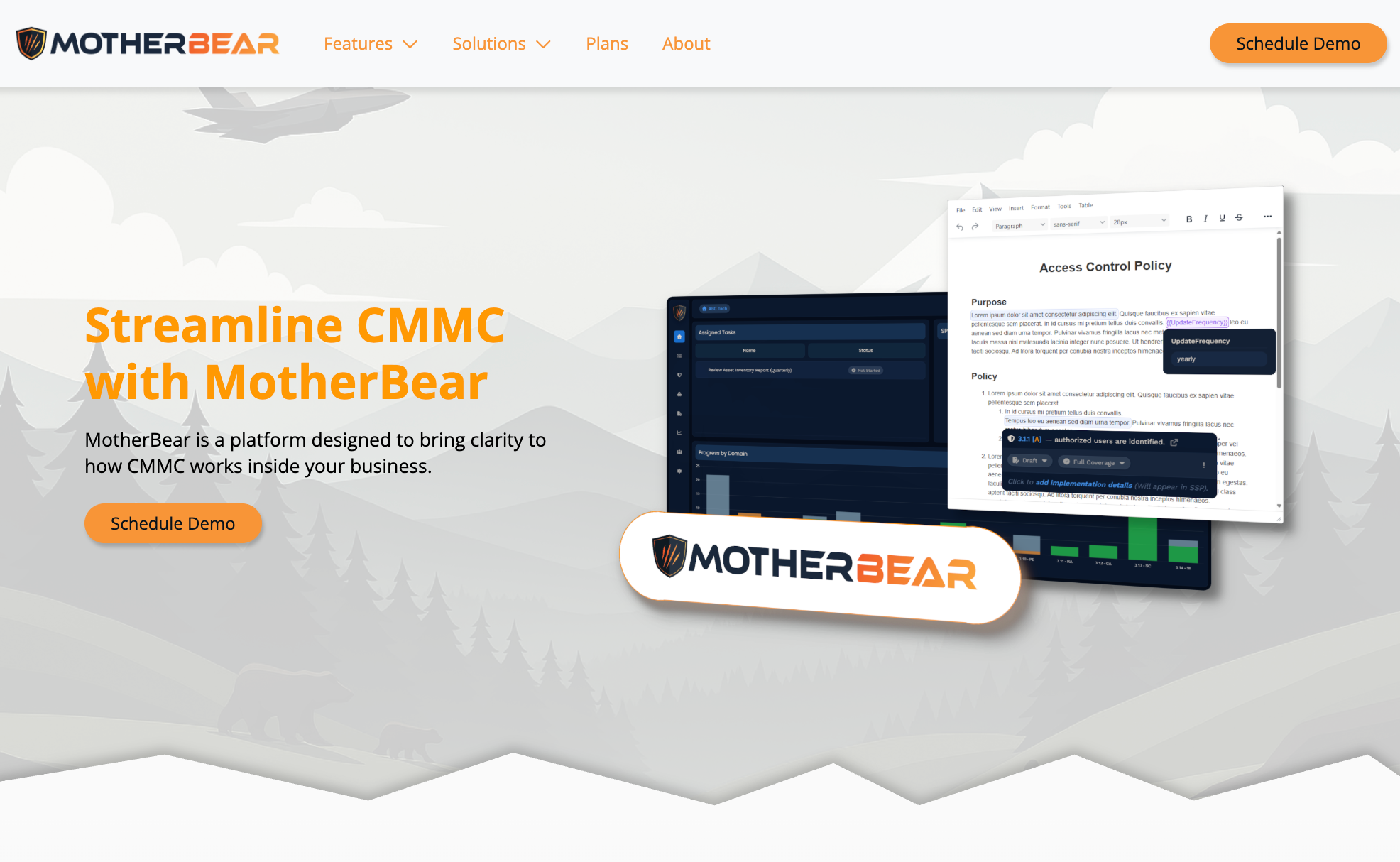
[MotherBear](https://www.motherbearsecurity.com/) is CMMC compliance software built as a central hub for creating and storing everything.
Control status, evidence, the SSP, and annual affirmations stay connected in a single workspace, mapped to the [CMMC requirements](https://www.motherbearsecurity.com/blog/dod-cmmc-requirements) your DoD contracts actually name, whether you're managing a single program or a full client roster.
Protecting CUI is the mission, but organized proof is what passes assessments.
[***Book a demo and see how MotherBear keeps your entire CMMC compliance journey in one place.***](https://www.motherbearsecurity.com/schedule-demo)
## **FAQs About CMMC Compliance Solutions**
### **What are the best software solutions to simplify CMMC compliance?**
The best platforms are CMMC-native rather than generic: they map evidence to all 110 controls, generate the SSP and POA&M from live data, show assessment readiness at a glance, and support continuous monitoring after certification.
### **What is the CMMC compliance program?**
CMMC is the Department of Defense's program for verifying that contractors handling FCI or CUI meet required cybersecurity standards. It has three levels, verified through self-assessment or third-party assessments depending on the sensitivity of the data and the contract requirements.
### **How much does CMMC compliance cost?**
It varies widely with scope. Level 1 can cost little beyond internal time, while a full Level 2 effort, covering remediation, tooling, advisory help, and the C3PAO assessment, commonly runs from tens of thousands of dollars into six figures.
The biggest cost lever is the assessment boundary: less sprawl in your CUI environment means less to implement, document, and assess.
### **Is CMMC compliance difficult?**
The security controls are established practice, so the difficulty isn't technical novelty. What makes the process hard is proof: implementing 110 controls consistently, documenting each one, and keeping evidence current under deadline.
Organizations with organized documentation find assessments manageable, while those without it struggle regardless of how secure they actually are.
## Need CMMC?
Book a demo of MotherBear to see if you can save time on your journey
[Schedule Demo](https://www.motherbearsecurity.com/schedule-demo)
## Read On
[](https://www.motherbearsecurity.com/blog/cmmc-services-and-tools)
### [CMMC Services and Tools: Category Guide](https://www.motherbearsecurity.com/blog/cmmc-services-and-tools)
Buying Cybersecurity Maturity Model Certification (CMMC) help isn't just a software decision....
[](https://www.motherbearsecurity.com/blog/cmmc-for-defense-contractors)
### [CMMC for Defense Contractors: 2026 Compliance Guide](https://www.motherbearsecurity.com/blog/cmmc-for-defense-contractors)
Winning defense contracts increasingly depends on more than technical capabilities, pricing, and...
[](https://www.motherbearsecurity.com/blog/cmmc-self-attestation)
### [CMMC Self-Attestation: What It Is and How to Get It Right](https://www.motherbearsecurity.com/blog/cmmc-self-attestation)
The word "self" does a lot of misleading work in Cybersecurity Maturity Model Certification (CMMC)...

#### Pages
[Home](https://www.motherbearsecurity.com)
[Plans](https://www.motherbearsecurity.com/plans)
[About](https://www.motherbearsecurity.com/about)
[Blog](https://www.motherbearsecurity.com/blog)
#### Features
[Requirements Tracking](https://www.motherbearsecurity.com/features/requirements-tracking)
[Documentation Builder](https://www.motherbearsecurity.com/features/documentation-builder)
[Evidence Repository](https://www.motherbearsecurity.com/features/evidence-repository)
[Task Management](https://www.motherbearsecurity.com/features/task-management)
#### Solutions
[For Defense Contractors](https://www.motherbearsecurity.com/solutions/defense-contractors)
[For Managed Service Providers](https://www.motherbearsecurity.com/solutions/managed-service-providers)
[For CMMC Professionals](https://www.motherbearsecurity.com/solutions/cmmc-professionals)
---
© 2026 Mother Bear Security, Inc. All rights reserved.
Privacy Policy
```json
{
"@context" : "https://schema.org",
"@type" : "BlogPosting",
"author" : {
"@type" : "Person",
"name" : "Nick Marteney",
"url" : "https://www.motherbearsecurity.com/blog/author/nick-marteney"
},
"dateModified" : "2026-07-18T14:54:07.207Z",
"datePublished" : "2026-07-18T14:54:07.000Z",
"headline" : "CMMC Compliance Solutions: What They Are and How to Choose",
"image" : [ "https://www.motherbearsecurity.com/hubfs/undefined-Jul-18-2026-02-05-53-6523-PM.png" ],
"mainEntityOfPage" : {
"@id" : "https://www.motherbearsecurity.com/blog/cmmc-compliance-solutions",
"@type" : "WebPage"
},
"publisher" : {
"@type" : "Organization",
"logo" : {
"@type" : "ImageObject",
"url" : "https://www.motherbearsecurity.com/hubfs/mbs-logo-transparent-h128.png"
},
"name" : "Mother Bear Security"
}
}
```