

Meeting Cybersecurity Maturity Model Certification (CMMC) requirements takes more than security tools. Defense contractors also have to scope their environment, document controls, close gaps, and prepare evidence. A CMMC consultant helps when the internal team lacks the time or expertise.
The catch is that "CMMC consultant" is a loose title. Anyone can claim it; the quality varies widely, and the wrong pick costs months and money. Choosing well is its own skill.
This guide is a practical walkthrough: what a CMMC consultant does, the signs you need one, what to look for, what it costs, and the red flags that separate a real partner from a résumé.
TL;DR
- A CMMC consultant guides a defense contractor through readiness, from scoping and a gap assessment to documentation, remediation, and preparing for the formal assessment.
- A title alone does not establish expertise. Check relevant credentials, CMMC-specific experience, and references from comparable projects.
- Match the consultant to your CMMC level and the services you actually need, and get the scope and documentation ownership in writing.
- A consultant who helped you prepare cannot run your Level 2 third-party assessment, so plan the two engagements as separate steps.
- MotherBear gives consultants and defense contractors a shared workspace for organizing requirements, evidence, and documentation, with separate records for each client program.
What Does a CMMC Consultant Do?
A CMMC consultant is an advisor who takes a defense contractor from "we have a requirement" to "we can prove we meet it." It is one shape of CMMC compliance support, distinct from a managed service provider that runs your systems or a third-party assessor that grades them.
Good CMMC consulting is practical work, not a lecture. The engagement usually spans a few core services, and understanding them is the first step in knowing what you are buying.
CMMC Readiness and Gap Assessment
The work almost always starts with a readiness assessment, part of the CMMC readiness services most consultants lead with.
The consultant scopes where Federal Contract Information (FCI) and Controlled Unclassified Information (CUI) live, then runs a gap assessment against your required level to identify gaps.
That initial assessment is the map for everything after it. It tells you how far you are from compliance and roughly what closing the distance will cost.
Documentation and Ongoing Support
From there, CMMC consulting services usually include documentation development and remediation. For Level 2, the consultant helps develop the System Security Plan (SSP), draft policies, and guide the technical implementation that will close compliance gaps.
That technical remediation covers the security controls and technical controls your level requires, from access control and multi-factor authentication to logging, each tied to the CMMC requirements an assessor checks.
Many also offer assessment support and ongoing support after the work is done. Since programs decay once the deadline pressure lifts, that continuing help is often what keeps a contractor compliant between cycles.
Signs You Need a CMMC Consultant
Not every contractor needs one. A larger firm with a capable IT team and real security staff can sometimes run readiness in-house, especially at Level 1.
Many contractors, from small subcontractors to prime contractors, do not have that depth. Department of Defense (DoD) contractors without dedicated security expertise may need outside support, particularly at Level 2, where the 110 requirements make preparation more demanding.
A few signs point toward bringing in help:
- CUI is in scope: Level 2 and its 110 requirements are a steep climb for a team doing it for the first time.
- No security lead: When CMMC lands on people who already have full-time jobs, expert guidance saves more than it costs.
- A deadline is close: A solicitation naming a required level leaves little room to learn the standard from scratch.
- Past gaps keep reopening: If self-assessment scores never seem to hold, a consultant can find the structural cause.
If two or more of these fit, the question is less whether to hire and more how to choose the right CMMC consultant.
As of November 2026, CMMC Phase 2 remains suspended, while Phase 1 self-assessment requirements continue. Before hiring, confirm what your current contracts require and whether the proposed work supports those obligations.
A good consultant should also explain how the engagement will adapt if the rollout changes.
How to Choose a CMMC Consultant
This is where buyers go wrong, usually by hiring on price or a familiar name. A better approach weighs a few specific things, because the goal is a consulting partner who leaves you stronger, not dependent.
Look for CMMC-Specific Expertise
General cybersecurity experience is not the same as CMMC expertise. Plenty of capable cybersecurity services firms have never taken a contractor through the program.
CMMC has its own rules, scoping logic, and evidence expectations that general cybersecurity standards do not spell out. A consultant should explain how the CMMC standards and wider DoD cybersecurity requirements apply to your environment.
Ask how many contractors the consultant has guided, and at what level. Then check for Cyber AB recognition, such as a Registered Practitioner (RP) or a Registered Practitioner Organization (RPO), formerly called a Registered Provider Organization.
These designations are a useful starting point, not a guarantee. A Registered Practitioner completes Cyber AB training, and an RPO meets the body's registration requirements, including employing at least one RP.
Evaluate the qualifications of the people assigned to your project, not just the firm’s registration. CCP or CCA credentials are useful indicators, but ask for evidence of implementation experience relevant to your environment.
For Level 2 work, ask about Registered Practitioner Advanced (RPA) training and demonstrated experience implementing National Institute of Standards and Technology (NIST) 800-171 controls, since credentials alone do not establish delivery quality.
Check the named practitioner and the firm separately in the Cyber AB Marketplace.
Check the CMMC Consulting Services and Scope
Advisory, implementation, and ongoing work are different kinds of compliance support, and a vague proposal hides which one you are getting. Confirm in writing whether the consultant covers documentation development, technical remediation, and assessment support, or only advice.
Settle documentation ownership while you are at it. Your contract should give you the SSP, policies, evidence, and other deliverables, and your team should be able to update and export those records after the engagement ends.
Match the Consultant to Your CMMC Level
The right fit depends on what your DoD contracts require. A Level 1 program built to handle Federal Contract Information is a lighter engagement than a Level 2 program that has to protect Controlled Unclassified Information and document it to assessment standards.
If your contract requirements allow a self-assessment, a consultant still adds value by validating it before it affects your contract eligibility.
If an external service provider touches your CUI or security protection data, the consultant should also understand how that provider fits your scope. A consultant who has only done Level 1 work may be the wrong choice for a Level 2 program.
Compare What Each Consultant Will Deliver
The cleanest way to decide is to ask every consultant for the same things and put the answers side by side. Request these before you sign:
|
What to check |
What to request |
|
Credentials |
Current credentials for the assigned practitioners and verification of any claimed Cyber AB registration |
|
Experience |
Client references and examples of completed Level 2 projects |
|
Deliverables |
A sanitized sample SSP, POA&M, evidence mapping, and gap assessment report |
|
Responsibility |
A written split of work between the consultant, your IT team, and any service providers |
|
Pricing |
Separate costs for scoping, documentation, technical remediation, assessment preparation, and ongoing support |
|
Handoff |
Confirmation that documents, evidence, and records stay accessible after the engagement |
The handoff and responsibility rows are where tooling shows. Ask how the consultant will organize your requirements, evidence, and deliverables, and whether you keep visibility and access throughout.
What CMMC Consulting Costs
The first question is usually, how much does CMMC consulting cost? There is no single answer. The CMMC consulting cost depends on your scope, your current security posture, your required level, and how much remediation the gap assessment uncovers.
Pricing usually takes one of two shapes. A fixed-price engagement covers a defined piece of work, such as a readiness assessment, while hourly or retainer billing suits open-ended remediation and ongoing support.
Judge value by fit, not just the number. The cheapest proposal that leaves gaps open is more expensive than it looks, since a failed assessment and a re-engagement cost far more than doing it once.
Red Flags to Watch For
Some warning signs show up before you sign. These are worth treating as reasons to keep looking:
- Guaranteed results: No honest consultant promises a passing status, since the assessment is not theirs to decide.
- No relevant examples: A firm cannot explain its role in preparing clients for CMMC assessments or provide comparable project references.
- Owning your documents: Deliverables you cannot access or maintain without them create lock-in, not compliance.
- No conflict-of-interest answer: A consultant should know they cannot run your Level 2 third-party assessment after advising you.
That last point matters most. Under the program's conflict rules, the same firm cannot both consult for you and perform your independent assessment within three years, so keep readiness and the formal assessment in separate hands.
Staying CMMC Compliant With the Right Partner
A good consultant leaves the contractor prepared to maintain compliance, whether the engagement ends after assessment preparation or continues through ongoing support. Achieving compliance is a milestone in a longer compliance journey, not the end of it.
Steady CMMC practices become a competitive advantage too, since primes screen subcontractors throughout the defense supply chain on security before they award defense contracts.
Keeping CMMC Compliance Current Between Assessments
Staying CMMC compliant requires continuous monitoring, current documentation, and organized evidence as systems change. A consultant should leave clear responsibilities and review schedules for this ongoing compliance work.
This is where the right tooling shows. Many consultants run their clients' programs in a shared workspace that keeps requirements, evidence, and status in one place, which also gives you visibility into your own compliance between assessments.
When you evaluate a consultant, ask how they will keep your program organized and how you will see its state. The answer tells you whether you are buying a lasting program or a one-time project.
Bring Clarity to Your CMMC Program With MotherBear
Choosing a good CMMC consultant is half the job. The other half is a program that stays organized once the work begins, so the sensitive information behind every requirement is accounted for, not scattered in a spreadsheet or someone's inbox.
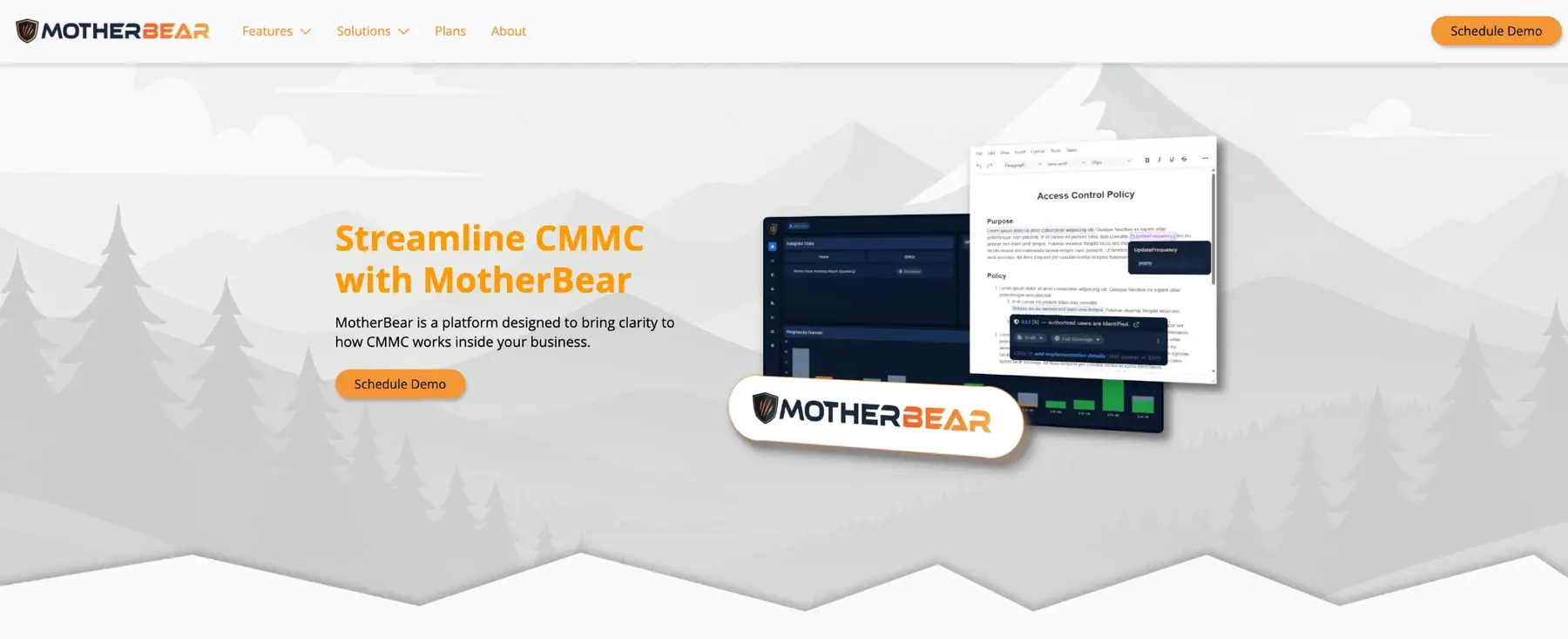
MotherBear is built for exactly that. It gives contractors and the consultants who serve them one workspace built around the NIST 800-171 standard.
It tracks each requirement's status, stores evidence against the requirement it proves, manages documentation, and turns gaps into remediation tasks with owners.
For a consultant, it keeps every client's program separate and current, so a growing roster never turns into a stack of disconnected files. For a contractor, it means you can always see where your own compliance stands.
If you are a consultant, that shared view is how you deliver readiness that holds. If you are hiring one, it is a fair thing to expect from a partner worth keeping.
FAQs About How to Choose a CMMC Consultant
Who are the best CMMC consultants?
There is no single best CMMC consultant, since the right fit depends on your level, your industry, and the services you need. The strongest candidates combine real CMMC experience with Cyber AB recognition, such as Registered Practitioner status.
Instead of chasing a name, evaluate each consultant on their track record with contractors like you, the clarity of their scope, and how they hand off documentation. The best choice is the one that leaves your program provable and maintainable.
How much do CMMC consultants make?
CMMC consultant earnings vary with experience, credentials, and whether they work independently or for a firm serving the defense industrial base.
For a contractor, the more useful figure is the engagement cost, which depends on your scope and remediation needs, not the consultant's salary.
What are the 5 C's of consulting?
There is no universally accepted set of five C's for consulting. One commonly referenced framework comes from marketing analysis: company, customers, competitors, collaborators, and context.
When choosing a CMMC consultant, focus on qualifications, the agreed scope, specific deliverables, documentation ownership, and assessment independence.
What is the average fee for a consultant?
Fees vary too widely to quote a single average, since CMMC consulting cost tracks scope, level, and environment size. A focused readiness assessment is often a fixed price, while remediation and ongoing support are billed hourly or on retainer.
The better question is what the fee covers. A clear scope that names the deliverables and who owns them matters more than the headline rate.