
Cybersecurity Maturity Model Certification (CMMC) Level 2 has two official assessment paths: Level 2 (Self) and a certification assessment conducted by a CMMC Third-Party Assessment Organization (C3PAO), which produces Level 2 (C3PAO).
Both can produce a CMMC status, but only the C3PAO route is a certification assessment and results in a Certificate of CMMC Status.
For Department of Defense (DoD) contractors throughout the defense supply chain, the first step is checking which Level 2 status the contract requires. Both assessment paths evaluate the same 110 Level 2 requirements.
Since July 2026, new requirement documents can designate only a Level 2 self-assessment, although contractors may voluntarily pursue a C3PAO certification assessment.
This guide covers both: the full route to a Level 2 status, and which parts of it are available right now.
TL;DR
- Level 2 generally applies to contracts requiring protection of Controlled Unclassified Information (CUI), but the solicitation or contract establishes the required level and assessment type.
- Level 2 has two assessment paths: Level 2 (Self) and Level 2 (C3PAO). Both assess the same 110 requirements, but only the C3PAO path is a certification assessment.
- Since the July 2026 Phase 2 suspension, new requirement documents may designate only Level 1 (Self) or Level 2 (Self). Voluntary third-party assessments remain available to contractors who want one.
- A Final Level 2 status is current for three years with annual affirmations. With Conditional Level 2 status, eligible Plan of Action and Milestones (POA&M) items must be closed within 180 days or the status expires.
- MotherBear keeps requirement status, documentation, evidence, and remediation work in one workspace, so the record behind a Level 2 status stays current between assessments.
What CMMC Level 2 Certification Actually Is
CMMC uses Level 2 for two different status paths. A successful self-assessment produces Final Level 2 (Self). A successful certification assessment performed by an authorized C3PAO produces Final Level 2 (C3PAO) and a Certificate of CMMC Status.
Both statuses attach to a defined CMMC Assessment Scope and appear in the Supplier Performance Risk System (SPRS).
The status, not a company-wide badge, is what matters for contract eligibility. A status tied to one assessed environment does not automatically cover a different system boundary used for another contract.
Level 2 runs on a three-year cycle, with an affirmation from an affirming official at assessment and annually thereafter confirming the controls remain in place.
How Level 2 Fits Into CMMC
CMMC has three levels. Level 1 applies to Federal Contract Information (FCI). Organizations at this level must meet 15 basic safeguarding requirements and complete an annual self-assessment.
Level 3 adds selected enhanced requirements and a government-led assessment for a narrow set of programs where advanced persistent threats and national security concerns drive the bar higher.
Level 2 sits between them and applies to contracts requiring protection of CUI on contractor systems, which is why it draws on an established federal standard and does not invent one.
Within the defense industrial base, it is the level tied to CUI work.
Where CMMC 2.0 Terminology Fits
You will see the program called CMMC 2.0. The label stuck when the DoD consolidated an earlier five-level model into three, and it is a naming convention, not a separate standard.
The rule in force is 32 CFR Part 170. When a source describes Level 2 under CMMC 2.0, it is describing the same CMMC framework and the same requirements covered here.
The CMMC program did not write those security requirements. It verifies that existing ones are implemented, which is why the standard behind Level 2 predates the program itself.
Knowing what the status is leaves the question of whether you need one.
When CMMC Level 2 Applies to Your Contract
The solicitation or contract establishes the required CMMC level and assessment type. Prime contractors flow the requirement to subcontractors alongside the data.
In general, contracts involving CUI point to Level 2, while FCI-only work points to Level 1, but the clause is the controlling requirement.
This is why DoD contracts rarely leave the level to interpretation. Contractors should not self-assign a level based solely on what they believe their systems handle.
Company size does not decide this. A twelve-person machine shop whose systems handle controlled unclassified information faces the same 110 requirements as a much larger firm, and contractors can easily misjudge that.
Read the clause instead of inferring from what you believe you hold, and raise ambiguity with the contracting officer before building a plan around a guess.
With applicability settled, the next question is which route you are on.
The Two Paths to a Level 2 Status
Level 2 was designed with two assessment types. Both evaluate the same 110 requirements against the same assessment objectives, so neither is a lighter standard.
What separates them is who performs the evaluation and how the result reaches the DoD.
Level 2 Self-Assessment
In a self-assessment, your organization evaluates its own implementation, scores the result, and submits it to SPRS, followed by an affirmation from the affirming official.
The accuracy obligation is identical to the third-party path. A submitted score is a representation to the government, and the self-attestation behind it carries real exposure if it is wrong.
Self-assessments run on the same three-year cycle, with annual affirmations between them.
Level 2 Certification Assessment
An authorized C3PAO conducts a certification assessment, examining documentation, interviewing the people responsible, and testing controls before issuing a result.
The difference is procedural and independent, not a different requirement set. A C3PAO evaluates implementation through the formal assessment process using examine, interview, and test methods, then records the certification assessment results through the CMMC reporting path.
A provider that helped prepare the organization may also face conflict-of-interest restrictions on participating in the certification assessment.
Assessors are authorized through the Cyber AB, which serves as the CMMC Accreditation Body. Third-party certification is therefore not something a consultant can issue, however closely they worked on the readiness effort.
Choosing an assessor is its own exercise, and the guidance on third-party assessment organizations covers what to look for.
What Changed in 2026
On July 13, 2026, the DoD suspended the Phase 2 transition along with pending and future implementation milestones, pending a task force review.
The practical effects are specific:
- Designations are limited: Requirement documents can specify Level 1 (Self) or Level 2 (Self), but not Level 2 (C3PAO).
- Waivers are unavailable: The suspension covers them, since they would only excuse assessments that are already paused.
- Existing contracts keep their terms: A contracting officer removes or revises the requirement by modification.
- Phase 1 obligations continue: Self-assessments, SPRS submission, and annual affirmation all stand.
- Voluntary assessments remain open: Contractors who want an independent result on the record can still engage a C3PAO.
No public outcome from the task force and no replacement date for Phase 2 had been announced as of October 2026, so the phased rollout is not running on its published calendar.
What that means for future contracts is unsettled, which is an argument for readiness, not against it. The program rollout dates are tracked separately from your own readiness.
So the honest answer to how you get a Level 2 status today is that one path is being designated in contracts and the other is available by choice. Organizations that want to achieve certification during the pause can still pursue a voluntary C3PAO assessment.
The underlying 110 requirements and assessment objectives are the same, but the assessment process, assessor independence, and reporting path differ.
What CMMC Level 2 Compliance Requirements Cover
CMMC Level 2 incorporates all 110 security requirements from National Institute of Standards and Technology (NIST) 800-171 Revision 2, as required by 32 CFR Part 170. Those requirements exist to protect controlled unclassified information on nonfederal systems.
The requirements fall into 14 families covering areas such as access control, configuration management, incident response, media protection, personnel security, physical protection, risk assessment, communications protection, and system and information integrity.
Behind those families sit familiar security controls: limiting system access to authorized users, restricting physical access to equipment, responding to security incidents under a documented process, and assessing security risks on a defined cadence.
Most are recognizable security practices, not exotic ones. Implementation also has to be demonstrable through the applicable assessment methods, which makes documentation and supporting evidence part of Level 2 readiness from the start.
That is what connects an organization's security posture to its assessment result.
The CMMC Requirements and 320 Assessment Objectives
Associated assessment objectives, 320 in total, determine each of the 110 requirements. A requirement is MET only when every applicable objective is satisfied.
If an applicable objective is NOT MET, the requirement is generally NOT MET, and the Level 2 scoring methodology then applies the requirement's point value.
That granularity is why partial implementation tends to surface late. A control can be largely in place and still fail on one objective nobody mapped, which the NIST 800-171 assessment objectives set out in detail.
Scoring and the CMMC Assessment Result
The Level 2 score starts at 110. Requirements assessed as NOT MET generally deduct one, three, or five points, subject to the limited partial-scoring rules defined in the CMMC methodology.
Final status requires a score of 110 and an affirmation of compliance. A score of at least 88 can support Conditional Level 2 status, but only when every remaining NOT MET requirement is eligible for a CMMC POA&M.
Conditional status starts a 180-day countdown from the status date to close every open item and pass a closeout assessment. Clear it and the status converts to Final.
Miss it, and the contract eligibility that depends on the status is at risk, which is why the assessment date belongs on the program calendar and not in someone's inbox.
POA&M eligibility is narrow. Generally, only one-point requirements qualify, with specific exclusions named in the rule and a limited exception for the CUI encryption requirement where encryption is employed but not Federal Information Processing Standards (FIPS) validated.
Therefore, you cannot engineer a Conditional status by postponing the hard parts.
With the standard clear, the sequence to reach it follows.
The Level 2 Certification Process Step by Step
There is no official DoD method for getting to Level 2, so the order below reflects what tends to save rework. Each step in the CMMC process produces something the next one needs.
It is a detailed process, though not a complicated one, and the assessment process at the end measures what the earlier steps built.
- Establish the assessment scope: Trace where CUI enters, moves, and rests, then classify assets, since everything downstream inherits this boundary.
- Run a gap analysis: Assess all 110 requirements at the objective level to identify gaps in your current cybersecurity practices, producing a record of compliance gaps and not a summary by family.
- Build a remediation plan around dependencies: Close foundational items such as identity and boundary protection before the work that assumes them, letting dependency drive the order ahead of score.
- Build the security plan and evidence set: Record how each implemented control meets its requirement in the System Security Plan (SSP), and capture the supporting evidence at the same time.
- Validate readiness: Measure the environment against the same objectives an assessment applies, confirming you can demonstrate compliance and not merely describe it.
- Complete the assessment: Follow the path your contract requires, whether that is a scored self-assessment or an engagement with a C3PAO.
- Record the result and affirm: For Level 2 (Self), submit results to SPRS. For Level 2 (C3PAO), the assessor submits results through Enterprise Mission Assurance Support Service (eMASS) for transmission to SPRS. Both paths require the affirming official’s affirmation.
The phased implementation roadmap covers how those stages fit together over a whole program.
Reaching a status is not the end of the obligation, though.
Maintaining CMMC Compliance After the Assessment
A Level 2 status describes an environment on a date. Environments change, and the status does not update itself.
That makes documentation upkeep a continuing part of compliance efforts, not a closing task.
New systems, new contracts, new providers, and new CUI categories all shift the picture an assessment captured, which is why scope review belongs in the operating rhythm and not in the month before a reassessment.
Maintaining CMMC compliance becomes harder when scope, systems, providers, or CUI flows change without corresponding updates to the SSP and evidence set. Keeping those records current as the environment evolves requires ongoing attention.
Staying CMMC-Compliant Between Assessments
Three things keep a status honest between assessments. The annual affirmation has to reflect reality, the SSP has to describe the current environment, and evidence has to stay current enough to show the security measures still operate.
Keeping records current as work happens reduces the amount of reconstruction required before the next assessment. For compliance teams, that is the practical difference between maintaining compliance and restarting cybersecurity compliance as a project.
You retain artifacts used as assessment evidence for six years from the CMMC Status Date, so settling where that evidence lives early saves reconstructing it later.
Automated evidence collection can reduce the manual load where volume is high, though the discipline of filing each artifact against the requirement it proves matters more than the mechanism.
Treating this as ongoing work keeps the record assembled and ready for the next security assessment.
How MotherBear Supports Your Path to CMMC Level 2
Reaching Level 2 produces a large and interconnected set of records: the status of each of the 110 requirements, the evidence behind each one, the SSP describing implementation, and the open items still outstanding.
Spreadsheets and shared drives carry that for a while. They become a significant challenge when someone asks which requirements are met today and what demonstrates each one.
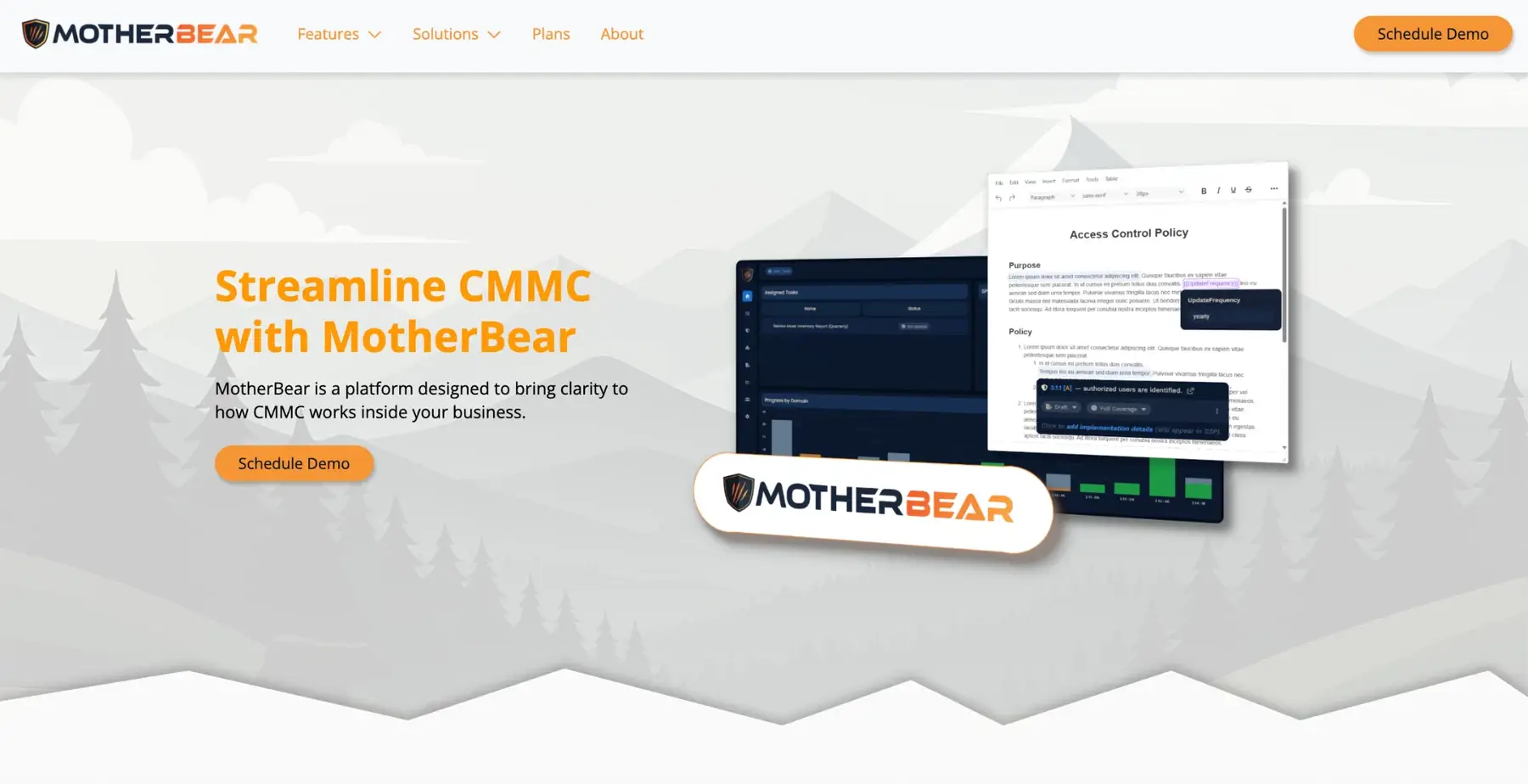
MotherBear gives defense contractors and the consultants who support them one workspace for requirement status against NIST 800-171, supporting evidence, SSP and policy documentation, and remediation tasks with named owners and deadlines.
For consultants taking several contractors through Level 2 at once, each client's status, documentation, and open items stay separate while remaining manageable from one place.
The effect is that the record behind your status stays current instead of being rebuilt before each cycle.
Book a demo to see how MotherBear keeps Level 2 evidence and documentation in step.
FAQs About How to Get CMMC Level 2 Certification
How much does it cost to get CMMC Level 2 certified?
Third-party assessment pricing varies substantially with scope, locations, complexity, and assessor. Industry estimates place Level 2 certification assessments in the tens of thousands of dollars, with some engagements reaching $100,000 or more.
Self-assessments carry no assessor fee. Remediation, consulting, tooling, and internal labor are separate costs and can materially exceed the assessment fee when significant gaps exist.
How long does it take to get CMMC Level 2 certification?
There is no standard CMMC Level 2 implementation timeline. Organizations with a mature NIST 800-171 program may reach assessment readiness in months, while environments with major scoping, technical, or documentation gaps can take substantially longer.
The gap assessment and remediation backlog are the best basis for estimating your own timeline. Assessor availability adds lead time where a third-party assessment is involved.
Is CMMC Level 2 still required?
Yes, where a contract requires it. The program is codified in 32 CFR Part 170 and reaches contracts through Defense Federal Acquisition Regulation Supplement (DFARS) clauses.
The July 2026 suspension paused the Phase 2 transition and narrowed which assessment types can be newly designated, but it did not repeal the program or cancel existing contractual obligations. Contractors under a CMMC clause remain bound by it until a modification says otherwise.
Can you self-assess CMMC Level 2?
Yes, and under current conditions it is the path being designated in new requirement documents. Level 2 was designed with both self-assessment and third-party paths, and during the Phase 2 suspension, only Level 1 (Self) and Level 2 (Self) may be specified.
A self-assessment evaluates the same 110 requirements, so it is not a reduced standard, and the affirmation behind it carries the same accuracy obligation.