
Cybersecurity Maturity Model Certification (CMMC) Level 2 compliance means implementing and maintaining the safeguards for Controlled Unclassified Information (CUI). The contract specifies when Level 2 status is required and which assessment path applies.
It is also more than a test passed once. Compliance is a sustained state: the security controls are implemented, written down, verified, and kept current as the environment changes.
This guide explains what Level 2 compliance consists of, who it binds, and how a contractor reaches and holds it. It stays on what compliance is, and points to separate guides for the family-by-family controls and the step-by-step assessment route.
TL;DR
- CMMC Level 2 compliance means meeting all 110 NIST 800-171 Revision 2 requirements that protect CUI, and the contract decides when it applies.
- Compliance rests on four things: implemented security controls, a System Security Plan, verified evidence, and ongoing maintenance.
- The 110 requirements contain 320 assessment objectives in total. Each requirement is MET only when all its applicable objectives are satisfied.
- Since the July 2026 suspension of Phase 2, new requirement documents may designate only self-assessment paths, while Phase 1 obligations and annual affirmations continue.
- MotherBear keeps requirement status, documentation, evidence, and remediation work in one workspace, so a Level 2 record stays current between assessments.
What Is CMMC Level 2 Compliance?
CMMC Level 2 compliance is the state of meeting all 110 security requirements that protect CUI on a contractor's systems, and being able to prove it. Level 2 is the advanced level of the CMMC program.
The requirements come from National Institute of Standards and Technology (NIST) 800-171 Revision 2, which the CMMC program rule specifies for Level 2. Control implementation must match the assessment objectives.
Compliance is also measured finely. Every requirement breaks into assessment objectives, 320 in total, and a requirement is met only when each applicable objective is met. Full implementation of each requirement is the goal, and partial implementation counts as a gap.
That is the difference between compliance and a status. A CMMC status is the recorded result on a date, while compliance is the condition that the result reports, and it has to hold between assessments as systems change.
Where Level 2 Sits Among the CMMC Levels
Level 2 is one of three CMMC levels, and the data an organization handles decides which applies.
Level 1 covers Federal Contract Information (FCI) with 15 basic safeguards. Level 2 covers CUI with the full 110 requirements. Level 3 adds selected enhanced requirements for a small set of programs facing advanced threats.
The required CMMC level depends on the data and the contract, not the size of the organization, so a contractor handling CUI is at Level 2 whether it is small or large. The CMMC levels guide compares all three, and the Level 1 versus Level 2 breakdown covers the jump in detail.
Who Must Meet Level 2 Compliance
Level 2 applies when a defense contract or subcontract requires that status for systems processing, storing, or transmitting CUI.
A Department of Defense (DoD) solicitation or contract names the required level, and prime contractors flow that requirement down to subcontractors handling the same data. Company size does not change it, so a small shop faces the same CMMC requirements as a large prime.
The stakes are contract eligibility. Without the required status on record, an organization can be ruled out before its bid is read, which is why these DoD CMMC requirements now sit at the center of how defense work is won.
The Security Controls Behind Level 2 Compliance
The core of Level 2 compliance is the security controls themselves. The 110 requirements are grouped into 14 families in NIST 800-171, each covering one area of protection.
Together, they span access control, configuration management, incident response, media protection, and system integrity, among others.
They are not equal in size. Access control and system and communications protection contain 38 of the 110 requirements, which makes them two of the largest families to implement and evidence.
A few families show the range:
- Access control: Restricting system access to authorized users and applying least privilege
- Incident response: Detecting, reporting, and handling security incidents under a documented plan
- System and information integrity: Catching flaws, malware, and tampering before they spread
The System Security Plan and Documentation
Implementing the security controls is only part of Level 2 compliance. Contractors must also document their systems and control implementations in a current System Security Plan (SSP), and back them with supporting evidence at assessment.
The SSP describes the environment in scope, how each requirement is met, and who is responsible, so an assessor can follow the program without a guided tour. Around it sit the policies and procedures that show the controls are routine rather than improvised.
Documentation is where accountability becomes visible. Each requirement has an owner, a method, and a record, which is what turns a claim into something an assessor can test.
A Plan of Action and Milestones (POA&M) tracks eligible unmet requirements, with owners and dates. Level 2 allows a Conditional status when the score is at least 88 and every open gap meets the POA&M eligibility rules.
Eligible gaps must be resolved and verified through a closeout assessment within 180 days of the Conditional CMMC Status Date. Final status requires every applicable requirement to be MET.
The Formal Assessment That Verifies Compliance
Compliance is confirmed through a formal assessment, and Level 2 uses two types. Both measure the same 110 requirements against the same objectives.
A self-assessment is scored by the organization and submitted to the Supplier Performance Risk System (SPRS).
A third-party assessment is conducted by an authorized CMMC Third-Party Assessment Organization (C3PAO), which examines documentation, interviews the people responsible, and tests the controls.
Since the July 2026 suspension of Phase 2, new requirement documents may designate only the self-assessment paths, while voluntary third-party assessments remain available.
The Affirming Official submits an affirmation in SPRS after each assessment and annually thereafter, confirming implementation and continued compliance. Level 2 assessments follow a three-year cycle; annual affirmations are still required between them.
Preparation builds confidence when control implementation aligns with official guidance. At this stage, check that the evidence expected for each assessment objective is available.
Achieving and Maintaining Ongoing Compliance
Reaching compliance and keeping it are two different jobs. Getting there usually starts with scoping, then a gap analysis that helps a team find where it stands against all 110 requirements, then a remediation process that closes the gaps in dependency order.
Staying compliant is the part teams underestimate. An environment drifts as systems, providers, and CUI categories change, and a status does not update itself.
A short example shows the shape of it.
A contractor adds a cloud service that will handle CUI, and the compliance work follows at once: the scope is updated, the provider's responsibilities are checked, the affected controls are re-verified, the SSP is revised, and current evidence is retained.
Ongoing compliance means monitoring the controls, refreshing evidence, and keeping the SSP current, so the next assessment confirms what is already true.
Evidence also has to be retained. Artifacts used in an assessment are kept for six years from the status date, which makes where you store them matter as much as collecting them.
Treated as continuous work, compliance becomes a steady state rather than a scramble before each cycle. That understanding is what separates programs that hold their status from those that rebuild it every three years.
Keep Level 2 Compliance Current With MotherBear
Level 2 compliance is not a document a team finishes. It is a live record of 110 requirements, each with a status, an owner, and the evidence that proves it, and that record has to stay true as the environment moves.
Spreadsheets and shared drives hold it at the start. They strain the moment someone asks which requirements are met today and what demonstrates each one, which is exactly what an assessor, a prime, or an affirming official will ask.
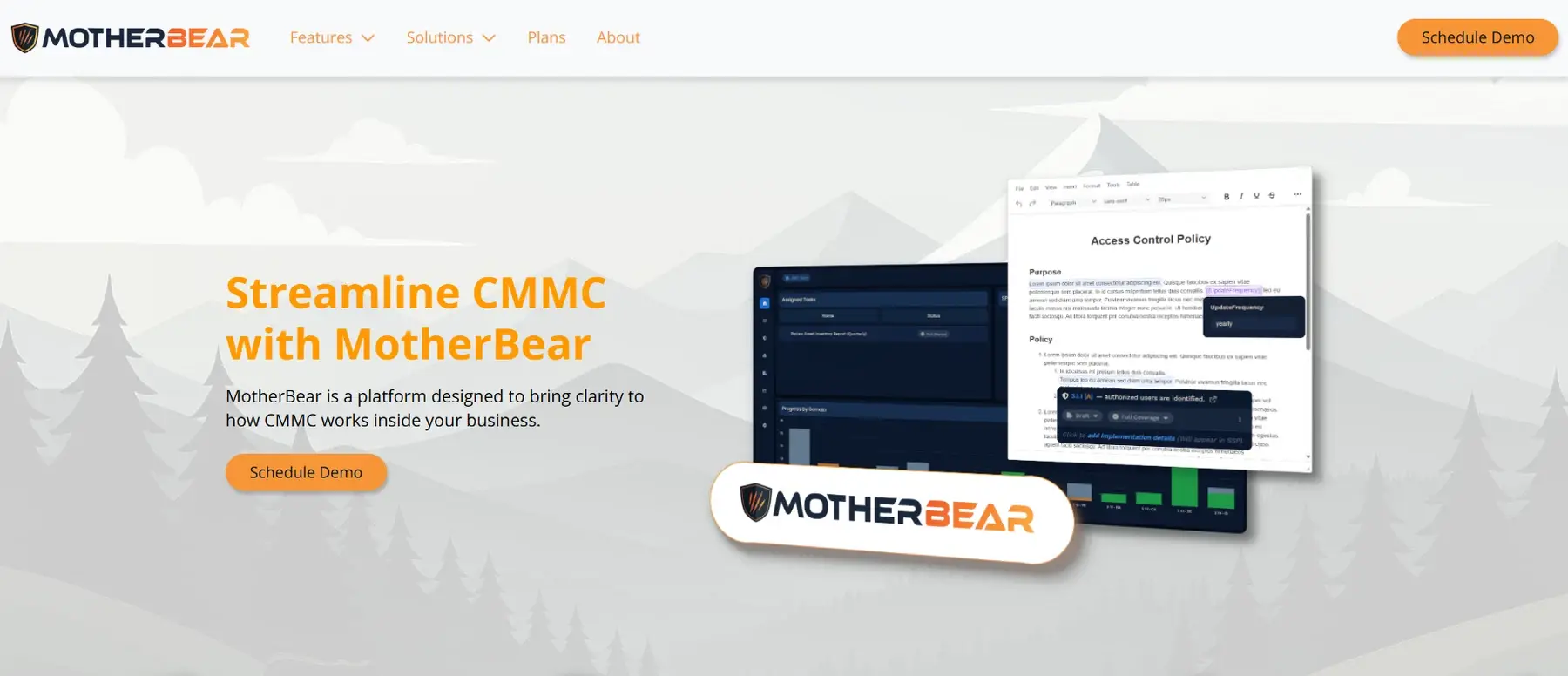
MotherBear gives defense contractors one workspace built around NIST 800-171, with readiness visible at a glance.
It tracks each requirement's status, stores evidence against the requirement it supports, manages the System Security Plan and policy documentation, and turns open gaps into remediation tasks with owners and deadlines.
For consultants, Registered Practitioner Organizations (RPOs), and Managed Service Providers (MSPs) maintaining many programs at once, each client's Level 2 record stays separate and current, so ongoing compliance scales without a new system per contractor.
The result is a program that stays assessment-ready between cycles instead of being rebuilt before each one.
Book a demo and see how MotherBear keeps Level 2 compliance current.
FAQs About CMMC Level 2 Compliance
What are the levels of CMMC compliance?
The program has three. Level 1 protects Federal Contract Information with 15 basic safeguards and an annual self-assessment.
Level 2 protects CUI with the 110 NIST 800-171 requirements, assessed by self-assessment or by a C3PAO depending on the contract. Level 3 adds selected enhanced requirements from NIST 800-172 for a small set of national security programs.
Can you be CMMC Level 2 compliant without a third-party assessment?
Yes, for the contracts that allow it. Level 2 has a self-assessment path and a third-party path, and the contract names which one applies.
Since the July 2026 suspension of Phase 2, new requirement documents may designate only self-assessment, so many contractors demonstrate Level 2 compliance without an outside assessor right now. The self-assessment covers the same 110 requirements.
How much does CMMC Level 2 compliance cost?
Cost depends on scope, starting posture, and assessment type. DoD’s 2024 analysis estimated about $31,000 for a small organization’s C3PAO engagement and $102,000 for total initial assessment and affirmation work, including internal and external labor.
These modeled costs exclude implementing and remediating the controls. Self-assessment avoids the C3PAO fee but still requires staff time and may involve outside support.
How many companies need CMMC Level 2?
DoD’s 2024 planning model estimated about 80,600 organizations at Level 2: roughly 76,600 on the third-party path and 4,000 on the self-assessment path.
These were projected populations, not counts of compliant companies. The July 2026 Phase 2 suspension means the original path split should not be treated as a current forecast.