Table of Contents
For years, defense contractors running Google Workspace were pushed toward Microsoft GCC High before anyone reviewed the tenant, data boundary, or contract language. The assumption was that Google couldn’t support a Cybersecurity Maturity Model Certification (CMMC) program.
That changed in November 2025, when Google Public Sector reached CMMC Level 2 certification under Phase 1 of the program, and the Google Workspace CMMC compliance path became a credible architectural decision rather than a workaround.
The Google Workspace environment still has to be built, documented, and operated correctly to achieve CMMC compliance.
This guide covers what the platform provides, where it stops, which configurations matter, and where compliance management has to sit above the productivity stack.
TL;DR
- Google Workspace can support CMMC Level 1 and Level 2 compliance, but only when the right tier, CUI boundary, and ongoing evidence are properly in place.
- Assured Controls Plus provides FedRAMP High-authorized infrastructure and U.S.-based data residency for CUI, but contractors still own configuration, scoping, and proof.
- Google Public Sector earned CMMC Level 2 certification in November 2025, confirming the platform is production-ready, though each contractor must still earn their own.
- Endpoint controls, boundary definition, and configurations like context-aware access are where most DIB organizations pass or fail scoping.
- MotherBear provides the compliance management layer Google Workspace lacks, tracking all 110 NIST 800-171 controls and keeping documentation audit-ready.
Is Google Workspace CMMC-Compliant?
It can be configured to support CMMC compliance, but configuration is required regardless of which tier you run.
- CMMC Level 1 covers Federal Contract Information (FCI) and can run on standard Google Workspace Enterprise plans with the right setup.
- CMMC Level 2 introduces Controlled Unclassified Information (CUI) and requires Assured Controls Plus, which runs on FedRAMP High-authorized infrastructure with U.S.-based data centers and personnel.
The bigger shift landed in November 2025, when Google Public Sector reached CMMC Level 2 certification, signaling that the platform is production-ready for CMMC 2.0 programs.
Compliance remains the customer’s responsibility either way, because the platform supports the controls, but the contractor still owns scope, configuration, evidence, and ongoing affirmations.
Organizations that want to achieve CMMC compliance using Google Workspace need to treat the platform as the foundation, not the finish line.
What Google Workspace Provides for CMMC
The platform contributes through two pillars: federal authorization status and a feature set that maps to NIST 800-171 control families. Each pillar handles a different part of the assessment story, and none is enough on its own.
FedRAMP High Authorization and Assured Controls Plus
Google Workspace earned FedRAMP High authorization in October 2021, meaning the underlying Google Cloud infrastructure is FedRAMP-authorized against a federal baseline that sits above FedRAMP Moderate.
Most commercial third-party tools target Moderate, but CMMC 2.0 requires Defense Industrial Base (DIB) organizations on national security contracts to operate at the higher level, and Google Cloud’s FedRAMP High authorization satisfies that baseline requirement.
Assured Controls Plus adds the boundary the contractor needs, keeping data in U.S.-based data centers with U.S.-person support staff and customer data segmented from general tenants, with administrative access restricted in ways that satisfy minimum security baselines.
Programs that handle highly sensitive CUI may also need Assured Workloads for tighter separation within Google Cloud.
The Google Workspace architecture is compliant with the International Traffic in Arms Regulations (ITAR), but it still needs legal review, because ITAR requirements can change the boundary decision for ITAR data even when the tenant is otherwise configured correctly.
Maintaining ITAR compliance is both a legal and technical question that goes beyond admin console settings.
Security Features That Map to NIST 800-171 Controls
The strongest coverage sits in identity, encryption, logging, and retention. Security controls still need to map to specific NIST 800-171 security requirements before an assessor can trust them, and contractors cannot rely on third-party tools to do that mapping automatically:
- Encryption can use customer-held keys for selected files and messages.
- Identity policies can gate entry by user and device state.
- Audit logging records admin and user actions for review.
- Retention rules help preserve evidence for assessments.
Google Drive can add Client-Side Encryption for sensitive information where customer-held keys are required, and end-to-end encryption approaches may fit the most regulated data types.
Data Loss Prevention rules support media protection and information integrity when configured around CUI markings, which strengthens cybersecurity posture and reduces exposure to cyber threats.
Protecting CUI through these controls requires mapping each one to specific NIST 800-171 objectives, and every control family needs documented evidence beyond a tenant settings review.
Google Workspace lacks the compliance management layer to produce that evidence automatically.
Compliance Requirements Beyond Google Workspace
The productivity stack is only the foundation. There are layers that must be in place before a contractor can pass a Level 2 assessment.
Configuration, Boundary Definition, and Endpoint Controls
The boundary definition comes first. The contractor needs a documented CUI boundary that specifies which Google Workspace accounts, drives, and tools are in scope, because without that decision, the entire Google Workspace environment is in scope by default.
From there, endpoint compliance follows, since CUI doesn’t stay in the browser, and accessing the Google Workspace environment from an unmanaged laptop or phone undermines the control story.
Mobile Device Management, managed Chrome devices, or Virtual Desktop Infrastructure can each satisfy CMMC mobile device requirements when documented and tested.
Using unmanaged mobile devices to access the Google Workspace environment is one of the most common scoping failures DIB organizations make.
Specific admin console configurations matter here, including context-aware access to gate entry by device state and identity, Google Vault for retention and legal holds, and access controls, such as Google Drive sharing restrictions, to block external sharing for contract data.
These configurations are where most teams either pass scoping or quietly fail it, and they define how much of the CMMC space the Google Workspace environment can credibly cover. A secure environment also needs evidence that users follow the rules.
Safeguarding Covered Defense Information and Cyber Incident Reporting obligations raise the bar beyond a settings review, and a cyber incident response plan has to be documented and tested alongside the technical controls.
Together, these form the enhanced security posture that assessors expect at this CMMC level.
Compliance Management and Documentation
Google Workspace doesn't track your 110 NIST 800-171 controls, generate your System Security Plan (SSP), maintain your Plan of Action and Milestones (POA&M), or schedule recertification. Microsoft Office and every other productivity stack share the same gap.
Microsoft 365 and GCC High are no different. That missing layer is where most contractors underestimate the work, because using Google Workspace for DoD contracts and actually meeting CMMC requirements for those contracts are two separate operational problems.
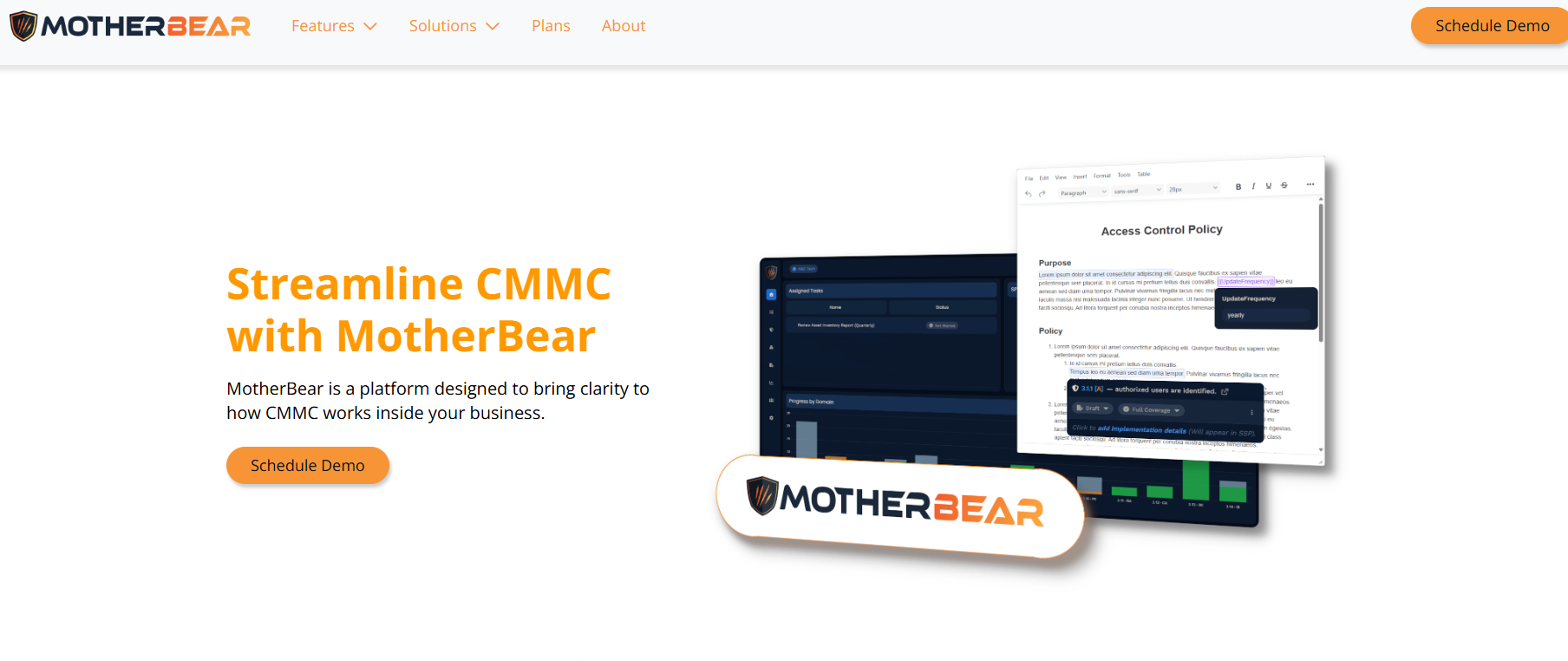
MotherBear operates in that role for organizations using Google Workspace on DoD contracts.
Its purpose-built plans cover requirements tracking, documentation, evidence, and readiness reviews that help government contractors verify their compliance posture before a contracting officer asks, with a veteran-built focus that also fits consultants managing multiple client programs.
The platform tracks the full NIST 800-171 control set, generates SSP and POA&M documentation, stores evidence against each control, and handles media preservation in a way that holds up under a Certified Third-Party Assessment Organization (C3PAO) review.
Use MotherBear to Fill the Gap Google Workspace Leaves Behind
A CMMC-capable Google Workspace tenant and an audit-ready CMMC program are two different things. The DoD phased rollout makes this an active, ongoing program, and when documentation lags behind the tenant, compliance gaps accumulate fast.
MotherBear maps every NIST 800-171 requirement to an owner and evidence record, generates SSP and POA&M documentation from scoped data, and keeps your recertification cycle on schedule so no DoD contract deadline catches you rebuilding from scratch.
Book a demo and see how MotherBear Security keeps your CMMC program audit-ready.
FAQs About Google Workspace CMMC Compliance
Is Google Workspace NIST-compliant?
Google Workspace includes security features that support many NIST 800-171 requirements, including identity management, encryption, audit logging, and data retention. However, no productivity platform is automatically "NIST-compliant" on its own because compliance depends on how the environment is configured, documented, and operated.
Organizations meet compliance requirements by implementing the required controls, maintaining evidence, and continuously monitoring their environment.
Is Google Workspace FedRAMP moderate?
Yes, Google Workspace services are available within environments that have achieved FedRAMP authorization, including FedRAMP High through Google Public Sector offerings and Assured Controls Plus.
FedRAMP authorization helps support government compliance efforts by providing a federally assessed cloud infrastructure baseline. Contractors should still verify compliance requirements for their specific contract and determine whether additional controls or services are required.
Is CMMC compliance mandatory?
For many DoD contracts, CMMC compliance is becoming a contractual requirement as the Department of Defense continues its phased rollout of the program.
The required CMMC level depends on the type of information being handled, with Level 1 focused on Federal Contract Information and Level 2 focused on Controlled Unclassified Information. CMMC is mandatory for many DoD contractors that must protect sensitive information, and organizations handling export-controlled data should also evaluate whether an ITAR-compliant architecture is necessary.