
Table of Contents
Universities run on openness. Research gets published, data gets shared, and campuses welcome collaborators from everywhere. Then a defense research award arrives, and suddenly one corner of that open institution is expected to operate like a defense contractor.
That expectation has a name: Cybersecurity Maturity Model Certification (CMMC). Federal research funding is the lifeblood of academic science, the government is its largest source, and eligibility for defense-related work now travels with a compliance status most institutions never needed before.
This guide covers what the program is, why research puts universities in scope, the fundamental research distinction that keeps some work out, how much of a campus actually needs to comply, and the challenges unique to academic environments.
TL;DR
- CMMC applies to universities whenever DoD funding and covered research are present: research labs, UARCs, and FFRDCs are all included in the program, with no exemption for academic status.
- Fundamental research is the key carve-out. Work whose results are ordinarily published stays out of scope, but publication restrictions, export controls, or received CUI break the exclusion per project.
- The entire organization doesn't certify. Scope follows covered research, and most institutions build a regulated research enclave so the open side of campus never enters the boundary.
- Campus culture is the real challenge: open collaboration, decentralized IT, personnel churn, and shared computing all collide with controls built for defense contractors.
- MotherBear gives universities and their consultants one place to track requirements, evidence, and SSP documentation for every covered project and award.
What Is the Cybersecurity Maturity Model Certification?
CMMC is the Department of Defense's (DoD) program for verifying that organizations handling its sensitive information actually protect it. It applies to two data types: Federal Contract Information (FCI) and Controlled Unclassified Information (CUI).
The program's roots run wider than one department. Executive Order 13556 established the government-wide CUI framework used by federal agencies, while CMMC applies that framework specifically to organizations working with the DoD.
The CMMC framework organizes cybersecurity best practices into three levels aligned with data sensitivity, built on standards from the National Institute of Standards and Technology (NIST), chiefly NIST 800-171 for protecting CUI.
Verification ranges from an annual self-assessment posted to the DoD's systems up to third-party assessments for the most sensitive work, with each contract specifying what applies.
The part that surprises academia is that the program follows data, not industry. Any organization whose systems process, store, or transmit FCI or CUI under defense work sits inside the defense industrial base for compliance purposes, and a university is no exception.
Why Higher Education Institutions Fall Under CMMC
DoD-sponsored research generates exactly the data the program protects. FCI arrives with the award itself, while CUI, including export-controlled technical data and covered defense information, flows through the research the award funds.
The academic sector is explicitly within CMMC’s reach. University-based research labs and facilities, University Affiliated Research Centers (UARCs), and Federally Funded Research and Development Centers (FFRDCs) can all be subject to its requirements when their defense work involves FCI or CUI.
Educational status does not provide a blanket exemption.
The exposure is broader than many research offices assume, because universities are usually subcontractors rather than primes.
A faculty lab supporting a defense contractor's program inherits the cybersecurity requirements through flow-down, and prime contractors must verify their academic partners just as they verify commercial ones.
Often the requirement arrives not from the DoD but from a prime's supplier questionnaire, sometimes years into a collaboration.
What's at stake is the research enterprise itself: institutions that can't demonstrate compliance risk losing research grants, and the faculty and programs that fundable work sustains.
There's an irony worth noting. Universities helped build the framework, with institutions like Carnegie Mellon and Johns Hopkins contributing to CMMC's development. Higher education isn't an afterthought of the program. It's a charter member.
The Fundamental Research Distinction
Not all DoD-funded research triggers CMMC. Fundamental research, a category recognized by the Office of the Under Secretary of Defense for Research and Engineering, means basic or applied research whose results are ordinarily published and shared broadly.
It generally involves no CUI, and no CUI means no Level 2 obligations. The exclusion follows the nature of the work, not the institution's preferences.
Publication restrictions, export-controlled elements, or restricted deliverables may mean the work no longer qualifies as fundamental research. However, Level 2 applies only when the project actually processes, stores, or transmits CUI under the applicable contract requirements.
So classification happens per project, not per department. Read the award, not the abstract: the clauses and data received decide, and when the answer is unclear, the sponsor or contracting officer settles it, not the principal investigator's intent.
Does the Entire Organization Need CMMC?
The compliance obligation follows covered research, not the institution's letterhead, so the scope covers the systems and people touching FCI and CUI, nothing more.
In practice, that means the computing environments, storage, and researcher workstations serving covered research projects are in. The registrar, the library, student systems, and every department doing open scholarship stay out. Most institutions end up certifying a small slice of themselves.
The standard answer is a regulated research enclave: a contained environment where CUI data lives, with its own access controls, monitoring, and documentation. Researchers on covered programs work inside it, and the rest of campus never enters the assessment boundary.
The enclave logic cuts costs in both directions. A smaller boundary means fewer systems meeting the security requirements and less evidence to maintain, and it protects the open side of campus from controls that would suffocate normal academic life.
The discipline that makes it work is keeping CUI where it belongs. One controlled file on a shared drive, a departmental server, or a commercial cloud collaboration tool can drag that system into scope, which is why data handling rules and researcher training carry as much weight as the technology.
Which CMMC Level Do Research Programs Need?
The data decides the CMMC level, so the certification process for universities usually begins with one question: whether a project involves CUI or only FCI.
Level 1: Federal Acquisition Regulations Basics for FCI
Research administration that touches only FCI, meaning award details, pricing, and deliverables not meant for public release, points to Level 1.
The obligations are 15 foundational security practices drawn from the Federal Acquisition Regulations, verified through an annual self-assessment posted to the Supplier Performance Risk System (SPRS).
For a university, this often covers the sponsored programs office and grants administration systems. It's the lighter end of the program, and no outside assessor is involved.
Level 2: When Research Handles CUI
Projects that handle Controlled Unclassified Information, whether export-controlled technical data, controlled technical information, or covered defense information received from a sponsor, carry Level 2.
That means full implementation of the 110 security requirements in NIST 800-171 throughout the covered environment, plus a System Security Plan (SSP) documenting how each requirement is met.
Verification at Level 2 depends on the contract. Some awards accept a self-assessment, while others require the institution to obtain third-party certification through an authorized assessor, with the Cyber AB, formerly the CMMC Accreditation Body, overseeing the assessment ecosystem.
The award's clauses state which certification requirements apply, so the contract, not a general rule, is the thing to read.
Level 3 exists for the most sensitive national security programs and adds additional controls beyond Level 2. If it applies to a university program supporting particularly sensitive defense work, the solicitation will say so explicitly.
The Unique Challenges of CMMC in Higher Education
The controls themselves are the same cybersecurity standards every contractor faces. What makes CMMC compliance harder on a campus is the environment they land in. Four collisions come up at most institutions:
- Open collaboration vs access management: Academic culture treats sharing as the default, while the DoD requirements demand need-to-know restrictions on CUI. Access management for covered projects means named users, documented permissions, and controlled sharing.
- Decentralized IT vs consistent controls: Departments, labs, and individual principal investigators often run their own systems, but defense contracts require uniform controls on everything touching covered data. Central IT usually has to reclaim authority over the covered environment, which is as much a governance negotiation as a technical project.
- Personnel churn and international researchers: Graduate students rotate, postdocs move on, and visiting scholars arrive from everywhere. Every person touching CUI needs training and documented access, and where export controls apply, separate access restrictions based on U.S.-person status, nationality, or licensing requirements may limit who can participate.
- Shared research computing: High-performance computing clusters and shared labs support many projects simultaneously, and CUI processed on shared infrastructure can bring the entire system into scope. Institutions either isolate covered workloads in dedicated environments or apply full controls to the shared resource.
Universities aren't new to federal data rules. Institutions already protect federal student aid records under their own security requirements. That muscle, plus the audit discipline of research compliance generally, transfers to the CMMC process better than most campuses expect.
A University's Path to CMMC Compliance
Five steps take an institution from uncertain to eligible, and the order matters.
- Log awards and clauses: Pull every active DoD contract, subaward, and everything in the pipeline. Flag the cybersecurity clauses, CUI markings, and any award language on publication restrictions or export control. This inventory is the foundation every later decision rests on.
- Classify each project: Fundamental research on one side, covered research on the other. Projects that handle CUI, or protect Federal Contract Information under a defense award, go on the covered list with their required level noted.
- Build the regulated research enclave: Stand up the enclave where covered work will live, then move covered projects in and keep everything else out so the boundary stays small.
- Align policies and training to real workflows: Write the SSP and procedures around how researchers actually work: data intake from sponsors, collaboration rules, personnel onboarding and offboarding. Train covered-project researchers on their specific duties, not generic awareness.
- Assess and maintain: Complete the verification path each contract award requires, from self-assessment in SPRS to third-party certification where the clauses demand it, and keep the environment, documentation, and affirmations current afterward.
Full compliance is a state the institution holds, not a milestone it passes.
Keep Every Covered Project Compliant With MotherBear
For a research institution, the hard part isn't any single control. It's running a program: multiple covered projects, each with its own award clauses, evidence, and researchers, all needing to stay current at once.
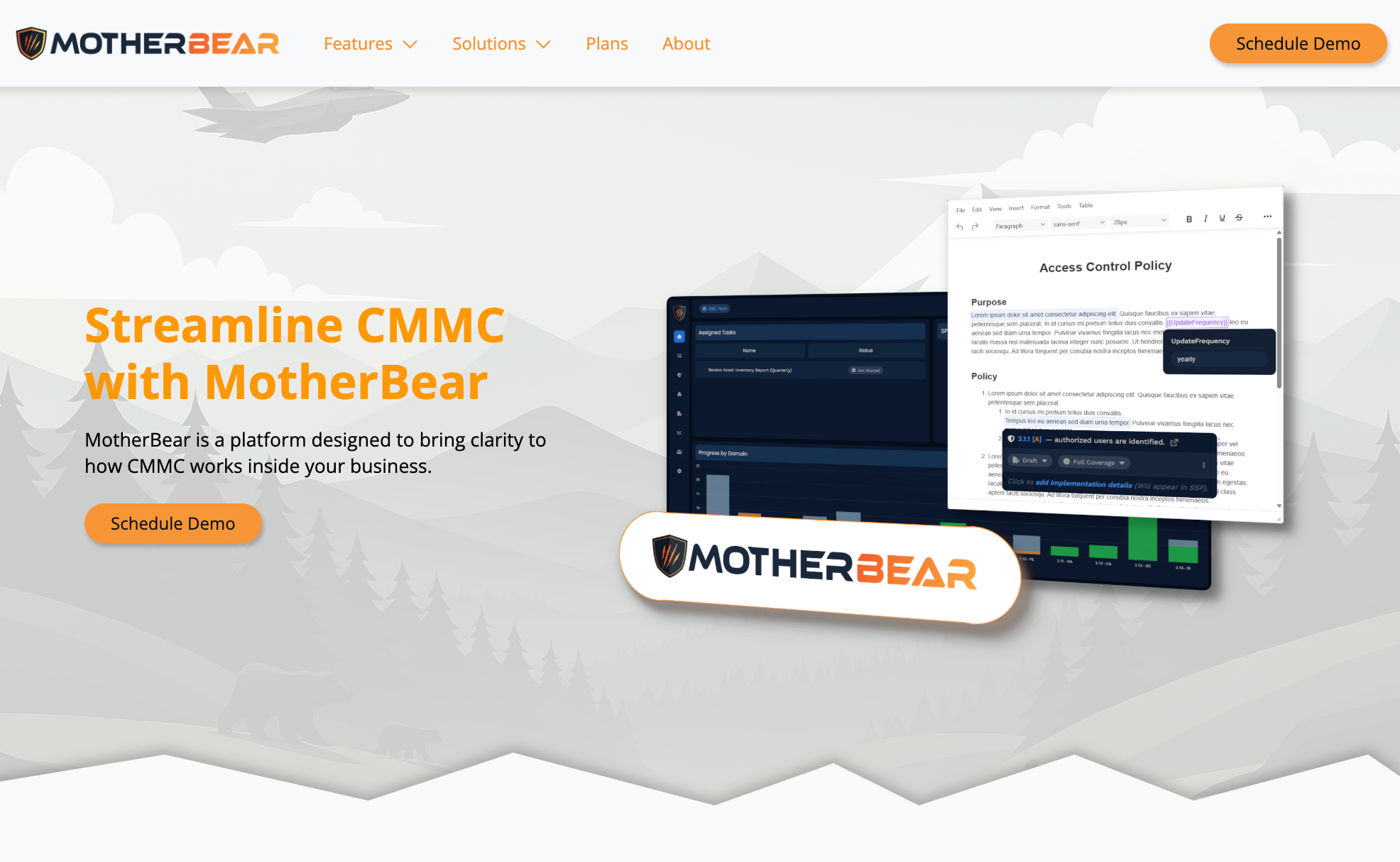
MotherBear gives universities and their consultants a central place to keep requirements, evidence, SSP documentation, and remediation work connected as they manage covered research programs.
The new CMMC mandate didn't change what research is. It changed what research offices must prove.
Book a demo and see how MotherBear keeps that proof organized for every award.
FAQs About CMMC for Universities
Do universities have to be CMMC?
Yes, when their research involves FCI or CUI under defense work. The program covers university-based research labs, UARCs, and FFRDCs, with no exemption for academic status.
Scope is limited to the covered research environment, though, not the whole institution, and purely fundamental research generally stays out.
Is CMMC now required?
The requirements attach through contract clauses, so what applies depends on each award.
Self-assessment obligations for organizations handling FCI and CUI are in force, and institutions doing defense research should treat CMMC readiness as current business, not a problem for the near future.
The clauses in your active DoD contracts are the authoritative answer.
Which companies need to be CMMC-certified?
Any organization in the DoD supply chain handling FCI or CUI, from prime DoD contractors down through subcontractors, and universities sit in that chain whenever their research is covered.
The verification path, self-assessment or certification, follows what each contract specifies.
How hard is it to get CMMC-certified?
The controls are established practice, and the difficulty is mostly institutional: scoping the environment, documenting how researchers actually work, and keeping evidence current across projects.
Universities with strong research compliance functions adapt fastest, since the audit discipline transfers. A tight enclave makes everything cheaper, while a sprawling boundary makes everything harder.