Table of Contents
An assessor points at a line in your System Security Plan (SSP) and asks which artifact supports objective AC.L2-3.1.1[d]. You have the evidence. Everyone in the room believes you have the evidence.
An assessor points at a line in your System Security Plan (SSP) and asks which artifact supports objective AC.L2-3.1.1[d]. You have the evidence. Everyone in the room believes you have the evidence.
The question is whether you can produce it in the next 30 seconds, and whether the file you hand over demonstrably covers that objective rather than the general area around it.
That's what evidence mapping decides. It isn't filing, and it isn't the same as collecting tangible proof. It's the index connecting each artifact to the requirement and objective it satisfies, and it doubles as the navigation tool an assessment runs on.
For defense contractors, this is where Cybersecurity Maturity Model Certification (CMMC) compliance stops being about protecting sensitive data and starts being about demonstrating that you do.
This guide covers what a CMMC evidence map contains, why objective-level granularity matters, how artifacts and requirements relate to each other, and how to keep the map from going stale.
One current note: CMMC remains paused in Phase 1, so applicable Level 2 requirements presently use self-assessment rather than third-party certification. The same objective structure governs how a Level 2 self-assessment is evaluated, so the mapping work is identical.
TL;DR
- Evidence mapping links each artifact to the specific requirements and assessment objectives it proves, with enough detail that someone else can follow it.
- Map to objectives, not controls. CMMC Level 2 evaluates 110 requirements through 320 assessment objectives, and findings happen at the objective level.
- The relationships run both ways. One artifact often covers several objectives, and one objective often needs several artifacts.
- Artifacts used as assessment evidence must be retained for six years from the CMMC Status Date. Keeping the map with them is what makes that archive usable during later CMMC audits.
- MotherBear maintains the mapping as work happens, so evidence stays tied to the requirement it proves instead of accumulating in a shared drive.
What Evidence Mapping Means Under Cybersecurity Maturity Model Certification
Evidence collection and evidence mapping get treated as one task. They're separate, and the second is where programs fall down.
Collection produces artifacts, and the evidence types vary: screenshots, exports, logs, training records, signed policies. Mapping produces the relationship between that CMMC documentation and the requirements it satisfies, recorded somewhere durable.
Worth stating plainly: CMMC doesn't prescribe a map format or require a standalone mapping document. Evidence mapping is a practical way to organize the objective-level proof the assessment methodology does require.
Security teams tend to be good at the first and inconsistent at the second.
A contractor with excellent collection and no mapping has a folder of files nobody can navigate under pressure. Our guide to objective evidence covers what qualifies as proof; this one covers what you do with it afterward.
The distinction has a practical test. Ask someone who didn't build your program to find the evidence for a specific requirement. How long it takes them is your mapping quality.
Map to Objectives, Not Just the CMMC Control or CMMC Level
This is the single decision that separates a map that survives an assessment from one that doesn't.
Under CMMC 2.0, Level 2 covers 110 security controls from NIST 800-171, and those requirements decompose into 320 assessment objectives. Assessors make findings at that finer grain, and a requirement is only met when every applicable objective under it is satisfied.
That means mapping to specific CMMC controls isn't enough on its own. The relevant controls have to be broken down further.
Mapping at the control level looks complete and isn't. A single requirement like access control enforcement might have four objectives, and evidence covering three of them still produces a finding.
Objective identifiers make this manageable. Requirements carry lettered objectives, so AC.L2-3.1.1 breaks into [a] through [f], covering the identification of authorized users, processes, and devices and then the limiting of access to each.
Your map should reference those directly rather than the parent requirement alone.
The DoD CMMC Level 2 Assessment Guide identifies the assessment objectives for each requirement, along with potential examine, interview, and test objects.
Building your map from that official structure, rather than guessing what evidence assessors expect, is the cheapest accuracy improvement available to you.
It tells you what CMMC assessors work from, which beats inferring it.
What Belongs in an Evidence Map
The format matters less than the fields. Whether it's a spreadsheet or a platform, your CMMC audit evidence needs enough detail that a stranger could follow it to the artifact.
Each entry should make control implementation traceable from requirement to proof.
- Objective identifier: The specific objective, not just the requirement. This is the column most maps are missing.
- Artifact name and location: Where the file actually lives, precise enough to open directly. A folder path isn't a location.
- Page or section pointer: For multi-page documents, the specific place the evidence appears. Handing an assessor a 40-page policy and letting them hunt wastes goodwill.
- Assessment coverage: Which examine artifacts, interview roles, and test mechanisms can support the objective. Documents get examined, people get interviewed, and mechanisms get tested, so these are three different columns rather than one label on a file.
- Owner: Who produces and maintains it. Evidence without an owner goes stale first.
- Date collected and refresh cadence: When it was captured and when it needs replacing. Dating is what separates current proof from historical trivia.
A map with these fields answers the assessor's question in one lookup. A map without them is a filing system with ambitions.
How Artifacts and Requirements Actually Relate
Contractors often build maps assuming one artifact per requirement. Real environments don't work that way, and forcing that shape creates both duplication and gaps.
- One artifact, many objectives: A single identity provider configuration export can serve objectives under access control, identification and authentication, and audit and accountability. Mapping it once against all of them beats exporting it three times.
- One objective, many artifacts: Demonstrating that a control operates usually takes a policy stating the intent, a configuration showing the implementation, and a record proving it happens. Three artifact types, one objective.
- Artifacts age at different rates: An approved policy may stay useful until the process or environment changes, while system configurations and records supporting system integrity lose relevance faster. Keeping evidence current means tracking refresh dates based on what each artifact proves, not one rule for everything.
Getting these relationships right is what turns a map into a coverage tool for your security practices. Once artifacts and objectives are properly linked, the gaps become visible: objectives with no artifact, or artifacts nobody can attribute to a requirement.
Objective Evidence Examples by Control Family
The abstract version only goes so far. Here's the shape of what maps to what, drawn from several common Level 2 families.
|
Control family |
Typical artifacts to map |
|
Access control |
Role-based access control configurations, account management records, user access review reports, lists of authorized users, system access request tickets |
|
Identification and authentication |
Multi-factor authentication enforcement settings, password policy configurations, identity provider exports |
|
Audit and accountability |
Access logs, system logs, log retention settings, records of log review |
|
Configuration management |
Baseline configuration documents, system settings exports, change tickets, network diagrams |
|
Incident response |
The incident response plan, incident reports, after-action reports, tabletop exercise records |
|
System and information integrity |
Current patch status reports, vulnerability scan results, flaw remediation records, malicious code protection status |
|
Risk assessment |
Risk assessment reports, scan schedules, remediation tracking |
|
System and communications protection |
Network diagrams showing boundaries, encryption configurations, settings for network devices |
Configuration Evidence, Incident Response, and Audit and Accountability
Three patterns are worth calling out. Configuration evidence appears in several families at once, which is exactly the one-artifact-many-objectives case.
Incident response evidence can be thin when plans are written but never exercised. Audit and accountability evidence can go stale as logging configurations change.
Most of these artifacts are system-generated rather than written, which means the collection problem is usually export and retention rather than authorship.
Building Audit-Ready Evidence and Assessment-Ready Evidence Continuously
The difference between audit-ready evidence and a pre-assessment scramble is whether mapping happens continuously or retroactively.
Retroactive mapping is expensive because context decays, and manual processes make it worse. Six months after a configuration change, nobody remembers why it was made, whether the screenshot predates it, or which objective it was supposed to cover.
That gap is what turns CMMC audit preparation into a project rather than a review, and it's the clearest signal of weak CMMC readiness.
Continuous mapping costs almost nothing by comparison. When an access review completes, it gets filed against its objectives that week, with the date and owner recorded while everyone still remembers.
A few habits carry most of the weight:
- Map at creation: The moment an artifact exists, record what it proves. This is a two-minute task then and an afternoon later.
- Review coverage quarterly: Walk the map looking for objectives with thin or aging evidence, checking that documented cybersecurity practices still match what runs.
- Re-map after environment changes: New cloud services, migrations, and tooling changes break existing mappings silently.
- Keep the map with the evidence: A map in someone's personal spreadsheet is a single point of failure.
Keep Your Evidence Map With the Assessment Record
Most contractors treat the map as internal housekeeping, which undersells it.
During a formal assessment, the map is the navigation tool. It's how an assessor moves between a finding and the artifact supporting it, and how your team answers questions without stalling.
It's also what makes audit preparation proportionate, since a mapped program only needs review rather than reconstruction of your security posture.
Afterward, the artifacts used as evidence must be retained for six years from your CMMC Status Date. The map isn't separately mandated, but storing it alongside them turns that archive into something navigable rather than a pile of dated files.
There's a practical consequence for how you build it. A map written for your own convenience, full of internal shorthand and assumed context, works until someone external reads it. Write it for a stranger.
Evidence Mapping Beyond the CMMC Assessment
The work has more reuse than most contractors expect, which changes the cost calculation.
A mapped evidence set supports Level 1 annual self-assessments, Level 2 self-assessments on their three-year cycle, the results entered in the Supplier Performance Risk System (SPRS), and any prime contractor asking how you protect Controlled Unclassified Information (CUI) or protect Federal Contract Information (FCI).
Same artifacts, different audiences.
It also lets you demonstrate current compliance quickly, because the map shows which artifacts reflect your current security posture and which need refreshing before additional evidence is requested.
It also travels between frameworks. Evidence organized by what it proves, rather than by which framework asked, gets remapped when a new requirement set appears. Evidence filed by framework gets rebuilt.
That's the argument for treating mapping as infrastructure rather than assessment preparation. You build it once for the assessment and keep using it for everything else.
Keep Evidence Mapped to Requirements With MotherBear
The reason mapping decays isn't that teams don't understand its value. It's that the artifact and the requirement live in different systems, so keeping them connected is manual work nobody owns.
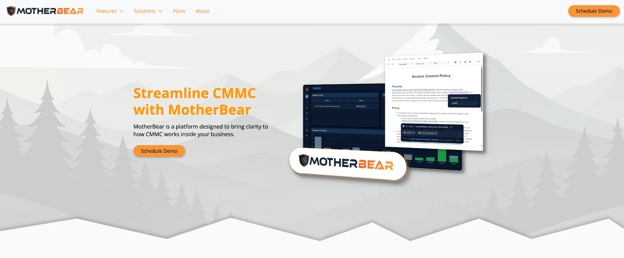
MotherBear removes that gap. Evidence uploads into a repository tied to the requirements each artifact proves, alongside requirement status, SSP and policy materials, and remediation tasks with owners.
Because the mapping is part of how evidence gets filed rather than a separate spreadsheet, coverage gaps surface while there's time to close them rather than during assessment preparation.
For consultants running programs for several contractors, the same structure per client is what makes evidence review repeatable instead of bespoke every time.
Book a demo and see how MotherBear keeps proof connected to the requirement it supports.
FAQs About CMMC Evidence Mapping
What is evidence mapping in CMMC?
Evidence mapping is the practice of linking each artifact you hold to the specific requirements and assessment objectives it demonstrates. It's the index between your evidence and the standard.
A usable map records the objective identifier, where the artifact lives, what assessment coverage it supports, who owns it, and when it was collected. Without that connection, evidence exists but can't be produced on demand, which assessors treat as equivalent to not having it.
Can one piece of evidence satisfy multiple CMMC requirements?
Yes, and this is common. A single identity provider export can support objectives under access control, identification and authentication, and audit and accountability.
Mapping it against every objective it covers is more efficient than duplicating the artifact, provided the map makes the multiple relationships explicit rather than filing it once and hoping an assessor makes the connection.
How much evidence do you need for each assessment objective?
There's no fixed number. The assessor determines whether evidence is sufficient and which methods suit the objective, so some objectives are supported by several artifacts and methods while others need less.
The more useful question is coverage rather than volume. Every applicable objective needs sufficient, current evidence, and objectives resting on a single aging artifact are where findings tend to come from.
How long do you need to keep CMMC evidence?
Artifacts used as assessment evidence must be retained for six years from the CMMC Status Date. The map isn't separately mandated, but keeping it with those artifacts makes the retained evidence easier to navigate and reuse.
That's longer than most contractors plan for, and it's a reason to keep evidence somewhere durable rather than in individual drives. Retention also matters between cycles, since evidence from a previous assessment provides context for the next one even when it no longer proves current state.
Should the evidence map live in a spreadsheet or a platform?
Either works if the fields are right and someone maintains it. A spreadsheet with objective identifiers, artifact locations, owners, and dates beats a platform nobody updates.
The practical difference is drift. Spreadsheets separate from the evidence they describe, so links break, and dates go stale unnoticed. Keeping the mapping attached to the artifacts removes that failure mode.