
Level 1 is the first tier of the Cybersecurity Maturity Model Certification (CMMC) program. It applies where Department of Defense (DoD) contracts require Level 1 (Self) for systems that process, store, or transmit Federal Contract Information (FCI) but not Controlled Unclassified Information (CUI).
People search for Level 1 certification, but no outside body issues a certificate at this level. You earn Level 1 status by completing a CMMC Level 1 self-assessment against 15 requirements, reporting the result, and affirming it every year.
This guide explains what Level 1 is for, the steps to reach and keep it, and the requirements you will check along the way. It also shows where Level 1 ends and Level 2 begins.
TL;DR
- Level 1 has no third-party assessment and no certificate. Contractors self-assess against the 15 requirements in Federal Acquisition Regulation (FAR) 52.204-21, enter the result in the Supplier Performance Risk System (SPRS), and affirm it.
- Level 1 permits no Plans of Action and Milestones (POA&Ms). All 15 requirements must receive a MET result to achieve Final Level 1 (Self) status.
- A practical sequence has six steps: define scope, run a gap analysis, close the gaps, organize evidence, submit in SPRS, and affirm.
- Status renews every year through a new self-assessment and affirmation, and assessment evidence stays on file for six years from the CMMC Status Date.
- MotherBear gives contractors and the consultants supporting them one workspace for requirement status, evidence, documentation, and remediation work.
What CMMC Level 1 Is For
Level 1 exists to protect FCI, which is information the government provides or a contractor generates under a contract and does not intend for public release. Public information and simple transactional data, such as what is needed to process payments, fall outside the definition.
The 15 CMMC requirements at this level set a floor of basic cybersecurity hygiene. They describe safeguards that any business handling Federal Contract Information should already have, such as controlling who can reach systems and keeping malicious code out.
Level 1 also works as a gate. When a solicitation requires Level 1 (Self), the contractor must achieve Final Level 1 (Self) status and submit the required affirmation in SPRS before award.
A subcontractor that processes, stores, or transmits only FCI in performing the subcontract is held to the same level.
CMMC 2.0 and Where Level 1 Fits
CMMC 2.0 is the shorthand for the three-level model that DoD now implements through 32 CFR Part 170. Level 1 covers only Federal Contract Information. Level 2 covers CUI, and Level 3 adds selected requirements from the National Institute of Standards and Technology (NIST) 800-172.
When a solicitation or contract includes a CMMC requirement, it specifies the applicable level and assessment type.
Understanding the CMMC levels matters when CUI enters the work: Level 2 becomes the minimum required level, while the solicitation or contract determines the assessment type.
The Level 1 Certification Process Explained
Despite the search term, Level 1 does not end with a certificate. The contractor performs the self-assessment, reports the result, and affirms it. No CMMC Third-Party Assessment Organization (C3PAO) takes part; they belong to Level 2.
Consultants and software can support the work, but the contractor remains responsible for the result and the affirmation.
Why CMMC Self-Assessments Still Carry Weight
A successful self-assessment produces Final Level 1 (Self) status, which requires a MET result for all 15 requirements.
DoD can still examine the records behind a result, and knowingly misrepresenting compliance in connection with government payment claims can lead to liability under the False Claims Act.
The 15 CMMC Requirements
The requirements come from FAR 52.204-21, and the CMMC rule incorporates them for Level 1. Under the Revolutionary FAR Overhaul deviation path, affected acquisitions may use FAR 52.240-93 for the same basic safeguarding obligation. The codified CMMC rule still references FAR 52.204-21.
The table groups the requirements by domain and pairs each group with evidence worth keeping. These safeguards form the foundation of FCI compliance, but this table focuses on what contractors should check and document before completing their Level 1 self-assessment.
|
Domain |
What the requirements ask |
Count |
Evidence worth keeping |
|
Access Control |
Limit information system access to authorized users, processes, and devices; limit it to permitted functions; control external connections and public postings |
4 |
User and device lists, role assignments, posting rules |
|
Identification and Authentication |
Identify information system users, processes acting on their behalf, and devices, then authenticate them before granting access |
2 |
Unique account lists, login settings |
|
Media Protection |
Sanitize or destroy information system media containing FCI before disposal or reuse |
1 |
Disposal and sanitization records |
|
Physical Protection |
Limit physical access to organizational information systems, equipment, and their respective operating environments; escort visitors, keep audit logs, and manage access devices |
2 |
Visitor logs, key and badge lists |
|
System and Communications Protection |
Monitor, control, and protect organizational communications at external and key internal boundaries; separate publicly accessible system components |
2 |
Network diagram, firewall configurations |
|
System and Information Integrity |
Correct information system flaws in a timely manner; deploy malicious code protection mechanisms at appropriate locations; update them; perform periodic scans |
4 |
Patch records, endpoint protection reports, scan results |
How to Check the Requirements Before Self-Assessment
Before completing the self-assessment, check whether your actual practices satisfy each applicable assessment objective. Review the relevant records, speak with staff responsible for the safeguards, and test configurations where appropriate, including remote access controls.
For example, account reviews can confirm whether only authorized users have access. Visitor logs and media-disposal records can demonstrate physical safeguards, while firewall configurations, patch records, and malicious-code protection reports help establish whether technical requirements operate as intended.
Record any unmet objectives and address them before submitting your assessment. Level 1 does not permit POA&Ms, so all 15 requirements must receive a MET result.
Six Steps to Complete a CMMC Level 1 Self-Assessment
DoD does not prescribe a six-step implementation method for Level 1. The sequence below is a practical way to prepare for the required self-assessment without leaving remediation or evidence work until the end.
The compliance process runs in order, and each step feeds the next. Scope comes first because every later step depends on it.
Step 1: Define Your Assessment Scope
Before you self-assess, you must specify the CMMC assessment scope. Systems that process, store, or transmit FCI are in scope. These covered contractor information systems get assessed against all 15 requirements.
Systems that do not handle FCI fall outside Level 1, and the rule sets no documentation requirement for them.
Specialized Assets that meet the rule's definition, including qualifying operational technology, Internet of Things devices, government-furnished equipment, and test equipment that cannot be fully secured, are also excluded from the Level 1 assessment scope.
The rule does not ask you to document specialized assets, but a short note on why you excluded them makes the decision easy to defend later. When scoping, consider your people, technology, facilities, and any external service providers that handle FCI.
Step 2: Run a Gap Analysis
A gap analysis measures every in-scope system against all 15 requirements, which are the required practices at this level. Examine records, interview staff, and test settings.
Assess each applicable objective and record MET, NOT MET, or, where appropriate, NOT APPLICABLE (N/A). An N/A objective is treated as equivalent to MET for determining the requirement result.
The self-assessment uses objectives from NIST 800-171A, with FCI substituted where an objective refers to CUI. A requirement receives a MET result when every objective is satisfied or properly assessed as N/A.
The output is a snapshot of your compliance posture and a list of gaps, each with an owner. The goal is to identify gaps while you can still fix them, and this list drives Step 3.
Step 3: Close Every Gap
Use an internal remediation plan, kept as a simple task list, that assigns each gap an owner, a due date, and a way to prove closure.
Typical fixes involve basic security controls and routines. These examples show the pattern.
- Account cleanup: Disable unused accounts and replace shared logins with individual ones.
- Protection updates: Update endpoint protection and schedule recurring scans.
- Media disposal procedure: Write down how your team destroys or sanitizes drives and track each disposal.
- Visitor logging: Start an escort and sign-in routine for visitors and shared spaces.
Step 4: Organize Your Evidence
Retain the artifacts you use as assessment evidence for six years from the CMMC Status Date. Store them against the requirement each one supports, so any item is easy to find later, and your compliance efforts are easy to repeat next year.
Useful artifacts include system logs, technical configurations, screenshots, written procedures, visitor logs, and disposal records. Together, these form the CMMC objective evidence supporting the self-assessment.
The Level 1 rule does not call for a System Security Plan (SSP). A short written description of your scope and environment is still worth keeping, because it ties your evidence together.
Step 5: Submit Your Results in SPRS
Enter the assessment results in SPRS. At a minimum, the submission includes your CMMC level, the CMMC Status Date, the assessment scope, the industry Commercial and Government Entity (CAGE) codes tied to the in-scope systems, and the compliance result.
Request SPRS access early. Account setup runs through the Procurement Integrated Enterprise Environment (PIEE), and it is a step that can delay a first submission.
Step 6: Complete the Affirmation
An Affirming Official, the senior-level representative responsible for your CMMC compliance, affirms the result. The affirmation states that the organization has implemented, and will keep implementing, all applicable requirements for its assessment scope.
The Affirming Official enters it electronically in SPRS. Level 1 requires the affirmation before award and every year after. The annual affirmation is the formal obligation behind what some teams call CMMC self-attestation, so review the evidence before anyone signs.
Maintain CMMC Compliance Between Assessments
Your Level 1 compliance status depends on yearly renewal. You complete an annual self-assessment and submit a new result and affirmation in SPRS each year. In between, staff change, devices arrive, and controls drift.
To maintain compliance, make cybersecurity practices and continuous monitoring routine. Continuous monitoring at this level can be as simple as scheduled reviews that ensure continuous compliance by keeping your evidence current.
- Account reviews: Check user and device lists on a schedule you set, and remove access that no longer applies.
- Patch and protection checks: Confirm that updates, malicious code protection, and scans still run.
- Visitor and key logs: Review them for gaps and store them with your evidence.
- Scope changes: Review the assessment scope whenever systems or boundaries change. Significant architectural or boundary changes can require a new self-assessment before the next annual cycle.
Check the contract requirements of each new award as well. The solicitation names the required level, and a contract that brings CUI changes the program you need.
What Level 1 Does Not Require
Level 1 is much smaller than the higher levels. The list below separates what the rule requires from what belongs to higher levels or to good practice.
- A third-party assessment: No C3PAO reviews a Level 1 self-assessment.
- An SSP: The Level 1 rule text does not require one, although Level 2 does.
- Incident response and risk assessment requirements: Level 2 adds formal requirements in both areas. A written incident response plan is common supporting documentation, but Level 1 does not require one.
- Multi-factor authentication: The clause requires authentication, not a second factor. Multi-factor authentication is good practice, and Level 2 includes it.
When CUI enters the contract scope, Level 2 adds substantially more technical, documentation, and governance requirements, including multi-factor authentication, an SSP, incident-handling requirements, and risk assessment.
The solicitation or contract determines whether the applicable Level 2 assessment is self-assessed or conducted by a C3PAO. For contractors, CMMC Level 1 vs. Level 2 means different information, safeguards, and assessment routes, not just a higher requirement count.
What the 2026 Suspension Means for Level 1
On July 13, 2026, DoD suspended Phase 2 and pending implementation milestones while a task force reviews the program. During the suspension, new requirement documents may designate only Level 1 (Self) or Level 2 (Self).
Level 1 never involved a third-party assessment, so the suspension does not change your steps. Phase 1 obligations continue, including self-assessments, SPRS submission, and annual affirmations.
DoD describes Phase 2 as suspended, and no replacement date has been announced as of this writing. Confirm what your specific contract requires in writing, because existing terms apply until a contracting officer modifies them.
Keep Level 1 Evidence Ready With MotherBear
Level 1 looks small: 15 requirements, one self-assessment, one affirmation. The part that grows is the evidence. Account lists, patch records, visitor logs, and disposal receipts end up scattered among drives and inboxes.
Because status renews each year, last year's evidence goes stale unless someone owns the record. Contractors with small teams, and the consultants who support several of them, feel that first.
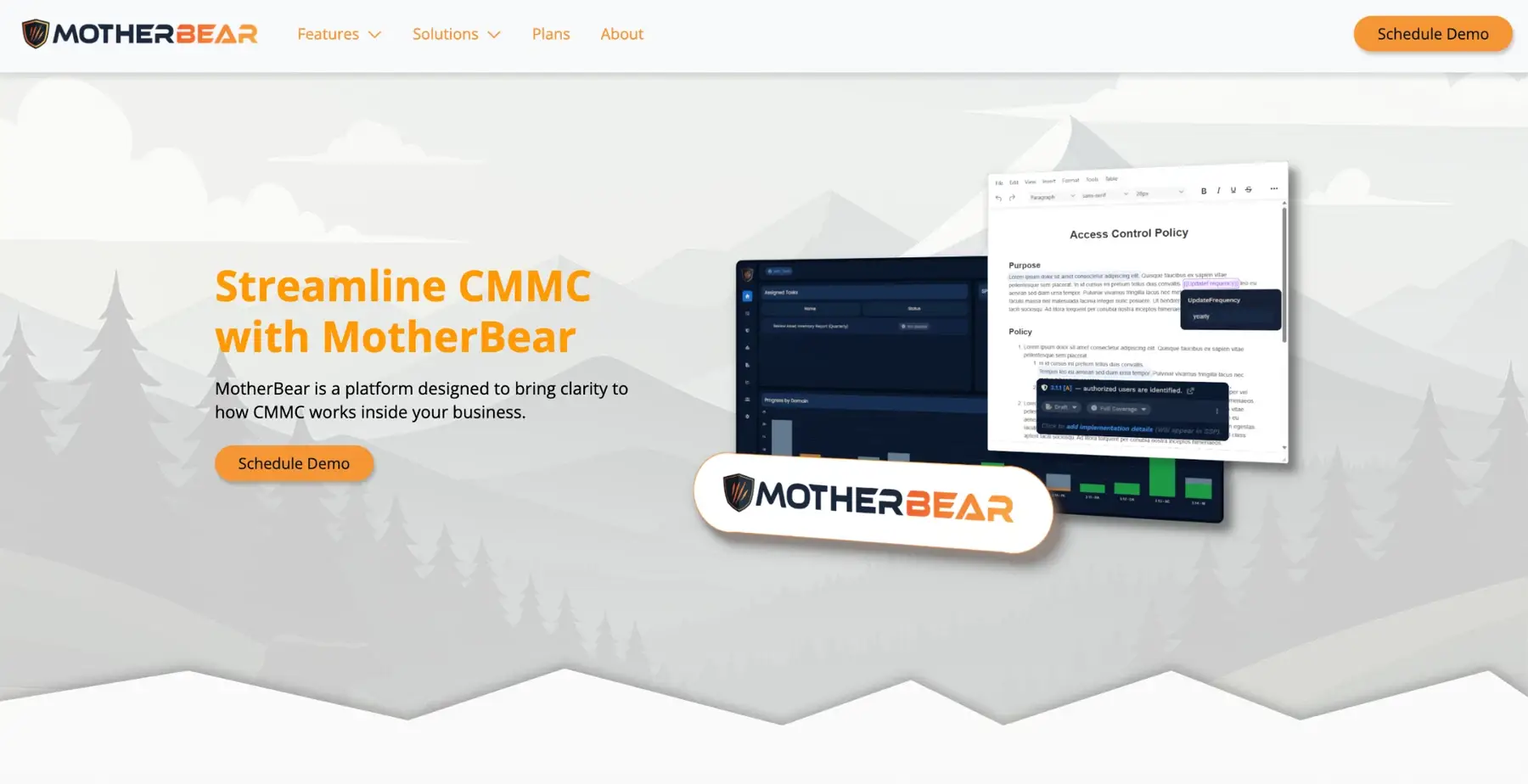
MotherBear gives defense contractors and their consultants one workspace to track requirement status, store evidence against the requirements it proves, manage documentation, and assign remediation tasks with owners and deadlines.
It also monitors assessment readiness, so gaps surface before the next self-assessment. The same workspace carries forward if a new contract brings CUI and a larger program.
FAQs About How to Get CMMC Level 1 Certification
How long does it take to get CMMC Level 1 status?
No official timeline exists. The time depends on your scope, your starting posture, and how many gaps the analysis finds.
A small environment with several practices in place needs less remediation than one starting from scratch. Treat any figure you see as a planning estimate, and build your own from the gap analysis.
Can you self-certify CMMC Level 1?
CMMC uses the term self-assessment, not self-certification, for Level 1. You complete the Level 1 self-assessment against all 15 requirements, submit the result in SPRS, and have the Affirming Official complete the required affirmation.
A successful assessment produces Final Level 1 (Self) status, not a CMMC certificate. No outside assessor is involved.
How can I get CMMC Level 1 status?
Define your assessment scope, run a gap analysis against the 15 requirements, and close every gap, since POA&Ms are not allowed. Organize your evidence, submit the results in SPRS, and complete the affirmation. Repeat the self-assessment and affirmation annually.
How difficult is CMMC Level 1?
The requirements are basic security practices, and some businesses already meet several of them. The difficulty lies in proving it.
Level 1 is pass or fail, so one unmet requirement blocks the result, and weak scoping or missing evidence can undo an otherwise sound environment. Level 2 is a far greater effort.