---
title: "CMMC Compliance Timeline: How Long It Really Takes"
description: Read our guide on the CMMC compliance timeline and learn how long it takes to become compliant. Discover how MotherBear can help you prepare.
image: https://www.motherbearsecurity.com/hubfs/CMMC%20compliance%20timeline.png
---
[](https://www.motherbearsecurity.com/)
- Features
- [Requirements Tracking Understand how and why you meet requirements](https://www.motherbearsecurity.com/features/requirements-tracking)
- [Documentation Builder Tools to streamline creating Policies, Procedures and your SSP](https://www.motherbearsecurity.com/features/documentation-builder)
- [Evidence Repository Store evidence with ease and ensure you are audit ready](https://www.motherbearsecurity.com/features/evidence-repository)
- [Task Management Assign, track, and manage tasks across your team](https://www.motherbearsecurity.com/features/task-management)
- Solutions
- [For Defense Contractors Purpose built for the Defense Industrial Base](https://www.motherbearsecurity.com/solutions/defense-contractors)
- [For Managed Service Providers Simplify program management for you and your clients](https://www.motherbearsecurity.com/solutions/managed-service-providers)
- [For CMMC Professionals Use tools that help you provide the best value to your clients](https://www.motherbearsecurity.com/solutions/cmmc-professionals)
- [Plans](https://www.motherbearsecurity.com/plans)
- [About](https://www.motherbearsecurity.com/about)
[Schedule Demo](https://www.motherbearsecurity.com/schedule-demo)
# CMMC Compliance Timeline: How Long It Really Takes
November 02, 2026

## Table of Contents
1. [TL;DR](https://www.motherbearsecurity.com/blog/cmmc-compliance-timeline#tldr)
2. [CMMC Compliance Timeline vs. the CMMC Implementation Timeline](https://www.motherbearsecurity.com/blog/cmmc-compliance-timeline#Timeline-vs)
3. [What Actually Drives Your Cybersecurity Maturity Model Certification Timeline](https://www.motherbearsecurity.com/blog/cmmc-compliance-timeline#What-Drives)
4. [CMMC Compliance Timelines by Use Case](https://www.motherbearsecurity.com/blog/cmmc-compliance-timeline#Timeline-Use-Case)
5. [Working Backward From CMMC Deadlines](https://www.motherbearsecurity.com/blog/cmmc-compliance-timeline#Working-Backward)
6. [The CMMC Program in 2026: Self-Assessments and Phased Implementation](https://www.motherbearsecurity.com/blog/cmmc-compliance-timeline#CMMC-2026)
7. [How to Maintain Compliance After the First Assessment](https://www.motherbearsecurity.com/blog/cmmc-compliance-timeline#How-to-Maintain)
8. [How MotherBear Keeps Your Timeline From Slipping](https://www.motherbearsecurity.com/blog/cmmc-compliance-timeline#Motherbear)
9. [FAQs About CMMC Compliance Timeline](https://www.motherbearsecurity.com/blog/cmmc-compliance-timeline#FAQs)
"How long is this going to take us?" It's the first question most defense contractors ask about [Cybersecurity Maturity Model Certification](https://www.motherbearsecurity.com/blog/what-is-cmmc-compliance) (CMMC), and it has a better answer than the internet usually gives.
[Implementation timelines](https://www.motherbearsecurity.com/blog/cmmc-implementation-timeline) cluster into recognizable patterns. Once you know which pattern you're in, a vague range turns into a date you can plan around.
Here's the encouraging part: much of your internal readiness timeline is something you can influence. The requirements and the rollout calendar come from the government, but how long the work takes depends on decisions you get to make, starting with how much of your environment is in scope.
Cybersecurity compliance schedules vary widely inside the Defense Industrial Base (DIB), and that variation is information rather than noise. Two companies with identical defense contracts can finish months apart for reasons that are visible up front.
This guide maps those patterns. We've organized it by use case, because a 12-person machine shop handling [Federal Contract Information](https://www.motherbearsecurity.com/blog/what-is-fci) (FCI) and a 400-person manufacturer building toward [Controlled Unclassified Information](https://www.motherbearsecurity.com/blog/what-is-cui) (CUI) readiness are running very different projects on very different clocks.
## **TL;DR**
- Two timelines exist. The program rollout is the government's schedule; your compliance timeline is how long your organization needs to be ready for it.
- For planning purposes, a simple Level 1 program may run two to four months, while Level 2 readiness often takes six to 18 months depending on starting posture and scope. A Certified Third-Party Assessment Organization (C3PAO) assessment adds lead time where that path applies.
- Within the same CMMC level, scope size, starting security posture, staffing, and external dependencies explain much of the timeline variance.
- Build the schedule backward from the award or option date tied to the first solicitation requiring a current status, not forward from today.
- [MotherBear](https://www.motherbearsecurity.com/schedule-demo) turns that schedule into tracked work: requirement status, evidence, documentation, and remediation tasks with owners and dates.
## **CMMC Compliance Timeline vs. the CMMC Implementation Timeline**
These two phrases get used interchangeably, and confusing them wastes planning time.
The CMMC implementation timeline is the government's rollout schedule. The original rule set out a phased implementation from November 2025 through full implementation in November 2028.
That changed on July 13, 2026, when the [Department of Defense (DoD) suspended Phase 2](https://business.defense.gov/Engage/News/Article/4542563/forging-the-arsenal-of-freedom-department-of-war-suspends-cmmc-phase-ii-require/) along with pending and future implementation milestones while it reviews the program. Phase 1 self-assessment requirements remain active.
That phased rollout is a government schedule. Each CMMC phase was intended to expand where requirements could appear, although the phased approach still left the requirement on any individual contractor depending on the solicitation and the information involved.
Your CMMC compliance timeline is different. It's the internal project: scoping, remediation, documentation, assessment, and submission, measured from where you are today to a defensible status.
The rollout tells you when the pressure arrives. Your timeline tells you whether you'll be ready when it does. The second is the one you can influence most directly.
### **Start by Confirming Your Required CMMC Level**
Before estimating anything, confirm the required [CMMC level](https://www.motherbearsecurity.com/blog/cmmc-levels), because it changes the scale of the project substantially.
CMMC uses a tiered model. FCI alone points to Level 1 and 15 basic safeguarding requirements.
CUI, meaning government information carrying safeguarding or dissemination controls, points to Level 2 and 110 requirements from the National Institute of Standards and Technology (NIST) [standard 800-171](https://www.motherbearsecurity.com/blog/what-is-nist-800-171).
Level 3 exists for programs facing advanced persistent threats, though most contractors never encounter it.
Check the solicitation rather than guessing. Contracting officers specify the level and assessment type, and program guidance won't answer the question for your specific contract.
Contractors who assume Level 1 and discover CUI mid-project can lose substantial time reworking scope and controls.
## **What Actually Drives Your Cybersecurity Maturity Model Certification Timeline**
Level sets the floor. These five factors decide where you land above it.
- **Scope size:** More systems, locations, and services handling or protecting FCI or CUI generally expand the assessment scope and increase how much has to be implemented and evidenced. Careful scoping, including a deliberately segmented CUI enclave where the architecture supports one, can be one of the strongest levers on duration.
- **Starting security posture:** Organizations with mature cybersecurity practices already satisfy a meaningful share of the requirements. Starting from informal habits and no documentation adds months, because missing controls have to be built before they can be evidenced.
- **Detailed documentation:** A substantial share of Level 2 work is writing rather than engineering. A System Security Plan (SSP), policies, procedures, and organized evidence take longer than most teams budget.
- **Staffing:** One part-time owner squeezing this between other duties is a common cause of a stalled program.
- **External dependencies:** Cloud migration and managed provider changes run on other people's calendars. If Level 2 C3PAO requirements return or a future procurement calls for certification, assessor availability adds lead time too, since assessors are accredited through the Cyber AB (formerly the CMMC Accreditation Body).
Most of these are ordinary project constraints layered onto the [CMMC requirements](https://www.motherbearsecurity.com/blog/dod-cmmc-requirements), which is why [CMMC assessments](https://www.motherbearsecurity.com/blog/cmmc-assessment-guide) land months apart for organizations working toward the same level.
## **CMMC Compliance Timelines by Use Case**
Here's what the work looks like for the situations contractors actually find themselves in. Treat these as planning ranges rather than promises.
### **FCI-Only Small Supplier**
For planning purposes, a small business with a handful of systems, no CUI, and a simple environment may budget roughly two to four months.
Most of that isn't technical. It's confirming scope, closing gaps in the 15 requirements, writing down what you already do, conducting the self-assessment, entering the result in the Supplier Performance Risk System (SPRS), and completing the annual affirmation.
The trap here is complacency. Level 1 is pass or fail with no remediation plans permitted, so a single unmet requirement stops the whole thing.
### **First-Time Level 2 Manufacturer**
A mid-sized organization handling CUI for the first time, with no formal security program, may reasonably budget 12 to 18 months.
The sequence is scoping, gap analysis, remediation, documentation, then assessment. Remediation is where the range widens: a gap analysis that surfaces 60 unmet controls is a very different project from one that surfaces 15.
Documentation runs parallel rather than afterward. Teams that leave the SSP until remediation finishes often lose time reconstructing decisions that were never written down.
### **Contractor With an Existing Security Framework**
An organization already running a mature program can often reach Level 2 readiness considerably faster, with six to nine months a reasonable planning figure.
The head start is real but partial. Control mapping means existing evidence covers a meaningful share of the 110 requirements, though the defense-specific requirements around CUI marking, handling, and flow-down usually still need building.
The other advantage is cultural. Teams that already collect evidence as a habit don't have to invent the discipline under deadline pressure.
### **Subcontractor Facing Flow-Down**
This can be one of the most compressed timelines in the defense supply chain. Prime contractors tell you a status is needed, and the date isn't negotiable.
When the window is under six months, scope and architecture become especially important levers. A deliberately segmented CUI enclave can reduce the number of systems involved.
Compliant cloud services can simplify some implementation work too, provided the resulting scope and service-provider obligations are handled properly rather than assumed away.
Have the conversation with your prime early. If you receive only FCI, Level 1 (Self) may be the correct requirement rather than Level 2. If the subcontract has you processing neither FCI nor CUI, a CMMC status may not be required at all, and no certification requirement flows down to you.
This is how obligations reach the entire supply chain, and how small suppliers end up with deadlines set by someone else's contract.
### **Consultant Onboarding a New Client**
For consultants and managed service providers, the timeline question is about capacity as much as duration.
For planning purposes, a readiness assessment may take roughly two to six weeks depending on environment complexity. What follows depends on the client, but the planning constraint is how many engagements one practice can run at once.
Consultants who standardize the intake, scoping, and evidence process compress the front end substantially. The clients who drag are the ones without an internal owner, regardless of how good the consultant is.
### **Restart After a Stalled Program**
Plenty of contractors are on their second attempt, and this is its own timeline.
Restarting usually takes less time than starting fresh, but only after an honest audit of what still holds. Configurations drift, documentation goes stale, and evidence collected 18 months ago may no longer prove the current state of the environment.
Budget several weeks just to establish where you actually stand before rebuilding the plan.
## **Working Backward From CMMC Deadlines**
The most common planning error is scheduling forward from today. Do it in reverse.
- **Find the trigger date:** Identify the first solicitation requiring CMMC, then work backward from the associated award or option date, since that's when the status has to be current. Read the contract language rather than assuming, and remember the deadline is the award rather than the day you bid.
- **Reserve a closing buffer:** Two to four weeks is a sensible planning allowance for final evidence review, assessment completion, SPRS entry, and affirmation. Don't treat the trigger date as the day remediation ends.
- **Subtract assessment scheduling:** If a certification assessment applies to your situation, add booking lead time, which is a constraint other people control.
- **Subtract documentation:** Overlap it with remediation, but don't assume it costs nothing.
- **What's left is your remediation window:** If that number is negative, revisit architecture, scope, staffing, sequencing, and contract assumptions.
That last point matters. When the calendar doesn't fit, changing the shape of the project usually beats asking the same team to move faster.
## **The CMMC Program in 2026: Self-Assessments and Phased Implementation**
The CMMC program's schedule shifted in 2026, and it changes the planning picture. Unlike the frameworks other government agencies impose, this one arrives with its own rollout calendar.
On July 13, 2026, the Department suspended Phase 2, which had been scheduled to introduce Level 2 C3PAO assessment requirements that November, along with pending and future implementation milestones.
The implementing memo went further than a date change. During the suspension, program managers may designate only Level 1 (Self) or Level 2 (Self), and active solicitations carrying Level 2 (C3PAO) or Level 3 requirements are to be amended to remove them.
Phase 1 continues. Self-assessments at Level 1 and Level 2 remain in force, results go into SPRS where required, and an affirming official maintains the annual affirmation of continuous compliance.
That affirmation, sometimes described informally as [CMMC self-attestation](https://www.motherbearsecurity.com/blog/cmmc-self-attestation), is a formal representation to the government and can create False Claims Act exposure where compliance is knowingly misrepresented.
For your timeline, the practical read is that the suspension changed the verification schedule, not the contractual duty to protect covered defense information.
Future changes are possible, and the review's outcome will decide what returns. Defense Federal Acquisition Regulation Supplement (DFARS) [clause 252.204-7012](https://www.acquisition.gov/dfars/252.204-7012-safeguarding-covered-defense-information-and-cyber-incident-reporting.) remains in effect throughout.
The Department, now also referred to as the Department of War in current program materials, continues enforcing baseline compliance through self-assessments and select government-led assessments. Plan against the requirements rather than against the news.
## **How to Maintain Compliance After the First Assessment**
The timeline doesn't end at submission, and planning as though it does creates the second project nobody budgeted for.
Level 1 requires an annual self-assessment and annual affirmation, with no Plan of Action and Milestones (POA&M) permitted.
Level 2 self-assessment runs on a three-year cycle with affirmations in between, and eligible items on a formal Level 2 POA&M must be closed through a closeout assessment within 180 days of Conditional status.
Between those milestones, systems change and evidence goes stale. Continuing to comply is cheaper than proving it again from scratch, so contractors who collect proof continuously can spend far less time preparing for the next cycle than teams rebuilding their evidence set.
## **How MotherBear Keeps Your Timeline From Slipping**
Timelines don't usually fail at the plan. They fail in month four, when nobody can say which requirements are done, who owns the open ones, or where the evidence for control 3.1.1 went.
That visibility gap is what can turn a nine-month plan into a much longer project. Status lives in someone's head, evidence lives in a shared drive, and the schedule stops matching reality weeks before anyone notices.
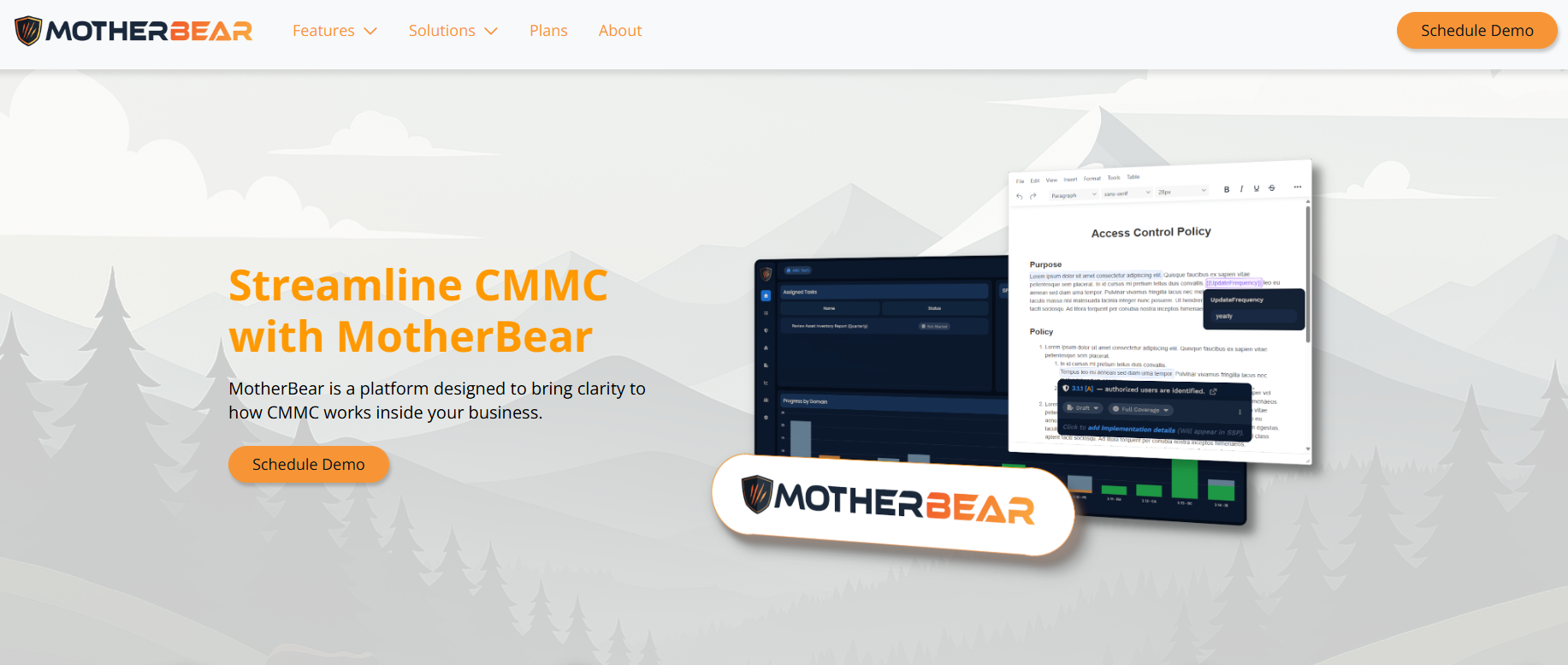
[MotherBear](https://www.motherbearsecurity.com/) gives defense contractors and their consultants one workspace where requirement status, evidence, documentation, and remediation tasks with owners and dates sit together.
For a consulting practice, that's also what makes the capacity question answerable: you can see which client programs are on schedule and which need attention this week rather than next quarter.
[***Book a demo and see how MotherBear keeps a CMMC timeline honest.***](https://www.motherbearsecurity.com/schedule-demo)
## **FAQs About CMMC Compliance Timeline**
### **How long does it take to get CMMC-compliant?**
For planning purposes, a simple Level 1 program may take roughly two to four months for a small environment handling only FCI.
Level 2 readiness often falls in the six-to-18-month range depending on starting posture and scope. A future C3PAO requirement can add scheduling lead time if that path returns or a later procurement calls for it.
Within the same CMMC level, scope size, existing security posture, documentation maturity, and staffing explain much of the variation. An organization with a mature framework and a tight scope can beat those figures; one starting from informal practices generally won't.
### **What is the CMMC timeline for 2026?**
Phase 1 has been active since November 2025, with Level 1 and Level 2 self-assessment requirements appearing in applicable solicitations. On July 13, 2026, the Department suspended Phase 2 pending a program review.
Phase 1 obligations continue throughout that review, so contractors still self-assess where required, submit results to SPRS, and complete annual affirmations.
### **Will CMMC be delayed?**
Part of it already has been. The Phase 2 suspension pushed back the introduction of third-party assessment requirements, and the review's outcome will determine what returns and when.
What hasn't moved is the underlying obligation. Defense Federal Acquisition Regulation Supplement (DFARS) clause 252.204-7012 safeguarding duties predate CMMC and continue regardless, so planning around a hoped-for delay is the riskiest scheduling assumption available.
### **Is CMMC compliance mandatory?**
Where a contract carries the requirement, yes. CMMC requirements began entering DoD contracts in November 2025, and holding the specified status is a condition of award where the relevant clause and provision appear.
Contracts without those CMMC provisions don't impose a CMMC status requirement, although separate FAR and DFARS safeguarding obligations can still apply where the contract involves FCI or covered defense information.
## Working on CMMC compliance?
Book a demo of MotherBear to see how we can help you prepare
[Schedule Demo](https://www.motherbearsecurity.com/schedule-demo)
## Read On
[](https://www.motherbearsecurity.com/blog/cmmc-for-universities)
### [CMMC for Universities and Research Labs: A Compliance Guide](https://www.motherbearsecurity.com/blog/cmmc-for-universities)
Universities run on openness. Research gets published, data gets shared, and campuses welcome...
[](https://www.motherbearsecurity.com/blog/cmmc-compliance-support)
### [CMMC Compliance Support: What You Need and Who Provides It](https://www.motherbearsecurity.com/blog/cmmc-compliance-support)
For many small defense contractors, Cybersecurity Maturity Model Certification (CMMC) compliance...
[](https://www.motherbearsecurity.com/blog/how-to-choose-a-cmmc-provider)
### [How to Choose a CMMC Provider: A Buyer's Checklist](https://www.motherbearsecurity.com/blog/how-to-choose-a-cmmc-provider)
Three proposals land on your desk, and all of them use the same buzzwords: Cybersecurity Maturity...

#### Pages
[Home](https://www.motherbearsecurity.com)
[Plans](https://www.motherbearsecurity.com/plans)
[About](https://www.motherbearsecurity.com/about)
[Blog](https://www.motherbearsecurity.com/blog)
#### Features
[Requirements Tracking](https://www.motherbearsecurity.com/features/requirements-tracking)
[Documentation Builder](https://www.motherbearsecurity.com/features/documentation-builder)
[Evidence Repository](https://www.motherbearsecurity.com/features/evidence-repository)
[Task Management](https://www.motherbearsecurity.com/features/task-management)
#### Solutions
[For Defense Contractors](https://www.motherbearsecurity.com/solutions/defense-contractors)
[For Managed Service Providers](https://www.motherbearsecurity.com/solutions/managed-service-providers)
[For CMMC Professionals](https://www.motherbearsecurity.com/solutions/cmmc-professionals)
---
© 2026 Mother Bear Security, Inc. All rights reserved.
Privacy Policy
```json
{
"@context" : "https://schema.org",
"@type" : "BlogPosting",
"author" : {
"@type" : "Person",
"name" : "Nick Marteney",
"url" : "https://www.motherbearsecurity.com/blog/author/nick-marteney"
},
"dateModified" : "2026-11-02T11:48:23.390Z",
"datePublished" : "2026-11-02T11:33:31.000Z",
"headline" : "CMMC Compliance Timeline: How Long It Really Takes",
"image" : [ "https://www.motherbearsecurity.com/hubfs/CMMC%20compliance%20timeline.png" ],
"mainEntityOfPage" : {
"@id" : "https://www.motherbearsecurity.com/blog/cmmc-compliance-timeline",
"@type" : "WebPage"
},
"publisher" : {
"@type" : "Organization",
"logo" : {
"@type" : "ImageObject",
"url" : "https://www.motherbearsecurity.com/hubfs/mbs-logo-transparent-h128.png"
},
"name" : "Mother Bear Security"
}
}
```