---
title: "CMMC Compliance Documentation: What You Actually Need"
description: Explore our guide on CMMC compliance documentation and learn how to get ready for assessment. Discover how MotherBear can help you out.
image: https://www.motherbearsecurity.com/hubfs/CMMC%20compliance%20documentation.png
---
[](https://www.motherbearsecurity.com/)
- Features
- [Requirements Tracking Understand how and why you meet requirements](https://www.motherbearsecurity.com/features/requirements-tracking)
- [Documentation Builder Tools to streamline creating Policies, Procedures and your SSP](https://www.motherbearsecurity.com/features/documentation-builder)
- [Evidence Repository Store evidence with ease and ensure you are audit ready](https://www.motherbearsecurity.com/features/evidence-repository)
- [Task Management Assign, track, and manage tasks across your team](https://www.motherbearsecurity.com/features/task-management)
- Solutions
- [For Defense Contractors Purpose built for the Defense Industrial Base](https://www.motherbearsecurity.com/solutions/defense-contractors)
- [For Managed Service Providers Simplify program management for you and your clients](https://www.motherbearsecurity.com/solutions/managed-service-providers)
- [For CMMC Professionals Use tools that help you provide the best value to your clients](https://www.motherbearsecurity.com/solutions/cmmc-professionals)
- [Plans](https://www.motherbearsecurity.com/plans)
- [About](https://www.motherbearsecurity.com/about)
[Schedule Demo](https://www.motherbearsecurity.com/schedule-demo)
# CMMC Compliance Documentation: What You Actually Need
November 03, 2026

## Table of Contents
1. [TL;DR](https://www.motherbearsecurity.com/blog/cmmc-compliance-documentation#tldr)
2. [What CMMC Compliance Documentation Actually Requires](https://www.motherbearsecurity.com/blog/cmmc-compliance-documentation#What-CMMC-Compliance)
3. [Mapping Documents to CMMC Requirements](https://www.motherbearsecurity.com/blog/cmmc-compliance-documentation#Mapping-Documents)
4. [The System Security Plan: Your Foundational Document](https://www.motherbearsecurity.com/blog/cmmc-compliance-documentation#System-Security-Plan)
5. [The Plan of Action and Milestones](https://www.motherbearsecurity.com/blog/cmmc-compliance-documentation#POAM)
6. [The Customer Responsibility Matrix](https://www.motherbearsecurity.com/blog/cmmc-compliance-documentation#CRM)
7. [Documented Policies and Procedure Documents](https://www.motherbearsecurity.com/blog/cmmc-compliance-documentation#Documented-Policies)
8. [CMMC Documentation vs Evidence](https://www.motherbearsecurity.com/blog/cmmc-compliance-documentation#Documentation-vs-Evidence)
9. [CMMC Documentation Templates: Where They Help and Where They Hurt](https://www.motherbearsecurity.com/blog/cmmc-compliance-documentation#Templates)
10. [CMMC Documentation Checklist by CMMC Level](https://www.motherbearsecurity.com/blog/cmmc-compliance-documentation#Checklist)
11. [Keeping Documentation Accurate Between CMMC Audits](https://www.motherbearsecurity.com/blog/cmmc-compliance-documentation#Accurate)
12. [How MotherBear Helps You Achieve CMMC Compliance](https://www.motherbearsecurity.com/blog/cmmc-compliance-documentation#MotherBear)
13. [FAQs About CMMC Compliance Documentation](https://www.motherbearsecurity.com/blog/cmmc-compliance-documentation#FAQs)
Most guides to Cybersecurity Maturity Model Certification (CMMC) documentation give a defense contractor a list of 20 documents and imply they're all mandatory. They aren't.
The number of documents CMMC actually requires is smaller than those lists suggest, though it isn't zero. What surrounds the required set is convention you're choosing rather than obeying.
Knowing which is which matters, because the expensive documentation mistake isn't a missing file. It's a document describing a company you aren't. A policy that says quarterly access reviews when you run them twice a year is a finding you handed the assessor yourself.
The CMMC framework asks for less paperwork than the market implies, and more accuracy. That trade-off shapes every stage of a CMMC journey.
This guide separates required from conventional, explains what belongs in each core document, and covers the part most articles skip: keeping documentation true as the environment moves.
## **TL;DR**
- [CMMC compliance](https://www.motherbearsecurity.com/blog/what-is-cmmc-compliance) documentation splits into a required set and a larger conventional one. At Level 2, you create a System Security Plan (SSP), an asset inventory, and a network diagram of the assessment scope, maintain operational plans of action, and obtain a Customer Responsibility Matrix where providers are in scope.
- The SSP is the foundational document. Assessors read it first, and everything else either supports it or contradicts it.
- Documentation and evidence are different things. Documentation states what you do; evidence is how you demonstrate compliance. Conflating them is why programs with full document sets still fail.
- Accuracy beats volume. Fewer documents that match reality outperform a comprehensive set that describes an environment you no longer run.
- [MotherBear](https://www.motherbearsecurity.com/schedule-demo) keeps documentation tied to requirement status and evidence in one workspace, so your files describe the environment you actually have.
## **What CMMC Compliance Documentation Actually Requires**
Start by separating three categories, because contractors routinely treat all of them as equally mandatory.
1. **Documents you create:** At Level 2, the SSP, an asset inventory covering every in-scope asset category, and a network diagram of the [CMMC assessment](https://www.motherbearsecurity.com/blog/cmmc-assessment-guide) scope. The scoping rules require those directly. CA.L2-3.12.2 separately requires operational plans of action for identified deficiencies and vulnerabilities.
2. **Documents you obtain:** Service descriptions and a Customer Responsibility Matrix from applicable in-scope external service providers, documenting how responsibilities are divided between the provider and your organization.
3. **Documents you choose:** Standalone policies per control family, detailed procedure documents, and supplementary material like data flow diagrams. Useful, widely expected, and not mandated in the way the first group is.
That third category is where over-documentation happens. Thorough documentation isn't the same as voluminous documentation, and you don't need 14 separate policy documents unless that structure genuinely helps you. Policies can live inside the SSP, and assessors will review them there.
The essential documentation is short. The key documents are the ones an assessor opens first, and proper documentation of those beats a complete shelf of everything else.
The organizing question isn't "which documents exist." It's whether someone reading your documentation could understand how each requirement is implemented and then verify it.
## **Mapping Documents to CMMC Requirements**
Each document answers a different question, and knowing which is which stops you from writing the same content into three files.
| **Document** | **The question it answers** |
| --- | --- |
| System Security Plan | How is this requirement implemented here? |
| Asset inventory and network diagram | What's in scope, and where does the data go? |
| Operational plan of action | What's deficient, and who's fixing it by when? |
| CMMC assessment Plan of Action and Milestones (POA&M) | Which eligible requirements are still NOT MET? |
| Policy | What has the organization committed to? |
| Procedure | How does that commitment get carried out? |
Duplicating content between them creates contradictions rather than coverage. When the same control is described in a policy and again in the SSP, one of the two eventually stops being true.
## **The System Security Plan: Your Foundational Document**
The SSP is one of the foundational documents assessors rely on, and it frames how they read everything else. At Level 2, an up-to-date SSP has to exist for an assessment to be completed at all.
Its job is descriptive. The SSP gives a comprehensive overview of what your environment is, where the boundary sits, and how each of the 110 security requirements from the [National Institute of Standards and Technology (NIST) standard 800-171](https://www.motherbearsecurity.com/blog/what-is-nist-800-171) is implemented in your specific setup.
For organizations handling [Controlled Unclassified Information](https://www.motherbearsecurity.com/blog/what-is-cui) (CUI), this is the document carrying the most weight, and the one that anchors the rest of the set.
That last part is where thin SSPs get exposed. Restating the requirement is not describing implementation, and an SSP that says "the organization limits system access to authorized users" for every access control requirement tells an assessor nothing.
### **What Belongs in an SSP**
The structure varies, but the content expectations are consistent.
- **System description and boundary:** What's in scope, what isn't, and the reasoning. Network and data flow diagrams belong here or alongside, showing where sensitive data moves and which systems carry cybersecurity requirements.
- **Identification of the data:** Where CUI and [Federal Contract Information](https://www.motherbearsecurity.com/blog/what-is-fci) (FCI) live, move, and rest, since protecting Controlled Unclassified Information is the point of the whole exercise.
- **Implementation detail per requirement:** How each control works in your environment, named systems and all, rather than restated requirement language.
- **Roles and responsible parties:** Who owns what. Requirements assigned to a department rather than a person tend to belong to nobody.
- **Inherited controls:** Which requirements come from external service providers, referencing their documentation and describing how you verify the inheritance holds.
Write it so a competent stranger could follow it. That's the same test an assessor applies.
## **The Plan of Action and Milestones**
Two related things share this name at Level 2, and keeping them apart avoids real confusion.
An operational plan of action, required under [CA.L2-3.12.2](https://ndisac.org/dibscc/cyberassist/cybersecurity-maturity-model-certification/level-2/ca-l2-3-12-2/), is how you address identified deficiencies and vulnerabilities as part of running the security program. It's the document that lets you address gaps on a schedule rather than in a panic.
It records security deficiencies, remediation efforts, responsible parties, and target dates, and it isn't subject to CMMC's 180-day closeout rule.
A CMMC assessment POA&M is different. It applies after an assessment when eligible requirements come back NOT MET and when seeking Conditional Level 2 status. That path needs a score of at least 88 out of 110, covers only eligible requirements, and closes within 180 days.
At Level 1, a CMMC assessment POA&M is not permitted, so every requirement must be MET for the assessment. Internal remediation tracking and operational plans of action aren't prohibited at any level.
You can keep the operational plan of action separate from the SSP or combine the two; official guidance allows either. What matters is that gaps are recorded somewhere visible rather than left in someone's head.
A POA&M isn't an admission of failure. An honest one signals a program that knows its own state, which is a better position than a clean document set nobody has tested.
It's also the document that shows how you plan to achieve compliance, which is what a security assessment looks for when requirements remain open.
## **The Customer Responsibility Matrix**
When an applicable cloud service provider (CSP) or external service provider (ESP) supports your CUI environment or security requirements, you need to document that responsibility split.
That is usually done through the provider's service description and Customer Responsibility Matrix. This is the document you obtain rather than write.
It maps which requirements the provider satisfies, which you satisfy, and which you share. Without it, the split lives in nobody's document, and the ambiguity becomes your finding rather than theirs.
Ask for it during procurement rather than during audit preparation. A provider without one is telling you something about how much defense sector work it has supported, and about how well it understands its place in your supply chain.
## **Documented Policies and Procedure Documents**
This is the conventional layer, and the one where teams most often produce volume instead of clarity.
The useful distinction is what each document type is for.
- **Policy:** States your organization's commitment and the reasoning behind it. Short, stable, approved.
- **Procedure:** Describes how the commitment gets carried out, step by step, with owners named.
- **Plan:** Governs a specific area over time, like incident response or configuration management.
- **Record:** Proves the procedure ran. This is evidence rather than documentation, and it belongs in a different bucket.
Most contractors write policies well and procedures poorly. Documented policies describe intended security practices, while procedures describe the security processes that deliver them.
When assessors conduct employee interviews, they're testing whether the procedure matches what that person actually does. Employee interviews expose vague procedures faster than any document review, because cybersecurity practices either live in people's hands or they don't.
## **CMMC Documentation vs Evidence**
This distinction causes more confusion than anything else in the document set, and it's worth being precise about.
### **What a CMMC Assessment Examines**
Documentation states intent and describes implementation. Your access control policy says accounts get reviewed quarterly. Your SSP describes how the review works and who runs it.
[Objective evidence](https://www.motherbearsecurity.com/blog/cmmc-objective-evidence) proves it happened. The completed review report, dated, with findings and follow-up tickets, is what demonstrates the policy is real.
Assessors work at the assessment objective level, and a requirement is only met when the evidence supports every applicable objective. A program can have flawless documentation and fail, because documents describe while evidence has to prove compliance.
That applies whether you self-assess or face a third-party assessment, and it makes evidence collection a parallel task rather than a later one.
The practical implication: when you write a policy, ask what artifact will prove it. If you can't answer, you've written a commitment you can't demonstrate.
## **CMMC Documentation Templates: Where They Help and Where They Hurt**
Templates are everywhere, and the honest assessment is mixed.
They genuinely help with structure. A template tells you what sections an SSP needs, which beats staring at a blank document, and it stops you from omitting something obvious.
They hurt when the content survives unedited. A template can describe a CMMC-compliant organization in the abstract while describing nothing about yours, and a downloaded SSP full of controls you never implemented creates damaging contradictions.
That isn't an argument for skipping the document. At Level 2, no current SSP means the assessment can't be completed, so the choice is between an accurate one and a harmful one.
Cybersecurity standards are consistent; environments aren't, and CMMC standards expect your documents to describe the second. It creates a documented discrepancy between what you claim and what you run, and that's the exact gap assessors probe.
The signs are easy to spot from the other side of the table. Requirement language restated instead of described, systems that don't exist in your environment, and procedures nobody in the room recognizes.
Use templates for the skeleton. Write the substance yourself, or with someone who has walked your environment.
## **CMMC Documentation Checklist by CMMC Level**
Here's a [CMMC compliance checklist](https://www.motherbearsecurity.com/blog/cmmc-compliance-checklist) focused specifically on documentation, separated by what's required and what's expected.
| **Document** | **Level 1** | **Level 2** |
| --- | --- | --- |
| System Security Plan | Recommended, simplified | Required |
| Operational plan of action | Not required by Level 1; may be used internally | Required under CA.L2-3.12.2 |
| CMMC assessment POA&M | Not permitted | Where eligible gaps remain |
| Customer Responsibility Matrix | Useful where providers are involved | Required for applicable ESP and CSP relationships |
| Scope and boundary information | Recommended | Required information, captured in the SSP, asset inventory, and network diagram |
| Asset inventory | Recommended | Required |
| Network diagram of the assessment scope | Recommended | Required |
| Data flow diagrams | Recommended | Useful, not mandated |
| Policies per control family | Optional structure | Optional structure |
| Procedure documents | Recommended | Expected |
| Incident response plan | Recommended | Expected |
| Training records | Not required at Level 1 | Typical evidence for Awareness and Training |
| Risk assessment records | Not applicable | Expected |
### **Using the CMMC Checklist Without Over-Documenting**
Level 3 sits outside this table. It adds selected requirements aimed at advanced persistent threats for a narrow set of programs, with documentation expectations to match.
Two notes on this CMMC checklist. Level 1 covers 15 requirements from [Federal Acquisition Regulation (FAR) clause 52.204-21](https://www.acquisition.gov/far/52.204-21), not the 17 some older sources still cite. Some of the lower rows are evidence rather than documentation, which is why they behave differently.
Organizations handling CUI carry the fuller set, but smaller firms in the Defense Industrial Base (DIB) should still size it to the defense contract in hand rather than to the longest list they can find. Documentation you don't maintain is a liability, not an asset.
## **Keeping Documentation Accurate Between CMMC Audits**
Documentation degrades quietly. Nothing alerts you when a configuration changes and the SSP describing it stops being true.
A few habits prevent most of the drift:
- **Tie reviews to change management:** When the environment changes, the document describing it changes in the same week rather than at the next annual review.
- **Give every document an owner:** Not a department. A person, named in the document, who is accountable for its accuracy.
- **Version and date everything:** Assessors notice undated documents, and so does anyone trying to work out whether a file still reflects reality.
- **Run internal audits against the documents:** Read your own procedures and check whether the described process is what happens. This is uncomfortable and cheap.
- **Feed** [**continuous monitoring**](https://www.motherbearsecurity.com/blog/continuous-monitoring-for-cmmc-compliance) **back into the files:** When monitoring shows the environment changed, treat that as a documentation trigger. Continuous improvement of your security posture only counts if the record follows it.
Documentation is the written record of your organization's cybersecurity posture, so a gap between the two is worth finding internally.
The test to apply periodically: hand a document to someone who didn't write it and ask whether the described environment matches what they see. Disagreement is the finding you wanted to catch internally.
That habit is what lets you maintain compliance between cycles, and it keeps your documented cybersecurity posture aligned with the real one.
## **How MotherBear Helps You Achieve CMMC Compliance**
Documentation drifts because it lives apart from the thing it describes. The SSP sits in a drive, requirement status sits in a spreadsheet, and evidence sits somewhere else again, so nothing signals when one stops matching the others.
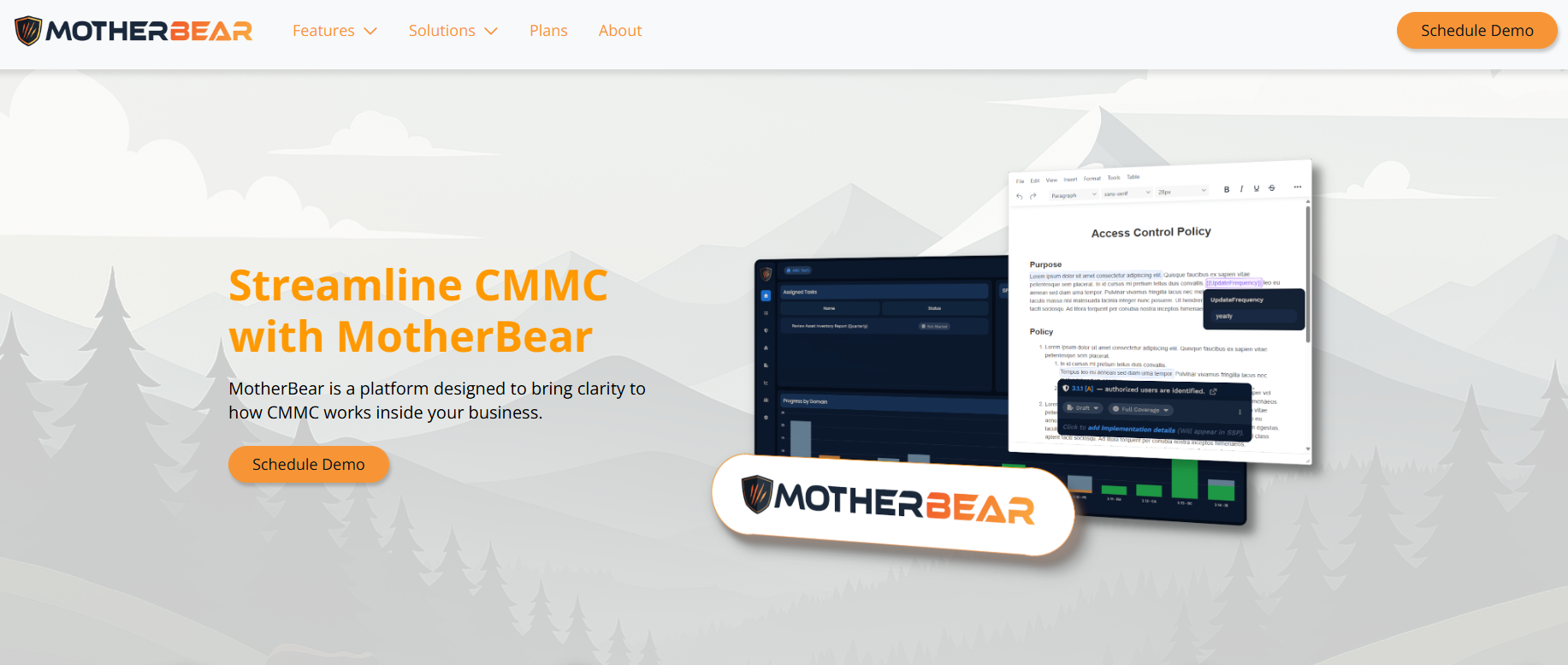
[MotherBear](https://www.motherbearsecurity.com/) closes that distance. Your SSP and policy material live beside the NIST 800-171 requirement they describe and the artifact that proves it, so a document going out of date is visible rather than silent.
Because documentation is connected to the requirements it describes and the evidence supporting it, a gap between claim and reality surfaces while you can still fix it rather than during an assessment.
That connection helps an organization achieve CMMC compliance without its documentation drifting away from its compliance efforts.
For consultants building documentation for several contractors, the shared structure also means a review looks the same on every engagement instead of depending on whoever set the client up.
[***Book a demo and see how MotherBear keeps your documentation describing the environment you actually run.***](https://www.motherbearsecurity.com/schedule-demo)
## **FAQs About CMMC Compliance Documentation**
### **What are the CMMC compliance requirements for 2026?**
The July 2026 suspension changed which assessment types can currently be required, but it did not change the underlying [Level 1 and Level 2](https://www.motherbearsecurity.com/blog/cmmc-level-1-vs-level-2) security requirements.
A Level 2 self-assessment still relies on an up-to-date SSP, an asset inventory, a network diagram of the assessment scope, applicable operational plans of action, and relevant provider service documentation and Customer Responsibility Matrices.
A separate CMMC assessment POA&M applies only where eligible NOT MET requirements remain under Conditional Level 2 status.
### **What are examples of compliance documentation?**
At Level 2, the core set includes the SSP, an asset inventory, a network diagram of the assessment scope, applicable operational plans of action, and relevant provider service documentation and Customer Responsibility Matrices.
Where Conditional Level 2 status applies, a separate CMMC assessment POA&M may join them. Around those sit policies for each control family, procedure documents describing day-to-day operations, an incident response plan, and supplementary data flow diagrams.
Training records, audit logs, and scan results are evidence rather than documentation, though assessors review both.
### **Can you self-certify CMMC?**
You can self-assess, which is the current path for Level 1 and Level 2 during the Phase 2 suspension. The organization conducts the assessment, records results in the Supplier Performance Risk System (SPRS), and a senior official affirms them.
That affirmation is a formal representation to the government rather than an internal sign-off, so the documentation and evidence behind it need to hold up to the same standard an outside assessor would apply.
### **Is CMMC compliance mandatory?**
Where a contract carries the requirement, yes, and the documentation obligation travels with it. Requirements began entering Department of Defense (DoD) contracts in November 2025.
For DoD contracts that carry the clause, holding the specified status is a condition of award.
A contract without a [CMMC requirement](https://www.motherbearsecurity.com/blog/dod-cmmc-requirements) imposes no CMMC status, although safeguarding obligations may still apply independently through clauses such as FAR 52.204-21 for FCI or Defense Federal Acquisition Regulation Supplement (DFARS) clause 252.204-7012 for covered defense information, where those clauses appear.
Documentation duties rarely disappear entirely.
### **Should documentation come before or after remediation?**
It should be done alongside remediation. Writing the SSP after the technical work finishes is the common mistake, because teams then reconstruct decisions nobody wrote down at the time.
The practical rhythm is to describe each control as it goes in, while the person who configured it still remembers why. That produces a more accurate document in less total time than a documentation phase bolted onto the end.
## Need help with CMMC documentation?
Book a demo of MotherBear to see how you can simplify CMMC management.
[Schedule Demo](https://www.motherbearsecurity.com/schedule-demo)

#### Pages
[Home](https://www.motherbearsecurity.com)
[Plans](https://www.motherbearsecurity.com/plans)
[About](https://www.motherbearsecurity.com/about)
[Blog](https://www.motherbearsecurity.com/blog)
#### Features
[Requirements Tracking](https://www.motherbearsecurity.com/features/requirements-tracking)
[Documentation Builder](https://www.motherbearsecurity.com/features/documentation-builder)
[Evidence Repository](https://www.motherbearsecurity.com/features/evidence-repository)
[Task Management](https://www.motherbearsecurity.com/features/task-management)
#### Solutions
[For Defense Contractors](https://www.motherbearsecurity.com/solutions/defense-contractors)
[For Managed Service Providers](https://www.motherbearsecurity.com/solutions/managed-service-providers)
[For CMMC Professionals](https://www.motherbearsecurity.com/solutions/cmmc-professionals)
---
© 2026 Mother Bear Security, Inc. All rights reserved.
Privacy Policy
```json
{
"@context" : "https://schema.org",
"@type" : "BlogPosting",
"author" : {
"@type" : "Person",
"name" : "Nick Marteney",
"url" : "https://www.motherbearsecurity.com/blog/author/nick-marteney"
},
"dateModified" : "2026-11-03T13:30:08.702Z",
"datePublished" : "2026-11-03T13:30:08.000Z",
"headline" : "CMMC Compliance Documentation: What You Actually Need",
"image" : [ "https://www.motherbearsecurity.com/hubfs/CMMC%20compliance%20documentation.png" ],
"mainEntityOfPage" : {
"@id" : "https://www.motherbearsecurity.com/blog/cmmc-compliance-documentation",
"@type" : "WebPage"
},
"publisher" : {
"@type" : "Organization",
"logo" : {
"@type" : "ImageObject",
"url" : "https://www.motherbearsecurity.com/hubfs/mbs-logo-transparent-h128.png"
},
"name" : "Mother Bear Security"
}
}
```